
The breakthrough did not begin with a spy walking into an embassy. It did not begin with a defector carrying a suitcase of documents. It did not begin with a stolen Soviet codebook.
It began with traffic.
Messages moved across the wartime world: diplomatic messages, intelligence messages, administrative messages, routine messages, urgent messages. Some were sent from Soviet missions in the United States. Some went to Moscow. Some came back. To the people sending them, the system was secure. The messages were encrypted. The most sensitive ones were wrapped in a method that, in theory, should have been impossible to break.
At Arlington Hall, the U.S. Army’s cryptologic center in Northern Virginia, those messages became a problem to be saved, sorted, numbered, studied, and attacked.
Most would never be read.
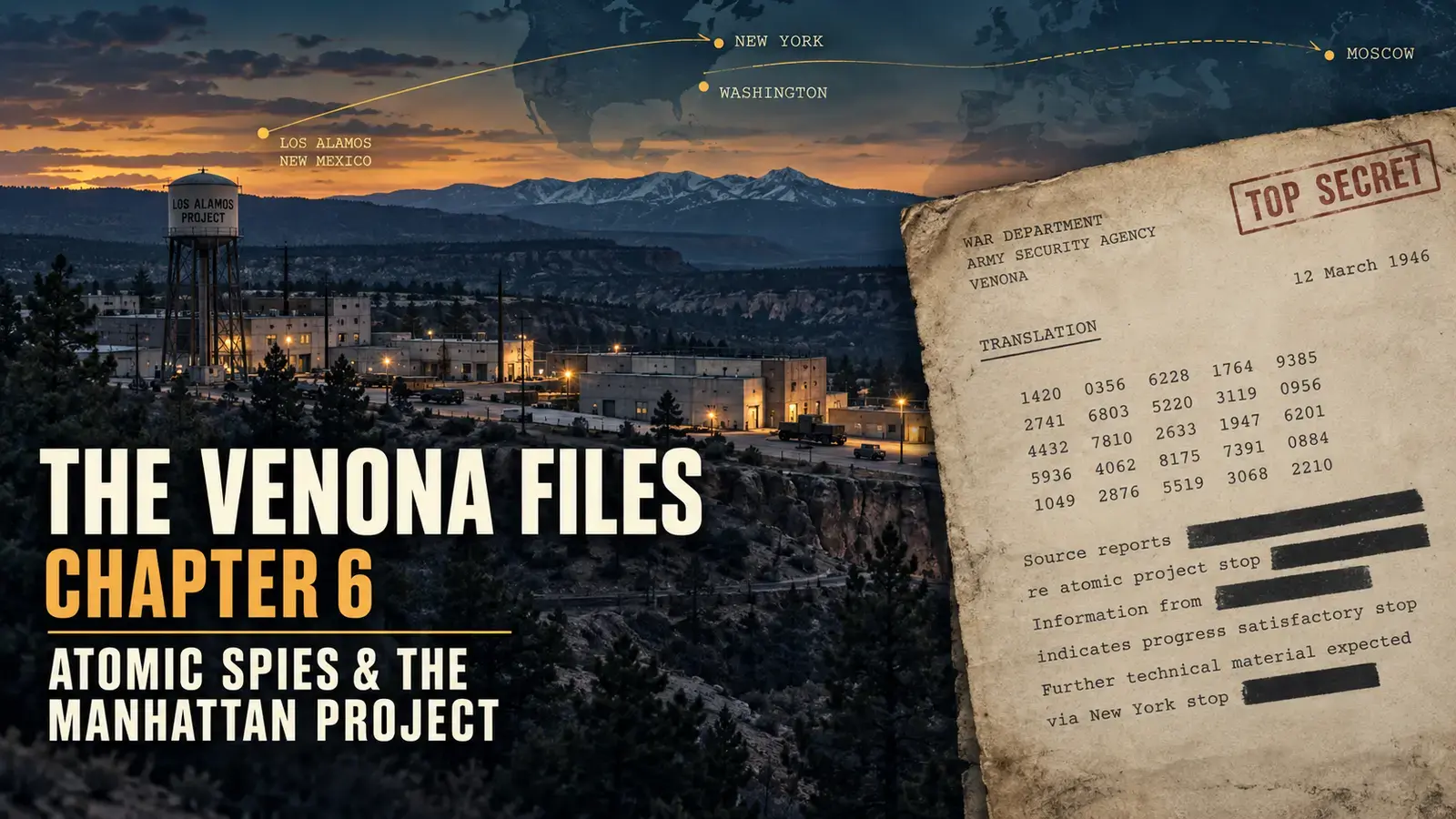
That point is worth sitting with. VENONA was not a magic window into Soviet intelligence. It was a long, uneven attempt to exploit a body of Soviet communications that were, in many cases, still effectively sealed. The U.S. Army’s Signal Intelligence Service began the secret program in February 1943 to examine Soviet communications, a story preserved in the NSA’s public VENONA release history. The first public release of translated VENONA messages did not come until July 1995, and that initial release focused heavily on Soviet efforts to collect information on the Manhattan Project and atomic bomb research.
That is the scale of the story: wartime collection, postwar analysis, decades of secrecy, and public release half a century later.
For the full series, start with The VENONA Files. If you are new to the story, begin with Chapter 1: The Secret That Stayed Hidden for 50 Years. Chapter 2, A World at War—and Allies Who Didn’t Trust Each Other, explains why Soviet espionage continued inside the wartime alliance. This chapter explains how the door cracked open.
The locked archive
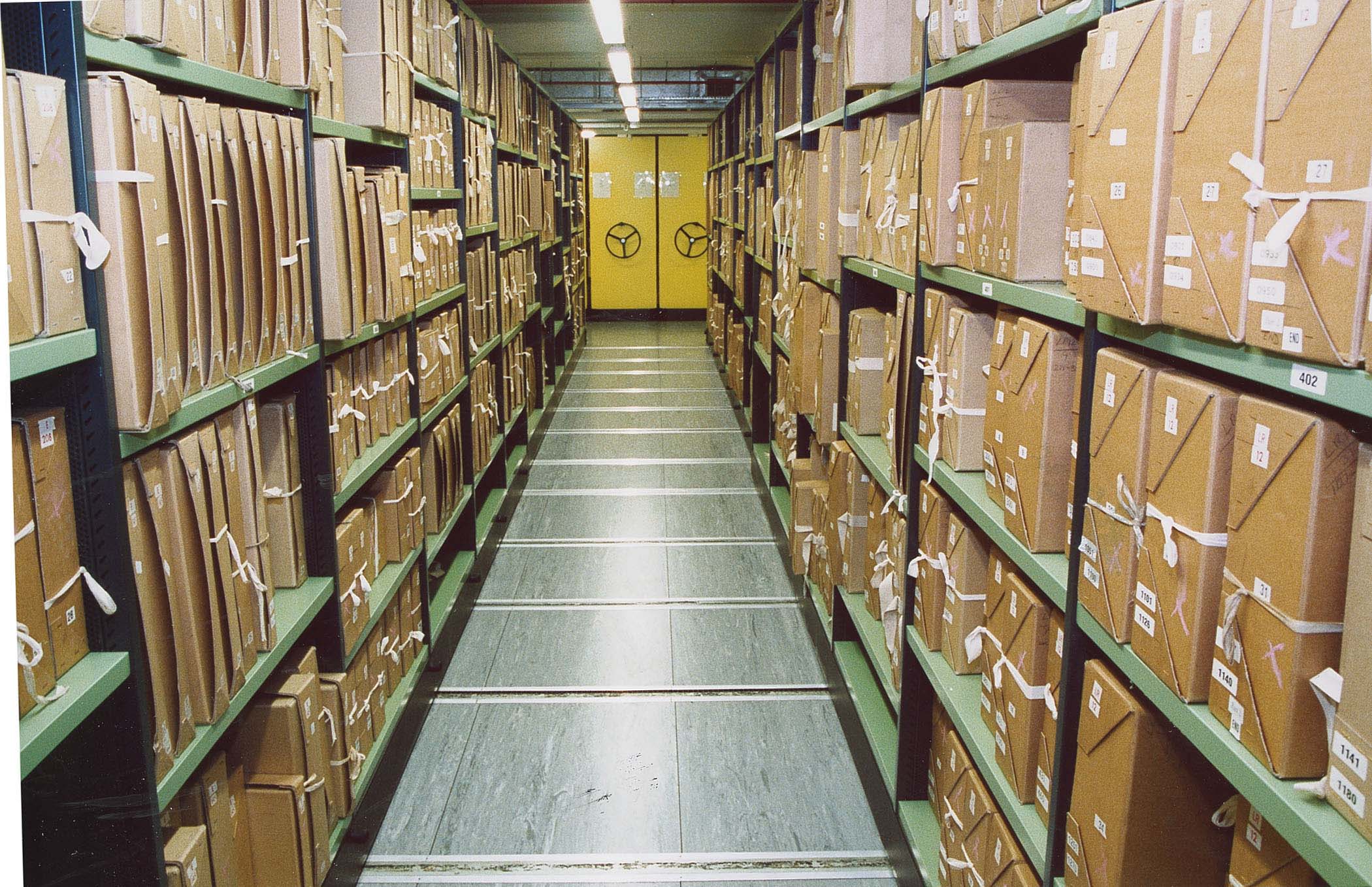
Imagine rooms full of messages that might matter but cannot yet speak.
That was the practical reality. Interception and collection were one problem. Decryption was another. The United States could collect and preserve Soviet traffic, but preservation did not mean understanding. Much of what came in was just encrypted text: groups of numbers, routing information, dates, and fragments of procedure.
The NSA’s historical study, The VENONA Story, makes clear how incomplete the readable record remained. About 3,000 VENONA translations were eventually released, but the serial numbers showed that the KGB and GRU had sent thousands more messages between Moscow and overseas recipients. Only a fraction of the total traffic became available to cryptanalysts in exploitable form, and even that material was not read in real time. In 1946, Meredith Gardner was still working on KGB messages from 1944.
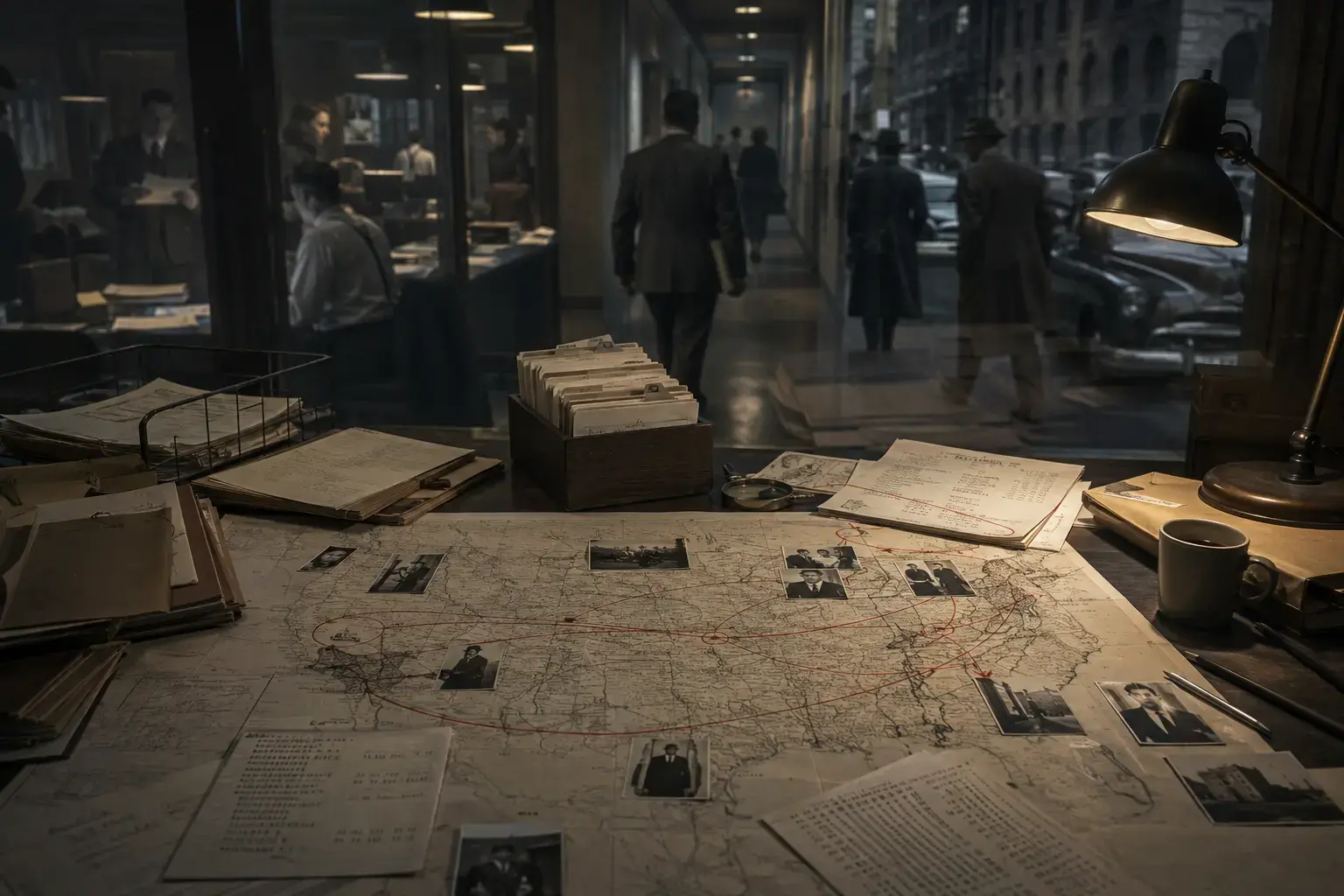
This is not the Hollywood version of codebreaking. There was no wall map where every red string suddenly lined up. There was no moment when someone cracked the system and the Soviet archive opened.
Instead, there were messages that remained silent, messages that yielded a word or phrase, messages that became more useful only after another fragment was solved, and messages that would never be recovered at all.
That was the first hidden discipline of VENONA: keep the material even when it cannot yet be read.
The Soviet system was strong
The Soviet services were not careless about communications security. Their system was formidable because it layered protection.
Many KGB messages used a codebook, where words and phrases were first converted into numbers. Those numbers were then enciphered again by adding random number groups from a one-time pad. The NSA’s explanation of the system in The VENONA Story is useful because it shows why the work was so difficult: Arlington Hall was not simply trying to solve one cipher. It was trying to peel away one layer of protection before attacking another.
That is why VENONA matters. The Americans were not defeating a sloppy children’s cipher. They were attacking a serious state system built to protect high-value communications.
The weakness was not the idea of the one-time pad. The idea was sound.
The weakness came from use, production, and pressure.
Field note: how a one-time pad works
A one-time pad is simple in principle and unforgiving in practice.
The sender and receiver each have matching pages of random numbers. The sender turns a message into numbers, then uses one page of random numbers to disguise it. The receiver has the matching page and uses it to remove that disguise. Once used, the page is supposed to be destroyed or retired forever.
The security rule is absolute: use the page once.
If the same page is used twice, the two encrypted messages begin to relate to each other. The analyst still may not know what either message says, but the repetition creates a pattern. It gives the cryptanalyst leverage.
In VENONA, the one-time pad was not the only layer. There was also an underlying codebook. That meant Arlington Hall first had to strip away the additive one-time-pad layer before analysts could attack the codebook underneath. The NSA’s VENONA history describes this two-layer problem as immensely difficult and notes that many code groups were never recovered.
That is why VENONA translations often look broken. The gaps are part of the story.
Wartime pressure and the Soviet mistake
The official NSA account says the KGB’s cryptographic material manufacturing center in the Soviet Union apparently reused some pages from one-time pads. That reuse gave Arlington Hall its opening. Very few 1942 KGB messages could be solved because there was little duplication, but the situation improved in 1943 and improved further in 1944, according to The VENONA Story.
The careful word is “apparently.” We should not pretend we know every shop-floor detail of how that failure happened. The useful question is not whether Soviet cryptographers understood the danger. They almost certainly did. The useful question is what kind of wartime system could produce a failure like that.
The Soviet Union was fighting for survival. German forces had invaded in 1941. Soviet institutions were relocated, disrupted, expanded, and militarized. Intelligence communications had to support diplomacy, Lend-Lease logistics, clandestine networks, military coordination, security reporting, scientific collection, and a global war effort. The need for secure communications did not slow down because the production of cryptographic material was difficult.
A one-time pad system has a brutal logistics problem: every secure message consumes key material. The sender and receiver must both have matching pads. Those pads must be generated, printed or otherwise prepared, controlled, distributed, stored, used, and destroyed. They must reach embassies, consulates, intelligence residencies, legal stations, and other official or semi-official channels around the world. Every new post, every increase in traffic, every emergency exchange, and every new line of communication consumes more pages.
That is the pressure point.
It is not that a Soviet officer in New York or Washington necessarily decided, “Use that page again.” The better reading is systemic. Somewhere in the chain of production or distribution, a system under wartime strain produced duplicated pad material. Once that material entered use in more than one message, the theoretical perfection of the cipher was gone.
Even then, the mistake did not make Soviet traffic easy to read. It only made it possible to begin.
The first cracks were not enough
The reused pages did not hand Arlington Hall the Soviet archive. They created relationships between messages. Analysts could compare number groups. They could test assumptions. They could look for repeated structure. They could ask whether a pattern reflected a name, a procedural phrase, a routing convention, or a repeated formula.
But a crack in the wall is not a door.
The NSA history describes the early work as “sweat-of-the-brow analysis,” a phrase that captures the real nature of the breakthrough. Analysts such as Richard Hallock, Cecil Phillips, Meredith Gardner, and others did not possess a neat answer key. They worked against the additive layer, the codebook structure, and the habits of Soviet communications over long periods of time.
VENONA was a case of institutional patience. Analysts were not just solving a puzzle. They were building the conditions under which future fragments could be solved. One small recovery might help another. A repeated indicator might help expose a codebook practice. A partial name might later align with an FBI lead. A pattern in New York traffic might make more sense after a Washington message was worked.
The record moved slowly from noise to fragments, and from fragments to intelligence.
Arlington Hall and the discipline of waiting
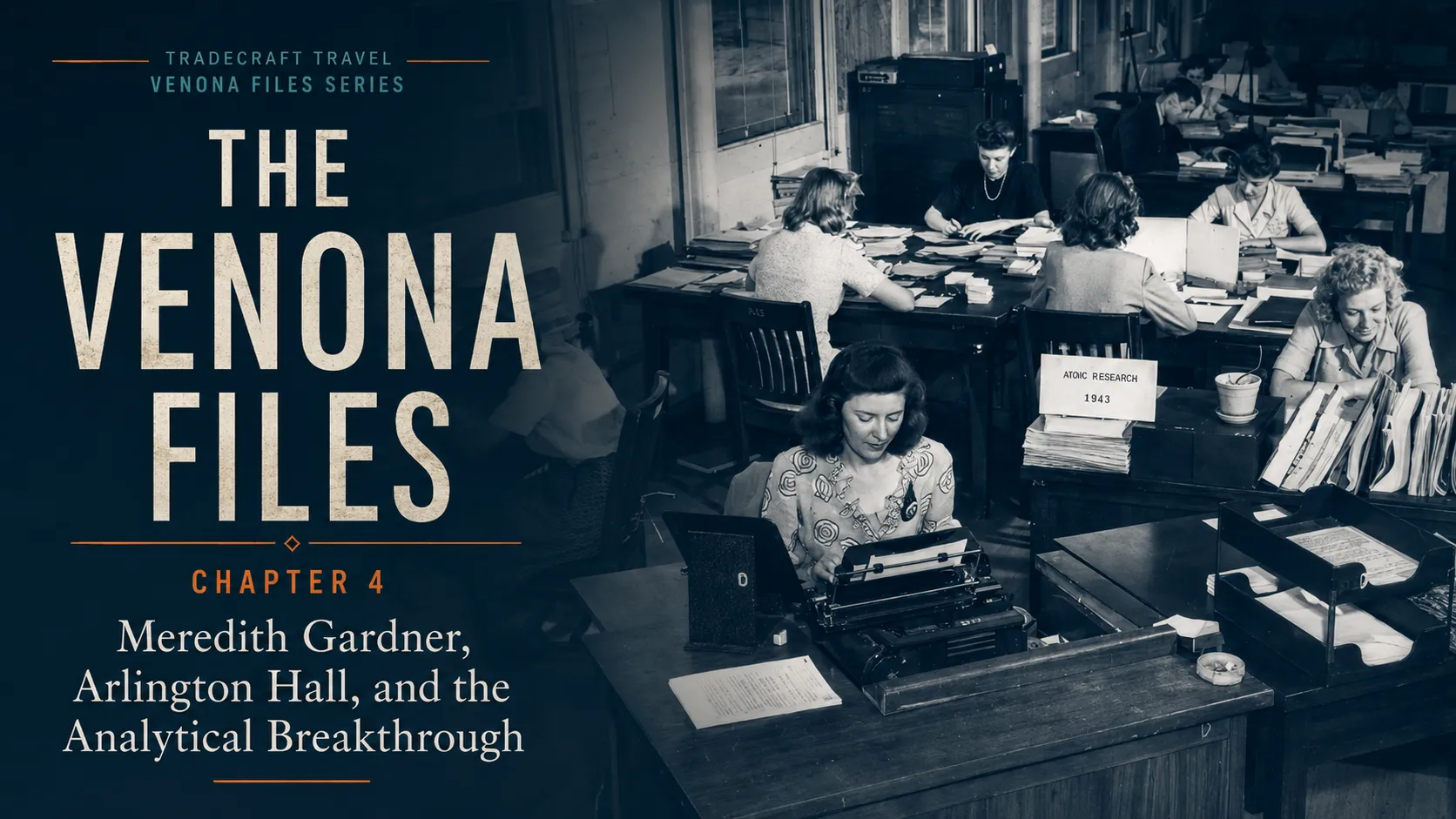
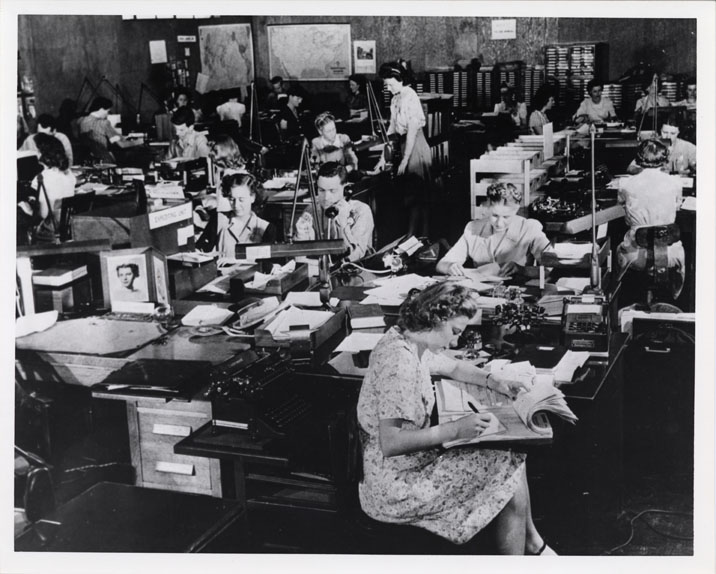
Arlington Hall was not built for drama. It was a former girls’ school in Northern Virginia turned into a wartime cryptologic center. Its importance came from the kind of work that rarely looks important while it is happening.
People sat with paper. They compared messages. They built files. They reconstructed systems they had never seen. They pursued patterns that might fail. They returned to old messages after new discoveries made them more promising.
The NSA’s profile of Meredith Gardner credits him with instrumental work in breaking the underlying code and reconstructing codebook material. Gardner became the name most closely associated with VENONA’s human breakthrough, but the deeper story is collective. Collectors saved traffic. Cryptanalysts worked patterns. Linguists recognized structure. Investigators tested leads. Leaders protected a sensitive source for decades.
That cooperation was essential because VENONA alone was rarely enough.
A decrypted fragment might show a cover name. It might describe a meeting. It might mention a scientific target, a diplomatic post, a courier, a source, or a line of work. But fragments had to be tested against other evidence: access, travel, surveillance, defectors, interrogations, personnel files, known contacts, and investigative leads.
This is where the VENONA story becomes more than cryptology. It becomes intelligence analysis.
What the Americans collected — and what they could not read
There is a temptation to think of signals intelligence as collection plus instant understanding. VENONA shows the opposite. Collection can create an archive of possibility. It does not guarantee exploitation.
Some messages were intercepted and preserved. Some were available to cryptanalysts. Some were not. Some were attacked repeatedly. Some were partially translated years after they had been sent. Some remained permanently sealed because the relevant key material had not been misused.
The NSA’s VENONA history draws an important distinction between “unrecovered” and “unrecoverable” text. Some portions were theoretically recoverable but lacked enough usable material. Other portions were unaffected by Soviet key reuse and could never be solved through the VENONA method.
That distinction is useful. It reminds us that VENONA was not a total penetration of Soviet communications.
The numbers make the point. In KGB New York-to-Moscow traffic, about 49 percent of the 1944 messages and 15 percent of the 1943 messages were readable, while only a tiny portion of the 1942 traffic could be read. For 1945 KGB Washington-to-Moscow traffic, the readable percentage was also very small.
That is the right mental picture: not a floodlight, but a narrow beam moving unevenly across a dark room.
The beam illuminated enough to matter.
The traffic behind the alliance
By the time Gardner and others began reading fragments, the wartime alliance had already begun to harden into Cold War suspicion. But the messages being worked often came from earlier years, when the United States and Soviet Union were still allies against Nazi Germany.
That is one of the reasons VENONA is so unsettling.
It showed that alliance and espionage were not opposites. They coexisted. The Soviet Union needed American industrial power, Lend-Lease support, and military pressure against Germany. At the same time, Soviet intelligence sought political, military, industrial, and scientific secrets from the United States and other allies.
The traffic reflected a real intelligence apparatus. The NSA’s VENONA history describes KGB residencies in New York, Washington, San Francisco, and Los Angeles, with officers working under diplomatic, press, trade, and procurement cover. Some of those arrangements were tied to the same wartime structures that made the alliance function.
That matters for the narrative. Espionage was not happening outside the war effort. In some cases, it was woven through the diplomatic, commercial, and logistical architecture of the alliance.
This is why Chapter 2 matters. The alliance was real. The distrust was real. VENONA sat at the point where both facts became visible.
A mistake becomes a map
Before the cryptographic break, the messages were mostly locked records. After the break, they became something stranger: a partial map of hidden activity.
It was not a complete map. It had torn edges and missing sections. Some cover names could be identified. Others could not. Some fragments aligned with FBI information. Others remained ambiguous. Some messages pointed to atomic espionage. Others dealt with tradecraft, political collection, organizational control, courier movement, security, and the routine mechanics of intelligence work.
The NSA’s public VENONA collection eventually made about 3,000 translations public. The first release in 1995 focused on Soviet efforts to collect atomic bomb information, but the broader archive reaches well beyond the bomb.
This is where VENONA becomes useful to Tradecraft Travel’s larger Espionage Travel work. The story is not just “spies stole secrets.” The richer question is: where did the system touch the ground?
The answer runs through Arlington Hall, Washington, New York, Los Alamos, Santa Fe, Oak Ridge, Hanford, Ottawa, London, and Cambridge.
The atomic shadow
The Manhattan Project made the stakes higher.
The U.S. Department of Energy’s Manhattan Project background describes a nationwide secret effort that employed about 130,000 people at its peak and spent $2.2 billion by the end of the war. The project’s major properties included Oak Ridge, Hanford, and Los Alamos — places now central to public interpretation and preservation.
Scale was the achievement. Scale was also the vulnerability.
A project that large required scientists, engineers, machinists, couriers, guards, administrators, procurement channels, transport, housing, and support staff. It could be compartmented, but it could not be made invisible. People moved. Paper moved. Rumors moved. Scientific ideas moved. Industrial processes left traces.
The National Park Service now interprets the Manhattan Project National Historical Park through three secret communities: Hanford, Washington; Los Alamos, New Mexico; and Oak Ridge, Tennessee. Those places ushered in the nuclear age, but they also remind us that atomic secrecy had geography.
That physical geography matters because atomic espionage was not abstract. It had rooms, roads, labs, train stations, apartments, offices, cover stories, and couriers.
The Atomic Heritage Foundation’s overview of Manhattan Project espionage explains how Soviet intelligence penetrated the atomic program despite secrecy and counterintelligence. Its profile of Klaus Fuchs gives one example of how scientific access and ideological commitment could become an intelligence channel.
VENONA did not tell the whole atomic spy story by itself. It clarified parts of it. It gave investigators and later historians fragments to place alongside confessions, testimony, archival records, defectors, and other evidence.
That is the responsible way to use VENONA: powerful, but not omniscient.
The fragments were intelligence, not certainty
A popular mistake is to treat VENONA as if it ended every argument.
It did not.
VENONA revealed important truths, but the material was fragmentary. Some translations had gaps. Some cover names were identified. Some remained uncertain. Some messages became clearer only after other information was brought to bear. The NSA’s VENONA history explains that messages were reworked over years as new discoveries allowed analysts to understand more of the text.
That is how intelligence often works.
A fragment is not nothing. It may be the thing that changes the question. But it has to be handled with discipline. What does the source actually say? What is missing? What is inferred? What can be corroborated? Is a cover name tied to one person, or could it refer to more than one? What do other records show?
That is why the VENONA series should not read like a set of spy-tour claims. The story is stronger when it respects uncertainty.
VENONA matters because it exposed real Soviet espionage. It also matters because it shows how hard it can be to move from secret knowledge to public proof.
The FBI’s history of VENONA and American counterintelligence is an important companion to the cryptologic record because codebreaking was only one part of the process. Investigating, corroborating, and acting on fragments was another.
Why the mistake mattered
The one-time pad mistake mattered because it turned stored traffic into exploitable traffic.
Without reused pad material, much of the Soviet traffic would have remained mathematically protected. With reused material, Arlington Hall had a narrow opening. That opening did not make the work easy. It made the work possible.
The rest depended on people.
Richard Hallock, Cecil Phillips, Meredith Gardner, Marie Meyer, and others attacked a system without the benefit of a neat answer key. Gardner later became the name most closely associated with VENONA’s human breakthrough, but the larger achievement was institutional. It required collectors who saved traffic, cryptanalysts who worked patterns, linguists who recognized structure, investigators who tested leads, and leaders who protected a sensitive source for decades.
The Soviet mistake created the crack.
American patience widened it.
Where this story lives on the ground
Arlington Hall is the central site for this chapter. It was the physical workplace where a Soviet cryptographic failure became an American intelligence opportunity. For a future Codebreakers & Atomic Spies journey, Arlington Hall is not optional background. It is foundational.
Washington, D.C. matters because the cryptologic work connected to policy, military, diplomatic, and investigative institutions. VENONA became more valuable when fragments could be checked against the broader machinery of government and counterintelligence.
New York matters because Soviet intelligence activity in the United States often ran through diplomatic, trade, political, scientific, and courier networks centered there.
Los Alamos and Santa Fe matter because atomic espionage is inseparable from the geography of the Manhattan Project.
Oak Ridge and Hanford matter because the atomic story was industrial as well as scientific. The bomb was not built in one laboratory. It was built through a national system.
To follow the larger geography, visit North America Espionage Travel and the full VENONA Files hub.
Continue the series
Chapter 3 explained the technical opening. Chapter 4 turns to the human side of the work.
Gardner’s story matters because VENONA was not solved by machines alone. It required language, memory, skepticism, patience, and the analyst’s instinct for what a fragment might mean.
Continue with Chapter 4: Meredith Gardner and the Cryptanalytic Breakthrough, then follow the evidence into Chapter 5: Inside Stalin’s American Networks. You can also return to the series hub at The VENONA Files, Chapter 1, or Chapter 2.
Selected sources and further reading
Start with the NSA’s VENONA Documents and the historical study The VENONA Story. The NSA profile of Meredith Gardner is useful for the human side of the cryptanalytic breakthrough, while the CIA VENONA monograph provides additional intelligence-history context.
For the investigative side, read the FBI’s VENONA and the Maturation of American Counterintelligence and Atom Spy Case. For the atomic geography, use the Department of Energy’s Manhattan Project background, the National Park Service’s Manhattan Project National Historical Park, and the Atomic Heritage Foundation’s material on espionage and Klaus Fuchs.