
“Nations have no permanent friends or permanent enemies. They have only permanent interests.”
— Often attributed to Lord Palmerston
Read Chapter 1: The Secret That Stayed Hidden for 50 Years
On paper, the United States, Great Britain, and the Soviet Union were allies.
Their armies fought a common enemy. Their leaders appeared together at conferences in Tehran, Yalta, and Potsdam. American factories produced tanks, aircraft, trucks, locomotives, radios, and food for the Soviet war effort. British and American merchant sailors braved the Arctic routes to Murmansk. Soviet soldiers bore the terrible burden of the Eastern Front, destroying much of Hitler’s army at staggering human cost.
The photographs from the period tell a reassuring story. Winston Churchill, Franklin Roosevelt, and Joseph Stalin sit together for the cameras. Newspapers celebrate Allied cooperation. Propaganda emphasizes unity, sacrifice, and common purpose.
That story was true.
It was also incomplete.
The alliance that defeated Nazi Germany was built on necessity, not trust. The United States, Britain, and the Soviet Union needed one another to win the war. That did not mean they trusted one another’s intentions. It certainly did not mean they stopped collecting intelligence.
This contradiction sits at the center of the VENONA story. To understand why American cryptanalysts eventually spent years trying to read Soviet communications, we first have to understand why Moscow was spying so aggressively on countries that were supposedly fighting on the same side.
What was the wartime alliance?
The U.S.-Soviet alliance of 1941–1945 was one of the most consequential partnerships of the Second World War. The U.S. State Department’s historical overview describes it as essential to defeating Nazi Germany, while also noting that relations between Washington and Moscow had been strained before the war and began unraveling soon after it ended.
That tension is the key.
The alliance existed because Germany’s invasion of the Soviet Union in June 1941 transformed the strategic map. Stalin needed help. Roosevelt and Churchill needed the Soviet Union to keep German forces tied down in the East. Each side understood the military necessity.
But necessity is not the same thing as confidence.
Roosevelt hoped personal diplomacy might moderate Stalin’s suspicions. Churchill respected Soviet resistance against Nazi Germany but remained deeply wary of Soviet ambitions in Eastern Europe. Stalin, meanwhile, had little reason—at least in his own mind—to believe that wartime cooperation would survive the peace.
The war created an alliance.
It did not create trust.
Stalin trusted almost no one
Joseph Stalin viewed international politics through a lens of suspicion.
That suspicion was not incidental to his rule. It was central to it. Stalin had survived revolutionary struggle, civil war, foreign intervention, assassination fears, party intrigue, and endless internal power struggles. During the 1930s, his Great Purge devastated the Soviet military, Communist Party, state bureaucracy, and intelligence services. Enemies were not only abroad. They were everywhere.
By the time Germany invaded the Soviet Union, Stalin believed deception was the normal condition of politics.
Every state spied.
Every ally had hidden motives.
Every negotiation contained a trap.
From Stalin’s perspective, Britain and the United States were not permanent friends. They were temporary partners whose postwar interests would eventually collide with Soviet security demands. To fail to collect intelligence against them would have been, in his mind, dangerously naïve.
This is one reason VENONA matters. It shows that Soviet espionage during World War II was not a strange exception inside an otherwise trusting alliance. It was part of how Moscow understood power.
The Soviet intelligence machine
Soviet intelligence during the war was not one organization. It was a system.
The NKVD handled internal security, political policing, counterintelligence, and foreign intelligence responsibilities. Its officers operated abroad under diplomatic, commercial, and other forms of cover. Alongside it was the GRU, Soviet military intelligence, focused on military capabilities, weapons development, force deployments, and technical collection.
The two services sometimes cooperated. They also competed.
That rivalry mattered. If one service missed a target, the other might pursue it. If one service had a weak source, the other might have a better one. If an operation touched both political and military questions, more than one Soviet channel might report on it.
For American investigators and cryptanalysts, this created a complicated picture. Messages did not come from one neat Soviet “spy network.” They came from overlapping services, stations, officers, sources, cutouts, couriers, and cryptonyms.
The encrypted cables later recovered through NSA’s VENONA releases reflected that sprawling bureaucracy.
They also reflected something else: Moscow’s deep appetite for American information.
Why America became the primary target
By 1943, the United States had become the industrial engine of the Allied war effort.
American shipyards launched cargo vessels at extraordinary speed. Factories produced aircraft, trucks, radios, tanks, and munitions on a scale that reshaped the war. Through Lend-Lease, the United States provided enormous quantities of military aid and supplies to Allied nations, including the Soviet Union.
To Moscow, this mattered for two reasons.
First, American production helped determine whether the war could be won.
Second, American capabilities would help determine what kind of world would exist after the war.
Soviet intelligence wanted to know what Washington was building, what it was planning, what it knew, what it feared, and what it intended to do when Germany was defeated.
That meant collecting military intelligence.
It meant collecting diplomatic intelligence.
It meant collecting economic and industrial intelligence.
And increasingly, it meant collecting scientific intelligence.
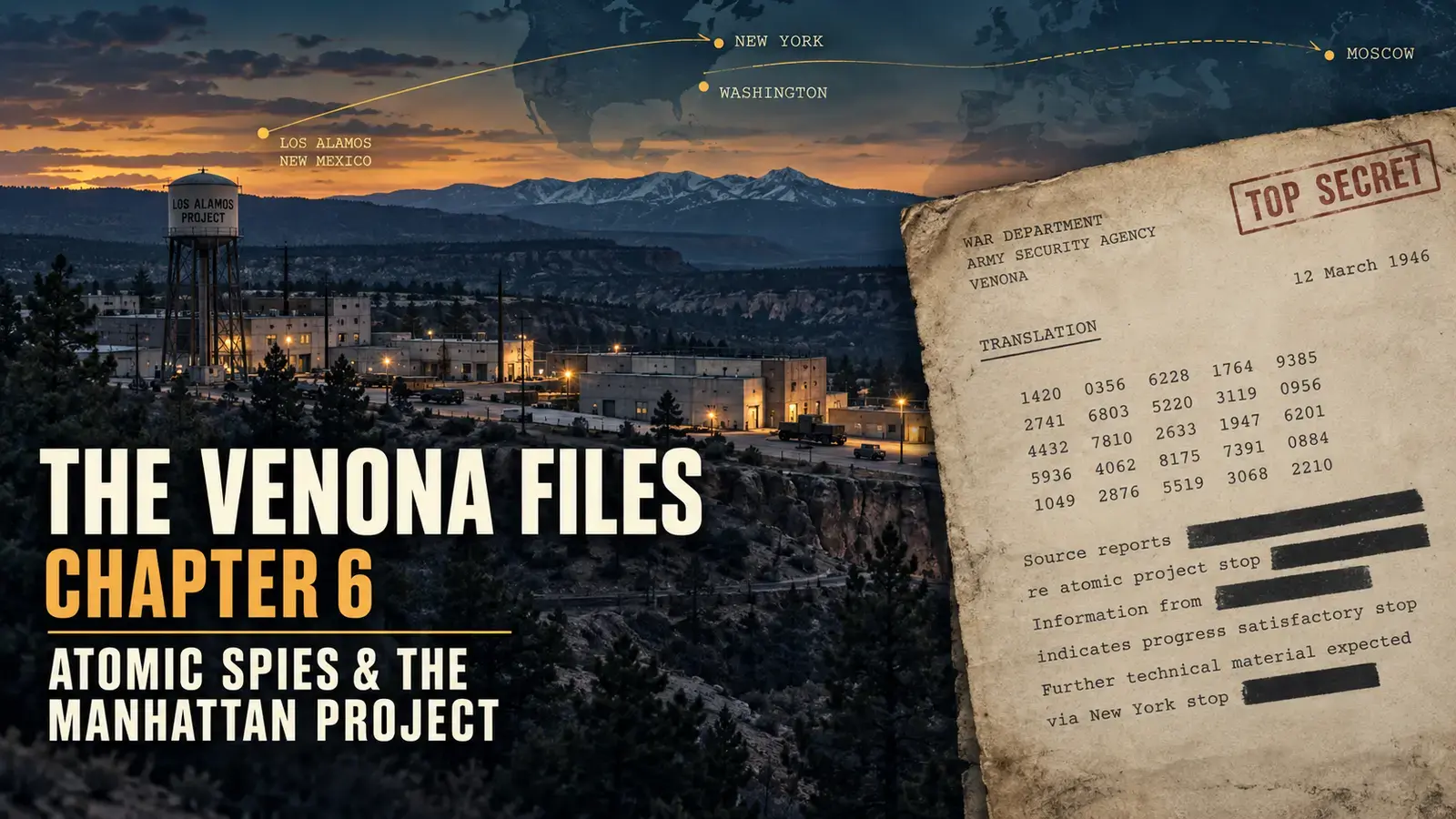
No target mattered more than the project that was hidden behind guarded fences in places most Americans had never heard of.
The Manhattan Project changes everything
The Manhattan Project was unlike anything the United States had attempted before.
It was not one laboratory. It was a nationwide system of research sites, production facilities, military administration, scientific teams, industrial contractors, security officers, and secret cities. The U.S. Department of Energy notes that, at its peak, the project employed about 130,000 workers and had physical properties, payroll, and a labor force comparable to the automotive industry.
The project’s major sites—Los Alamos, Oak Ridge, and Hanford—were chosen in part because they were remote, controllable, and easier to secure. Workers passed checkpoints. Military police guarded facilities. Employees wore badges and operated under strict need-to-know rules. Mail was censored. Conversation was restricted. The project’s purpose was compartmented even from many of the people helping build it.
The secrecy was extraordinary.
It was not perfect.
A project employing more than 100,000 people across multiple sites could not be invisible. Construction consumed materials. Factories used enormous quantities of electricity. Scientists and engineers disappeared into classified work. Trains moved people and equipment. Entire communities appeared behind fences.
Even before Soviet intelligence understood the full scope of the bomb project, it could recognize that something important was happening.
Once Moscow understood that the work involved nuclear weapons, the collection requirement became urgent.
The Soviet Union had excellent physicists. What it lacked was time.
If espionage could shorten the Soviet path to an atomic bomb by even a year or two, it could change the postwar balance of power. That calculation would shape one of the most consequential intelligence contests of the twentieth century.
Recruitment without Hollywood
Espionage is often imagined as theatrical.
Coded messages in smoky bars. Strangers in trench coats. Seduction, gadgets, and dramatic betrayals.
The reality was usually quieter.
Many Soviet sources during this period were not recruited through elaborate spy-movie scenarios. They were academics, scientists, engineers, government employees, military personnel, civil servants, journalists, or political sympathizers. Some were committed communists. Some believed the Soviet Union deserved access to information because it was bearing the heaviest burden against Nazi Germany. Some feared that an American monopoly on atomic weapons would make the postwar world more dangerous. Some were motivated by ideology, some by ego, some by money, and some by a complicated mixture of all three.
This complexity matters.
Not every source saw himself or herself as a traitor. Some believed they were serving history. Others believed they were protecting the wartime alliance. Others understood exactly what they were doing and who they were serving.
Intelligence history is rarely clean.
That is why VENONA remains so important. The decrypts did not turn every contested case into a simple morality play. But they did provide documentary evidence that Soviet intelligence had successfully built networks inside the United States and its allies during the war.
Washington: a city of secrets
By 1944, Washington had become one of the world’s busiest intelligence capitals.
Diplomats moved through embassy receptions and hotel lobbies. Military officers rushed between meetings. Scientists consulted with government agencies. Foreign delegations arrived with official agendas and unofficial questions. Wartime agencies expanded rapidly, hiring thousands of people into offices where sensitive information moved faster than security procedures could always control.
To Soviet intelligence officers operating under official cover, Washington offered extraordinary opportunities.
The city was full of people who knew something useful.
Some knew policy.
Some knew production.
Some knew weapons.
Some knew personalities.
Some knew rumors that could be tested against other reporting.
Most people did not imagine they were moving through an intelligence environment. They were attending meetings, trading gossip, making contacts, and serving the war effort. But intelligence services live in exactly those spaces: the overlap between official work, informal conversation, professional ambition, and private conviction.
Washington was not just the capital of an ally.
It was a target.
Radio waves carry the war
Every day, Soviet diplomatic and intelligence stations sent encrypted messages back to Moscow.
Some reported political developments. Others passed operational instructions. Some discussed money, travel, cover arrangements, personnel matters, or source handling. Others carried scientific and technical information.
American monitoring stations intercepted large quantities of foreign radio traffic during the war. At first, much of the Soviet traffic appeared useless. The messages were encrypted in groups of numbers. Without the proper key material, they looked random.
But the Army’s cryptologic specialists kept collecting.
That decision mattered. Intelligence collection often requires patience before anyone knows whether the material will ever become useful. A message that is unreadable today may become readable years later. A fragment that appears meaningless may become important when matched with another fragment.
This is one of the quiet lessons of VENONA: sometimes the most important decision is not the dramatic breakthrough. It is the discipline to preserve material that may not pay off for years.
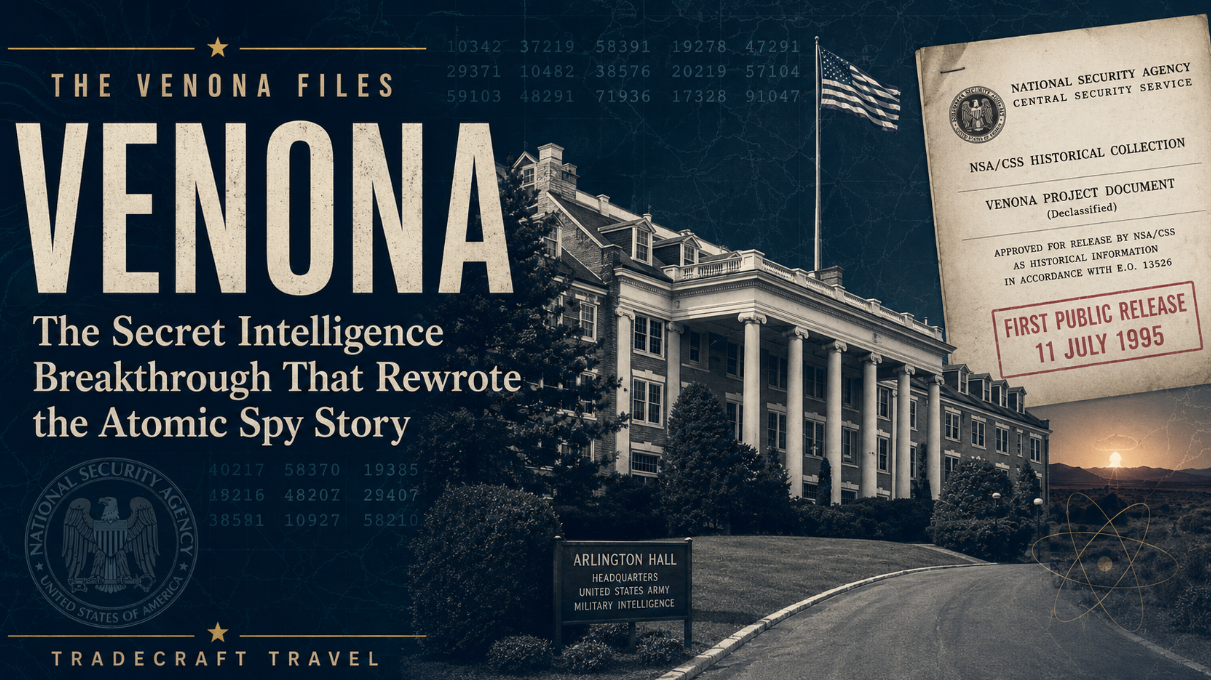
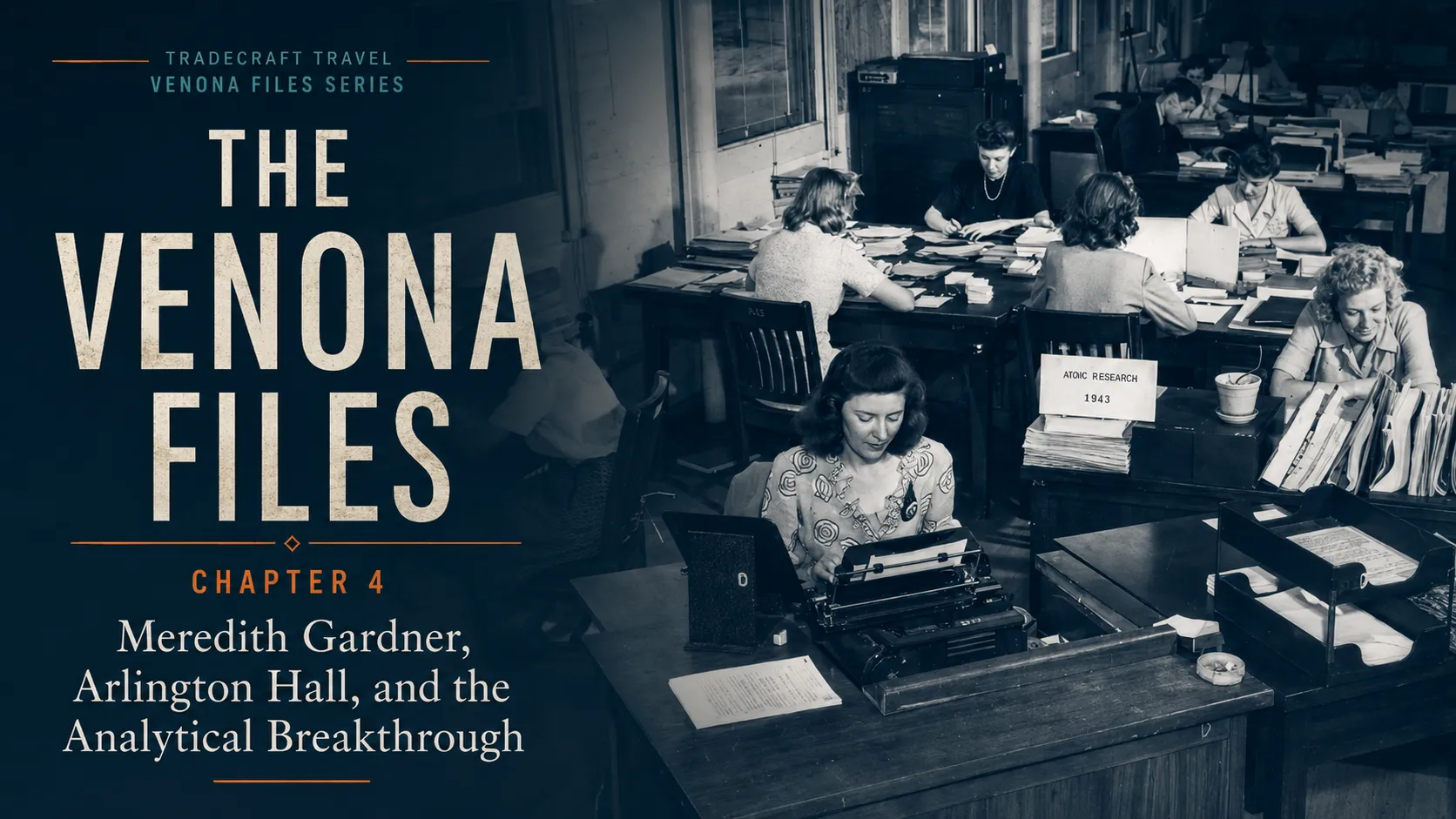
The U.S. Army’s Signal Intelligence Service began the secret program later known as VENONA in February 1943. According to NSA, the original mission was to examine and exploit Soviet diplomatic communications, but the traffic later included espionage efforts as well.
That meant American cryptanalysts were not simply reading routine diplomatic chatter.
They were beginning, slowly and painfully, to glimpse the hidden war inside the alliance.
The illusion of perfect security
The United States understood that foreign governments wanted information. Security around classified programs tightened steadily during the war.
The Manhattan Project, in particular, was protected by layers of physical security, background investigations, compartmentation, military police, badge systems, mail censorship, and strict rules about disclosure. The Atomic Heritage Foundation’s account of Manhattan Project security describes guarded checkpoints, barbed-wire fencing, clearance procedures, and need-to-know compartments across the major sites.
Yet absolute security is impossible.
Large organizations leak information in small ways. A conversation. A copied note. A friendship. A political commitment. A careless phrase. A source with partial access. A courier who makes one more trip.
Espionage rarely requires that one person know everything.
It often works by accumulation.
One source provides a technical detail. Another confirms a facility. A third explains a process. A fourth names a scientist. A fifth supplies documents. A case officer in New York, Washington, London, or Moscow compares reports and turns fragments into understanding.
That is why the Manhattan Project was such an attractive target. It was vast, secret, urgent, and scientifically revolutionary. It contained thousands of people who knew small pieces of a much larger whole.
Soviet intelligence did not need to steal the entire project in one act.
It needed to collect enough fragments to accelerate its own work.
The hidden war inside the alliance
The public war was fought by armies, fleets, factories, and air forces.
The hidden war was fought through sources, cables, couriers, microphones, dead drops, diplomatic pouches, and encrypted radio traffic.
Both wars mattered.
The visible alliance helped defeat Nazi Germany. The hidden intelligence contest helped shape what came next.
This is where the VENONA story becomes larger than cryptography. The decrypted messages did not merely reveal that Soviet spies had operated in the United States. They revealed that the early Cold War had roots inside the wartime alliance itself. The distrust that defined the postwar world did not suddenly appear in 1946 or 1947. It was already present while the Allies were still fighting together.
The Soviet Union was receiving American aid.
Soviet troops were dying in enormous numbers on the Eastern Front.
American and British leaders were trying to hold the coalition together.
And Soviet intelligence was collecting against them.
That contradiction is not an odd footnote. It is the setting in which VENONA was born.
Why this matters now
VENONA forces us to read World War II and the early Cold War together.
The same period that produced the Allied victory also produced the intelligence networks that would haunt American politics, counterintelligence, and nuclear strategy for decades. The same alliance that defeated Hitler also contained the mistrust that would divide Europe. The same scientific project that ended one war helped define the next one.
That is why this story belongs not only in archives but in places.
It belongs in Washington, where wartime agencies expanded and Soviet officers worked under diplomatic cover.
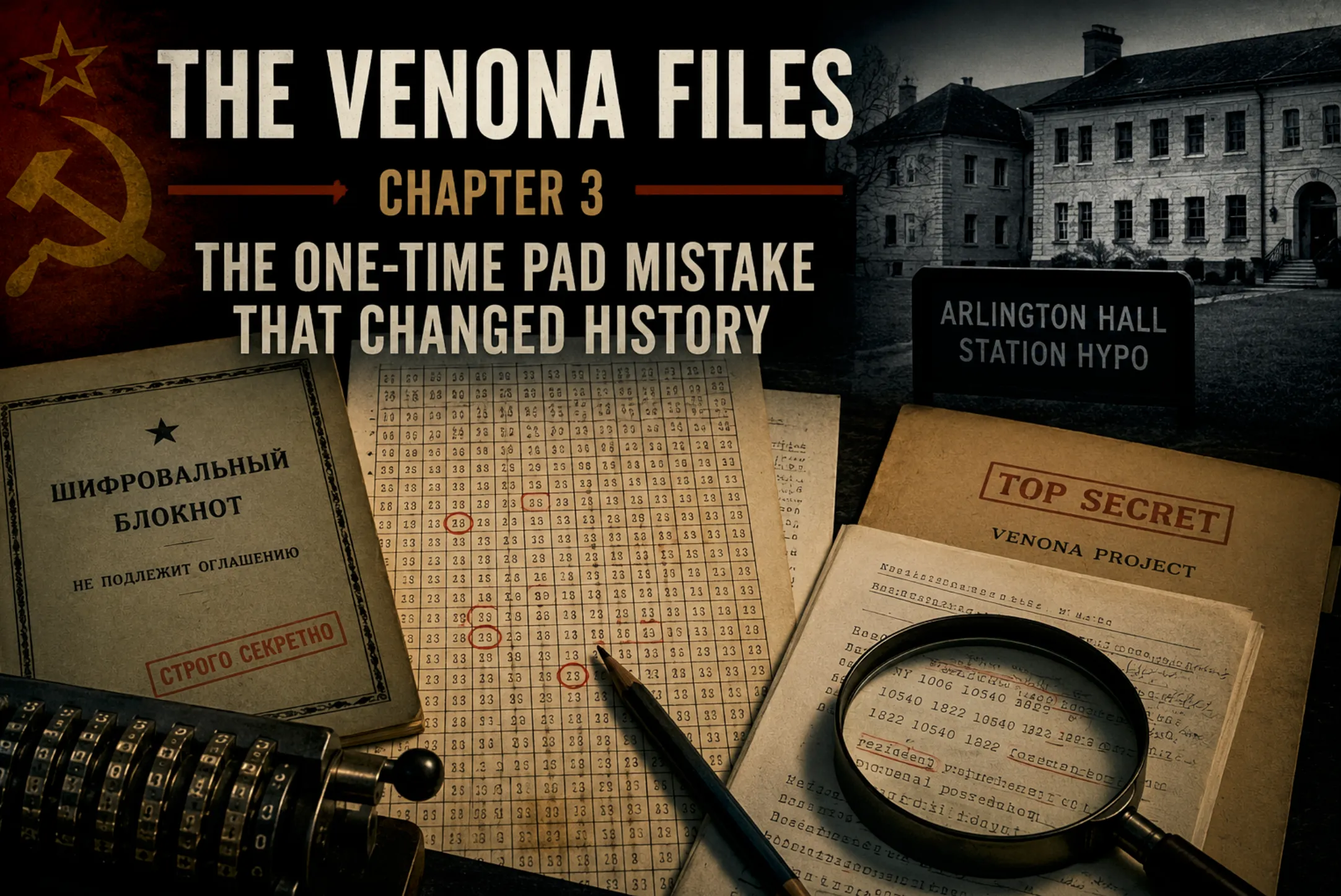
It belongs in Arlington, where cryptanalysts at Arlington Hall began turning impossible numbers into intelligence leads.
It belongs in New York, where Soviet intelligence officers met sources and managed networks.
It belongs in Los Alamos, Oak Ridge, and Hanford, where the atomic project became both a scientific achievement and an intelligence target.
It belongs in Ottawa and London, where allied counterintelligence and Soviet penetration intersected with the broader story.
The geography matters because intelligence history is not abstract. It happened in offices, laboratories, embassies, apartments, rail stations, and ordinary streets.
That is the foundation for Tradecraft Travel’s developing Codebreakers & Atomic Spies journey: a future itinerary built around the places where cryptology, atomic science, espionage, and counterintelligence collided.
In Chapter 1, we introduced the secret that stayed hidden for nearly fifty years.
In this chapter, we stepped back into the world that made that secret necessary.
Next, we turn to the mistake that made VENONA possible: the duplicated one-time pad pages that cracked open one of the most secure communications systems in the world.
Where this story lives on the ground
Arlington Hall, Virginia
The former girls’ school became one of America’s most important wartime cryptologic centers. It is central to the VENONA story and should anchor any future Washington-area intelligence-history itinerary.
Washington, D.C.
The wartime capital was not only a center of Allied planning. It was also a crowded intelligence environment full of diplomats, military officers, scientists, and government officials moving through agencies, embassies, hotels, and private homes.
New York City
New York was a major operating environment for Soviet intelligence officers, couriers, political contacts, and scientific networks. It is essential to understanding the human side of the VENONA story.
Los Alamos, New Mexico
Los Alamos became the scientific heart of the atomic bomb project—and one of the most consequential espionage targets of the twentieth century.
Oak Ridge, Tennessee, and Hanford, Washington
These production sites remind us that the Manhattan Project was not just a laboratory story. It was a vast national enterprise, spread across secret cities and industrial landscapes.
Ottawa and London
VENONA was not only an American story. Soviet intelligence operated across allied territory, and later chapters will move into the British and Canadian dimensions of the atomic espionage story.
Continue the series
Read Chapter 1: The Secret That Stayed Hidden for 50 Years
Explore the larger intelligence-history travel framework: Espionage Travel
Follow the North American buildout: Codebreakers & Atomic Spies
Selected sources and further reading
U.S. State Department: U.S.-Soviet Alliance, 1941–1945
U.S. State Department: Lend-Lease and Military Aid to the Allies
U.S. Department of Energy: Manhattan Project Background Information and Preservation Work
Atomic Heritage Foundation: Security and Secrecy in the Manhattan Project
FBI: In the Enemy’s House — VENONA and American Counterintelligence