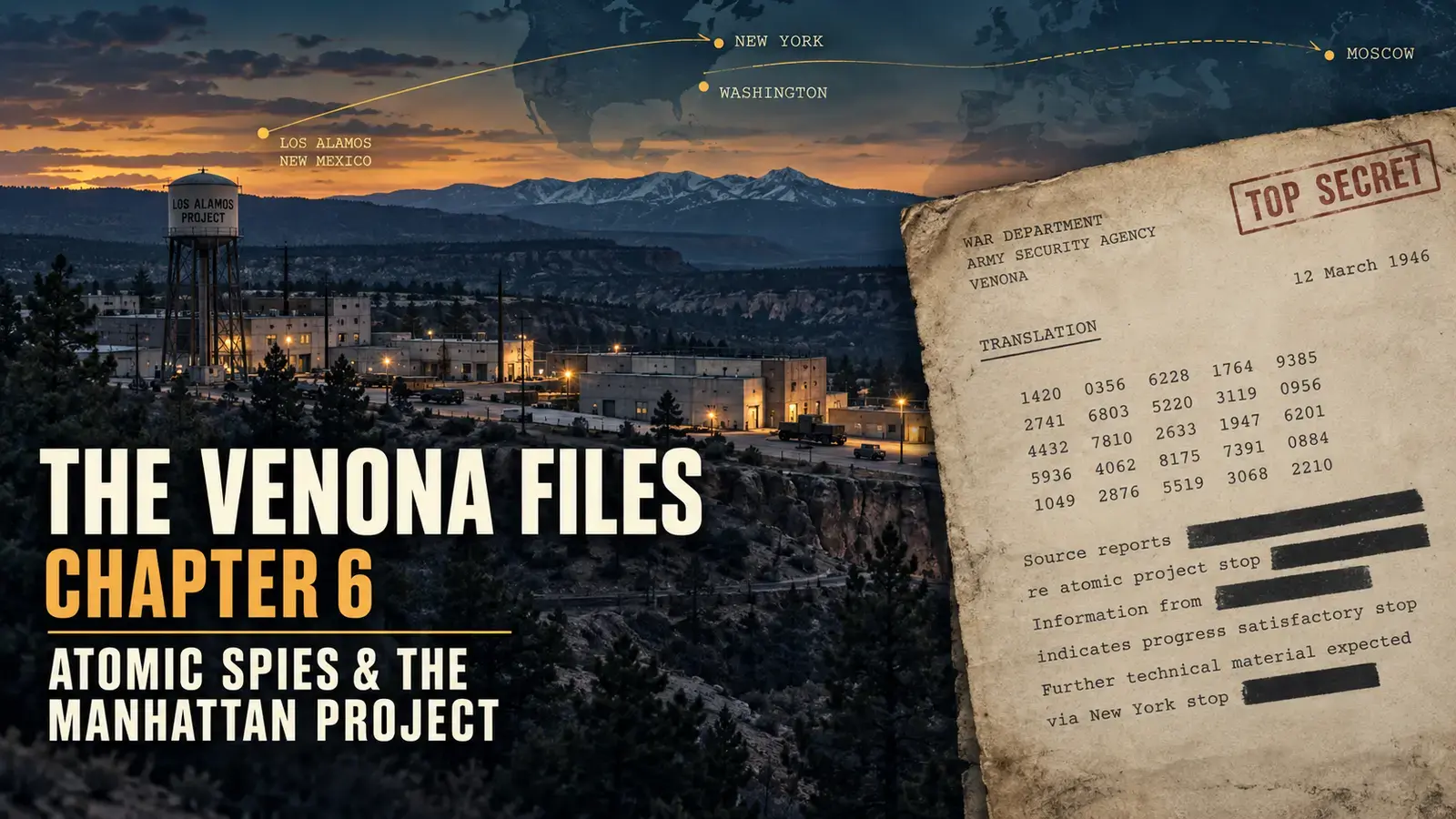

In Chapter 3 of The VENONA Files, we examined the Soviet production failure that made VENONA possible: limited reuse of one-time-pad material that should never have been used twice.
That mistake mattered enormously.
But it did not suddenly expose readable messages.
The reused pad revealed a relationship between encrypted messages. Everything after that still had to be earned.
At Arlington Hall in northern Virginia, cryptanalysts first had to identify where Soviet additive material had been reused. They then had to work backward toward the numeric code groups underneath it. Even after that, the numbers still did not say agent, Washington, uranium, or any other recognizable word.
The codebook connecting numbers to language remained hidden.
Turning those numbers into fragments of Russian—and then turning those fragments into intelligence—required a different kind of ability. It required linguistic instinct, memory, skepticism, contextual knowledge, and a willingness to test the same uncertain reading repeatedly.
Few people embodied that work more completely than Meredith Gardner.
An opening is not the same as a reading
Soviet intelligence traffic was protected in layers.
First, words and phrases were converted into numeric groups using a codebook. A common word might have one assigned value. A name, technical expression, or uncommon term might require special spelling procedures.
Those code groups were then concealed again by combining them with numbers from one-time-pad material. When every pad page was unique, used only once, and destroyed, the resulting message was effectively beyond cryptanalytic attack.
The Soviet mistake weakened this outer layer.
When the same additive material protected more than one message, analysts could compare the affected traffic and begin separating relationships among the concealed code groups from the reused pad material. That was the cryptographic opening described in Chapter 3.
But the opening did not reveal the underlying Russian.
Imagine removing the outer wrapping from a locked container. You have made progress, but you have not opened the container. The analysts might now see recurring four-digit groups, patterns, and structural features, but they still had to determine what those groups represented.
A repeated group could be a word.
A number.
A punctuation mark.
A procedural instruction.
A title.
A place.
Or part of a name being spelled one letter at a time.
That was the problem Gardner inherited.
Arlington Hall and the scale of the human work
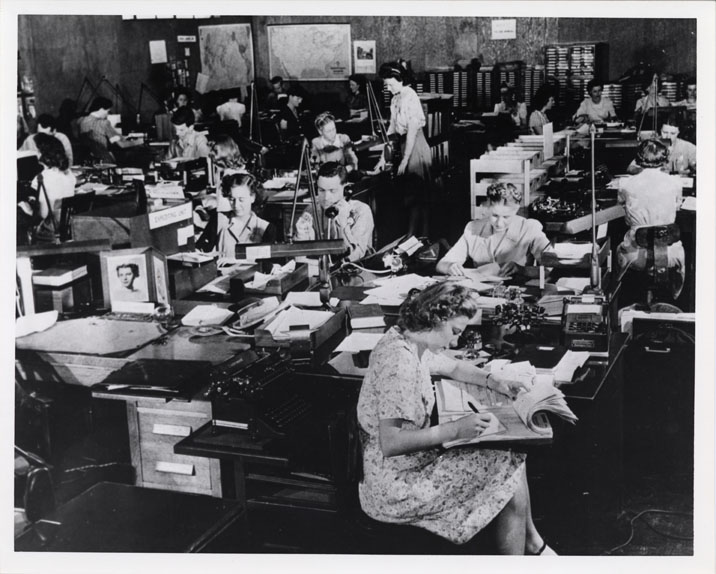
Arlington Hall had begun as a girls’ school. During World War II, it became one of the principal centers of American military cryptology.
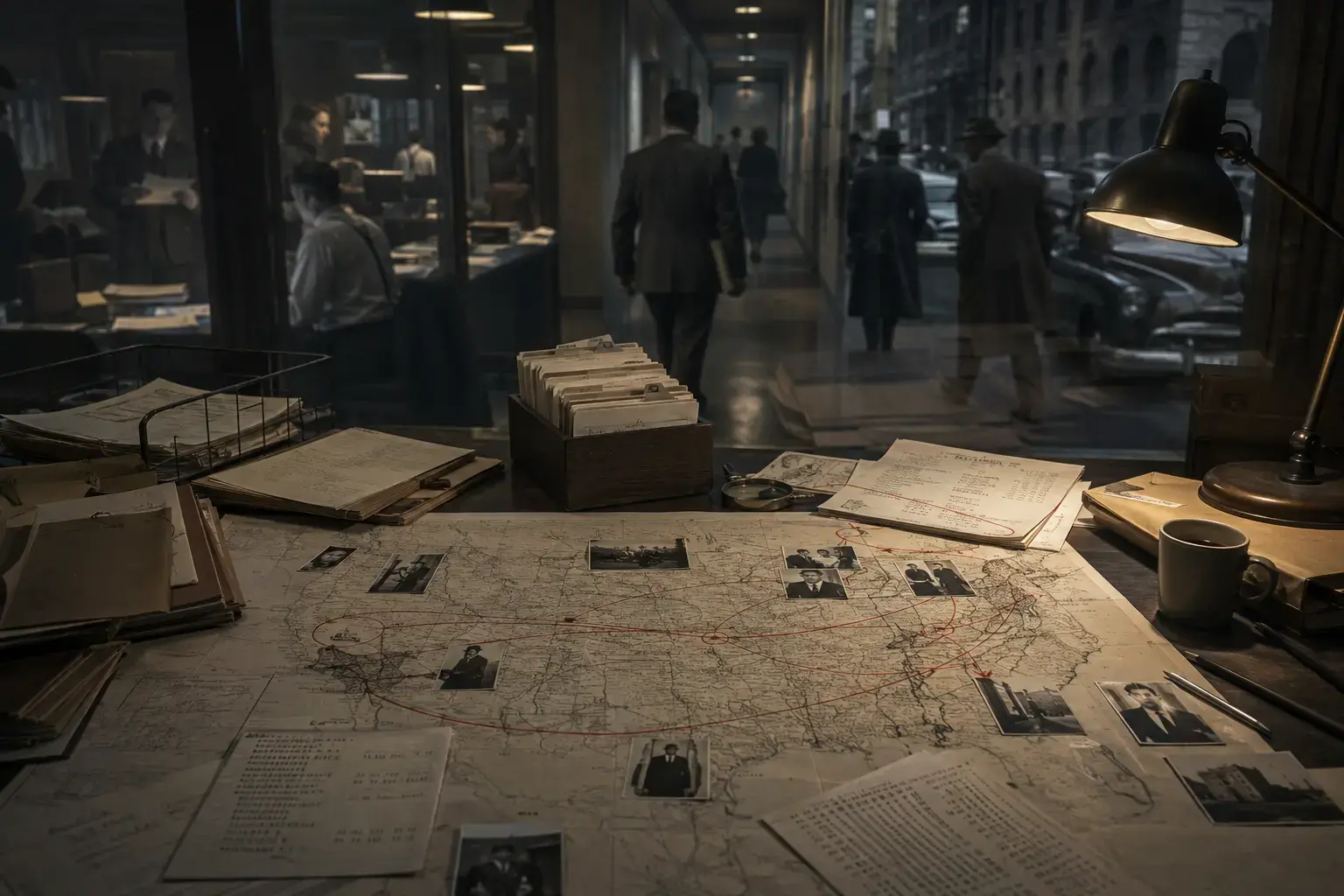
Its surviving images are a useful corrective to the familiar image of a solitary codebreaker confronting a single decisive message. The rooms were filled with long tables, worksheets, card files, intercepted traffic, handwritten annotations, and people comparing one uncertain fragment against another.
The work was cumulative.
A cryptanalyst might identify a repeated structural pattern. A linguist might suggest a possible Russian meaning. Someone else might find the same group in another message. A researcher might connect a date, address, occupation, or covername with information supplied from outside the cryptologic unit.
Progress depended on preserving and organizing these small gains so another analyst could build on them months or years later.
Meredith Gardner was exceptionally well suited to this environment. Before coming to Arlington Hall, he had taught German. He worked on German and Japanese material before moving to the Soviet problem and developing the Russian expertise that became central to his VENONA work.
His gift was not simply that he knew languages.
It was that he could hold patterns in mind, compare possible meanings, recognize when a reading almost worked, and resist treating an attractive solution as proven merely because it produced a few plausible words.
From numeric groups to a reconstructed codebook
The underlying Soviet codebooks were not sitting on Gardner’s desk.
They had to be reconstructed analytically.
The earliest recoveries were often modest: numbers, dates, punctuation, common words, and short grammatical elements such as prepositions. These were useful because they appeared frequently and could provide structure around less familiar groups.
A date might help establish the subject of a message.
A common preposition might indicate the grammatical relationship between nearby words.
A repeated procedural expression might reveal the beginning or end of a standard transmission formula.
Each reliable recovery became another entry in an American reconstruction of a Soviet codebook the analysts had never seen.
That reconstruction was not a simple list assembled in a straight line. A proposed meaning might fit one message but fail in another. A group could have more than one use. A copy error, transmission error, or variant spelling could send an analyst in the wrong direction.
The work therefore depended on consistency.
A candidate meaning became more valuable when it produced plausible Russian in several different settings, fit the surrounding structure, and continued to make sense as additional traffic became available. A reading that worked only once remained a possibility—not a conclusion.
Public histories do not preserve every desk-level test used in every recovery. The process described here is therefore a careful simplification, not a reconstruction of a single Arlington Hall worksheet. What is clear is that Gardner and his colleagues did not move directly from duplicated pad material to fluent translations. They accumulated codebook values, tested language, corrected earlier assumptions, and expanded partial readings over time.
The importance of spelling indicators
One of Gardner’s most useful contributions involved recognizing special indicators that marked the beginning and end of spelled material.
A codebook could assign one numeric value to a common Russian word or phrase. Proper names, English expressions, and unusual terms were more difficult. When no single codebook entry existed, the cipher clerk could use a spelling system to represent the term letter by letter.
For an analyst, identifying the equivalent of spell and end spell was important because it changed the question.
The groups between those indicators were probably not ordinary codebook words. They belonged to a spelling table.
Recovering portions of that table gave the analysts a new way to attack names and foreign terms—the very material that could make an otherwise vague intelligence report identifiable. A fragment containing an unknown official might remain ambiguous. A fragment that yielded several letters of a surname, alongside a workplace, date, or subject, could be compared with investigative information.
Gardner’s work on the spelling system helped open more of the codebook and made some English names and phrases accessible. One of his early recoveries included names of scientists associated with wartime atomic research.
Even then, spelling did not eliminate uncertainty. Names could appear in altered forms. Transliteration varied. A covername could replace a real identity. A clerk could abbreviate a word or make an error.
Spelling indicators created leverage. They did not create certainty.
Language testing was analytical work
Calling Gardner a linguist is accurate, but it can make his contribution sound like translation performed after someone else had already solved the message.
That understates the work.
He was helping determine what could be translated in the first place.
Consider an unknown numeric group appearing several times. An analyst might suspect that it represented a common Russian word. Gardner could test that possibility against the neighboring groups and the structure of the sentence.
Did the proposed word fit the Russian grammar?
Did it make sense in messages from different stations?
Did the same value appear where the same kind of word would be expected?
Did the interpretation conflict with a date, name, or procedural pattern already considered reliable?
Did a later message strengthen the reading—or expose it as wrong?
This was disciplined inference. The objective was not to find a clever answer once. It was to find an answer that remained defensible when tested against the rest of the traffic.
That is one reason VENONA translations evolved. A message revisited years later might yield more than it had originally because the analysts had reconstructed additional codebook values, identified a new covername, or received corroborating information from an investigation.
The historical decrypts should therefore not be imagined as transcripts arriving fully formed. They were analytical products assembled from recoverable portions of messages, revised as knowledge improved, and marked by persistent gaps.
The women who made VENONA possible
Gardner deserves his place in cryptologic history. He should not become the center of another lone-genius story.
Women played essential technical roles from the beginning of the project.
Gene Grabeel, a young former teacher, was assigned to begin examining the accumulated Soviet diplomatic traffic in 1943. That work helped establish the body of material from which VENONA grew.
Genevieve Feinstein and Lucille Campbell worked with Cecil Phillips on early cryptanalytic advances against the Soviet intelligence system. Gardner later credited Alice Joys and Marie Meyer with making some of the first recoveries of codebook values before his own work expanded what could be read.
Other women, including Mildred Hayes, Angela Nanni, and Janice Cram, were among those who carried VENONA work forward during its long classified life.
Their contributions should not be reduced to “assistance.” Wartime cryptologic organizations recruited thousands of women because the work required language ability, mathematics, pattern recognition, organization, patience, and judgment. Women served as cryptanalysts, translators, researchers, machine operators, traffic analysts, and supervisors, even though public accounts often concentrated on a few male leaders.
The NSA’s history of women in wartime cryptology describes a much broader mobilization of women into the country’s secret communications effort. VENONA emerged from that world.
The better historical picture is not Gardner working alone.
It is Gardner inside a small, highly skilled community whose members solved different parts of the problem and preserved their work for one another.
A breakthrough built from partial decrypts
The word breakthrough can be misleading.
It suggests a moment after which the system was broken and the messages became readable. VENONA never reached that condition.
Some portions of affected traffic could be recovered. Other portions remained unknown because analysts had not reconstructed the necessary codebook values. Still others were beyond recovery because their one-time-pad material had not been duplicated and therefore offered no comparable opening.
The official history distinguishes between material that remained unrecovered and material that was effectively unrecoverable through the VENONA method.
That distinction matters.
An unrecovered group might become readable if analysts later obtained more related traffic, identified additional codebook values, or received useful collateral information.
An unrecoverable passage lacked the cryptographic weakness needed to begin that process.
Even successful messages could remain incomplete. A readable sentence might sit beside a gap. A covername might be clear while the person behind it remained uncertain. A real identity might be suspected but not established strongly enough for action.
The work also was not occurring in real time. Many messages became partly readable years after they had been sent. VENONA was enormously valuable for understanding Soviet networks, supporting counterintelligence investigations, and reconstructing past activity, but it was not a continuous window into current Soviet communications.
Nor did the main achievement result from American analysts receiving an intact Soviet codebook. A damaged codebook obtained later assisted work on other traffic, but the central advances had already come through analysis of the messages themselves.
That is what makes the achievement so striking.
The analysts were reconstructing parts of an unseen system from its outputs.
From cryptanalysis to intelligence
A partial decrypt was not the end of the process.
It was the beginning of another analytical problem.
A fragment might mention a covername, a government office, a meeting place, a scientific subject, or a payment. Cryptanalysts could identify what the recovered language said. Counterintelligence investigators then had to determine whom it described and what could be established independently.
Information moved in both directions.
A VENONA fragment could give investigators a lead. Investigative information about a person, address, occupation, or relationship could help Gardner and his colleagues test a codebook value or identify a covername in another message.
This interaction also demanded restraint. A plausible identity was not automatically a proven identity. A partial translation was not the same as a complete account. Investigators needed evidence that could stand independently of a cryptologic source whose existence remained among the government’s most closely protected secrets.
The strongest conclusions came when several forms of evidence converged.
Gardner helped create the readable fragments. The larger intelligence system had to determine what those fragments meant.
VENONA: Break the Traffic
Begin as a Soviet cipher clerk, convert a fictional report into code groups, and protect it with simplified one-time-pad material. Then move to Arlington Hall and explore how duplicated additive created an opportunity for partial recovery.
The game is a fictional educational reconstruction. It simplifies the historical systems and does not reproduce Gardner’s exact procedures or imply that VENONA messages could be completely recovered.
Gardner’s real achievement
It is tempting to say Meredith Gardner “broke the VENONA code.”
That phrase is memorable. It is also too broad.
Gardner did something more precise.
He helped convert a cryptographic vulnerability into readable language. He reconstructed portions of Soviet codebooks. He recognized spelling procedures that opened names and foreign terms. He tested proposed meanings against Russian language and message context. He produced translations and analytical reports that helped other parts of the U.S. government understand the value of the material.
He did so as part of a team whose work stretched across decades.
The result was not a complete archive of Soviet communications. It was a scattered body of fragments strong enough to expose networks, confirm relationships, clarify long-contested cases, and reshape the history of Soviet espionage.
That is a different kind of intelligence success from the cinematic version.
It is slower.
More collaborative.
More uncertain.
And, in many ways, more instructive.
The mistake in the one-time pad created the opportunity. Gardner and his colleagues supplied the disciplined human judgment that made the opportunity useful.
Next in The VENONA Files
Once Arlington Hall could read portions of the traffic, a more consequential question followed:
Who were the people behind the covernames, meetings, payments, and reports?
Chapter 5: Inside Stalin’s American Networks turns from the cryptanalytic process to the officers, recruiters, sources, couriers, cutouts, and intermediaries who formed connected Soviet spy networks across wartime America.
Read Chapter 5 now, or return to The VENONA Files to explore the full series and its historic locations.
Primary sources and further reading
The NSA profile of Meredith Gardner provides the concise official account of his linguistic background, work on spelling indicators, codebook reconstruction, and role in making VENONA material readable.
The NSA study POLYGLOT: The Meredith Gardner Story provides greater detail on Gardner’s work, the early codebook recoveries, Alice Joys and Marie Meyer, and the relationship between cryptanalysis and FBI investigation.
The official history The VENONA Story explains the layered Soviet cryptographic system, the early work of Gene Grabeel, Genevieve Feinstein, Lucille Campbell, Cecil Phillips, and others, and the limits of the recovered traffic.