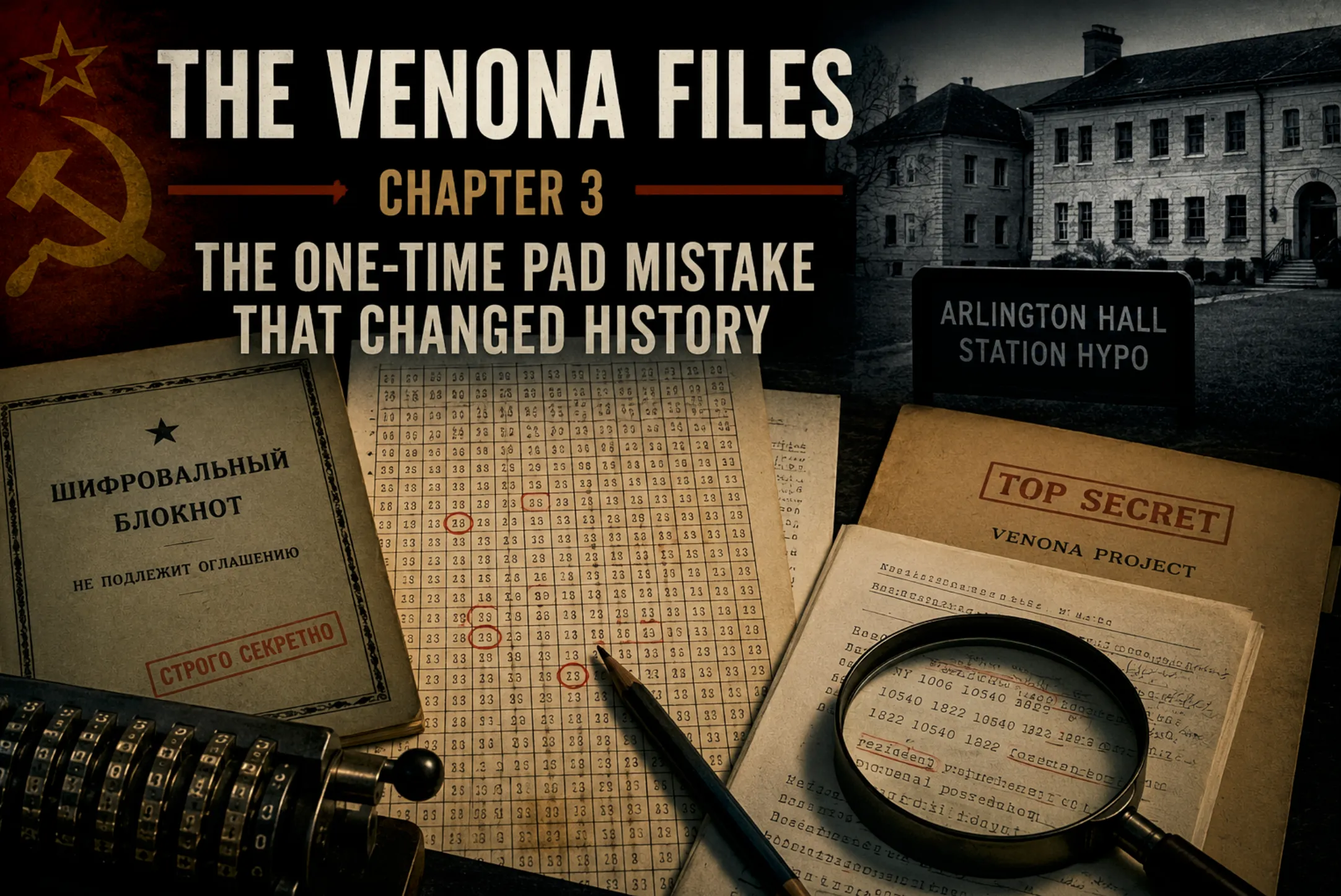

In brief: VENONA helped reveal that Soviet atomic espionage was not a single theft and not a single spy ring. Klaus Fuchs, Theodore Hall, David Greenglass, and other sources supplied different kinds of information through separate channels. Couriers and recruiters moved that information from Los Alamos toward Soviet intelligence officers in New York. The decrypts gave investigators leads, but secrecy, incomplete corroboration, and the demands of a criminal trial produced very different outcomes for the people involved.
The atomic secret did not leave Los Alamos in one briefcase.
There was no single stolen blueprint that told Soviet scientists everything they needed to know. No courier walked out of New Mexico carrying the Manhattan Project in finished form. What moved instead were pieces: equations, sketches, design principles, production information, names, observations, and confirmation that particular technical approaches worked.
Those pieces moved through more than one channel.
Some came from scientists who understood the physics at the heart of the weapon. Some came from a machinist with narrower access but proximity to the work. Some passed through couriers who never met the Soviet officers directing the larger effort. Recruiters and intermediaries connected people who otherwise might never have known one another. Moscow compared what one source reported with what another supplied.
That is the first correction VENONA brings to the familiar atomic-spy story.
The Soviet Union did not depend on one famous couple, one compromised scientist, or one dramatic handoff. It built a collection system around the most important technological target of the war.
In Chapter 5 of The VENONA Files, we treated the network—not the celebrity spy—as the proper unit of analysis. The Manhattan Project shows why that matters. Atomic espionage was a networked collection problem aimed at a compartmented scientific enterprise. Different sources could answer different questions. Their reporting overlapped, reinforced, and sometimes corrected one another.
The result did not give the Soviet Union an atomic bomb by itself. Soviet scientists still had to build an industrial program, produce fissile material, solve engineering problems, and turn intelligence into a functioning weapon.
But espionage reduced uncertainty.
In a race defined by cost, secrecy, and fear, knowing that a design had already worked was an extraordinary advantage.
ENORMOZ: the target was larger than Los Alamos
Soviet intelligence used the cover name ENORMOZ for its atomic-bomb collection effort. The name was appropriate. The Manhattan Project was not simply a laboratory in the New Mexico mountains. It was a vast, distributed system connecting scientific research, industrial production, military management, universities, factories, and secret facilities across the United States, Britain, and Canada.
Los Alamos—Project Y—was where weapon design converged. Oak Ridge produced enriched uranium and developed separation methods. Hanford produced plutonium. Columbia University, the University of Chicago, Berkeley, and other institutions contributed research, personnel, and technical foundations. British and émigré scientists joined an Anglo-American effort whose urgency had been created by fear that Nazi Germany might build the weapon first.
Compartmentation limited how much any one worker could see. A technician might understand a component without knowing the entire design. A scientist might know the theory but not the scale or status of production elsewhere. Even many people at Los Alamos did not possess a complete picture.
That protected the project from a single catastrophic breach.
It also encouraged an adversary to recruit multiple sources.
Moscow did not need every spy to know everything. It needed access at several points, people with different expertise, and an intelligence service capable of assembling fragments into a broader assessment. The NSA’s collection of declassified VENONA messages allows readers to see that process imperfectly: technical reporting, cover names, personnel descriptions, meeting arrangements, assessments of sources, and requests for more information appear across damaged and partial translations.
The gaps are important. VENONA did not recover the entire Soviet record. What survives is evidence from a larger system, not a complete transcript of it.
Klaus Fuchs: access at the center of the design
Klaus Fuchs had what an intelligence service prizes most: legitimate access, deep expertise, and the ability to explain why information mattered.
Fuchs was a German-born theoretical physicist who fled the Nazis and established himself in Britain. He joined the British atomic program and then traveled to the United States as part of the British mission to the Manhattan Project. At Los Alamos, he worked close to central questions of weapon design.
He was not passing rumors from the perimeter. He understood the science.
Before coming to the United States, Fuchs had already supplied information to Soviet military intelligence in Britain. During his Manhattan Project work, he met an American courier he knew only as Raymond. Raymond was Harry Gold, a Philadelphia chemist who had worked for Soviet intelligence for years.
The two met in New York and Santa Fe. Fuchs supplied technical information; Gold carried it onward. Fuchs did not need to know the Soviet officer at the end of the chain, and the Soviet officer did not need to meet Fuchs directly. The courier created separation.
The official MI5 history of the Fuchs case describes how VENONA reporting on meetings between Fuchs and Gold helped investigators narrow the identity of a major Manhattan Project source. The decrypts could guide the investigation, but they could not safely be displayed in open court without exposing one of the West’s most sensitive cryptanalytic successes.
That distinction shaped everything that followed.
Investigators placed Fuchs under scrutiny and confronted him. He eventually confessed in 1950. His admission allowed Britain to prosecute him without revealing VENONA and gave investigators the information needed to look for Raymond.
Once Harry Gold was identified and confessed, the case moved outward through the network.
Harry Gold: the value of the person in the middle
Couriers disappear easily in popular history. They are less famous than scientists and less visible than defendants at the center of a political controversy. Operationally, they can be indispensable.
Gold connected a technically valuable source to Soviet intelligence without requiring direct contact between them. He could travel, recognize the person he was sent to meet, receive material, and carry it to the next point in the system. He was an interface between compartments.
He also became a point of failure.
When the investigation reached Gold, his confession did not stop with Fuchs. He described a separate 1945 collection in Albuquerque involving another source from Los Alamos. That source was David Greenglass.
The FBI’s history of the atomic-spy investigation traces the chain from Fuchs to Gold, from Gold to Greenglass, and from Greenglass to Julius Rosenberg. That sequence is often remembered as a clean investigative progression. In reality, it combined secret signals intelligence, interviews, confessions, surveillance, records, and decisions about what evidence could be used publicly.
Gold did more than move material. Once identified, he connected cases that had appeared separate.
That is the double-edged nature of a courier. The same person who protects sources by separating them from handlers can expose several parts of a network when the separation fails.
Theodore Hall: an independent path into the same secret
Theodore Hall presents a different problem.
Hall was a young physicist at Los Alamos—still a teenager when he joined the project. His age, scientific ability, and access made him unusual. His motivation also differed from the simplest caricature of a spy bought by money. Hall appears to have believed that an American monopoly on atomic weapons would be dangerous and that sharing the secret with the Soviet Union would create a balance of power.
That belief did not make the disclosure authorized. It shows why motive must be analyzed rather than assumed.
Hall and his friend Saville Sax made contact with Soviet representatives independently. Hall was assigned the cover name MLAD, derived from a Russian word associated with youth. He supplied information from Los Alamos through a channel distinct from Fuchs and the Rosenberg-Greenglass network.
A declassified VENONA translation identifying MLAD connects Hall to reporting on the Manhattan Project and places his information alongside material attributed to Fuchs. That juxtaposition is revealing. Moscow was not waiting for one source to answer every question. It could compare technically informed reporting acquired through separate operations.
Hall was questioned by the FBI but never prosecuted.
The government faced a problem that appears repeatedly in the VENONA story: intelligence can be persuasive without being courtroom-ready. The translation was incomplete. The underlying intercept was extraordinarily sensitive. Revealing it would tell the Soviet Union that its supposedly secure communications had been penetrated. Without sufficient independent evidence or a confession, a prosecution risked sacrificing the source of the lead.
Fuchs confessed and was convicted. Hall did not confess at the time and was not charged.
Similar intelligence produced different legal outcomes because the surrounding evidence was different.
David Greenglass and the Rosenberg network
David Greenglass was not Klaus Fuchs.
He was an Army machinist assigned to Los Alamos, not a theoretical physicist positioned to explain the weapon at the highest technical level. His access was narrower. The information attributed to him was less sophisticated than the material Fuchs could provide.
But intelligence services collect what sources can obtain, not only what later historians judge most important.
Greenglass could describe work at the site, identify personnel, produce sketches, and report aspects of the implosion weapon. Soviet intelligence could compare his information with reporting from more technically capable sources. Even imperfect reporting might confirm that another channel was reliable or show which questions remained unresolved.
Greenglass entered the network through family and ideology. Julius Rosenberg, his brother-in-law, had become an important recruiter and group leader for Soviet intelligence. Julius was not limited to atomic information. He recruited engineers and other sources with access to military and industrial technology, managed contacts, and helped information move toward Soviet officers.
VENONA identified Julius under the cover name LIBERAL. A January 1945 translation concerning Greenglass links the cover names assigned to David and Ruth Greenglass with Julius and the New York-based Soviet officer Leonid Kvasnikov. Once again, the message is not a complete case file. It is a window into relationships, tasking, and the language an intelligence service used to manage people.
The role of Ethel Rosenberg requires greater care than the shorthand phrase “the Rosenbergs” usually allows.
A November 1944 VENONA message about Ethel says that she knew about Julius’s work and about the roles of two other people, while also stating that she was not then being used operationally. That is evidence of knowledge. It does not, by itself, establish that her operational role was equivalent to Julius’s.
At trial, the prosecution relied heavily on testimony from David and Ruth Greenglass, including an allegation that Ethel typed notes describing atomic information. David Greenglass later acknowledged that his trial testimony about the typing was false and that he had sought to protect his wife; the discrepancy is also visible in the grand-jury record released after his death. The distinction does not erase Julius Rosenberg’s espionage or make Ethel wholly unaware. It does make precision essential when assessing her actions and the punishment imposed.
The historical questions are separate:
- Was Julius Rosenberg a Soviet agent and recruiter? The documentary evidence is strong.
- Did Ethel Rosenberg know about her husband’s espionage? The VENONA record indicates that she did.
- Did the available evidence prove that she performed the same operational role as Julius? That is much less clear.
- Did the government use the threat against Ethel to pressure Julius to confess and identify others? The prosecution strategy and later record make that question unavoidable.
History becomes less useful when those questions are collapsed into a single verdict about “the Rosenbergs.”
A fourth source—and a reminder that the record kept changing
For decades, public accounts concentrated on Fuchs, Hall, and Greenglass as the identified Los Alamos sources.
The picture later widened.
Research based on declassified records identified Oscar Seborer, an Army technician and engineer at Los Alamos, as another Soviet source. Los Alamos National Laboratory’s current account of the Project Y spies now treats Fuchs, Hall, Greenglass, and Seborer as four penetrations of the wartime laboratory.
Seborer matters for more than the addition of another name.
His case shows that even a historic intelligence success such as VENONA did not reveal everything. Some messages remained unreadable. Some cover names remained unresolved. Some relationships only became clearer when later archives, records, and scholarship could be brought together.
Intelligence history is not a sealed case. Declassification changes the evidentiary landscape.
What the Soviet Union actually gained
Atomic espionage is often described in extremes.
One version says Soviet spies “gave Stalin the bomb,” reducing Soviet scientists to passive recipients of an American design. Another minimizes espionage because the Soviet Union possessed capable physicists and an enormous state-directed program of its own.
Neither framing is sufficient.
The Soviet Union could almost certainly have developed an atomic weapon without espionage. It had first-rate scientists, substantial resources, captured information, and a government willing to impose extraordinary costs on the effort.
Espionage still mattered.
It provided technical detail. It confirmed that implosion worked. It revealed how the United States had approached difficult design and production problems. It helped Soviet leaders judge which paths deserved resources and which uncertainties had already been resolved by the American program. It gave Moscow a benchmark against which Soviet work could be tested.
The Soviet Union detonated its first atomic device on August 29, 1949. The weapon closely resembled the American plutonium implosion design. The official Los Alamos account of the first Soviet test connects that outcome to multiple penetrations of Project Y while preserving the necessary point: collected intelligence had to be absorbed and turned into a functioning Soviet weapon.
The precise number of months or years espionage saved remains debated. That may be the wrong way to measure its value.
An intelligence service is not always seeking a complete answer. Sometimes it is seeking confidence. Confirmation that an expensive technical path can succeed may be worth as much as a drawing. Independent reports that agree can be more valuable than a single spectacular source. A fragment that closes one uncertainty may allow a scientific and industrial program to move faster and with less risk.
Espionage did not substitute for Soviet science.
It made Soviet science better informed.
Why VENONA could expose a network but not settle every case
VENONA was intelligence, not a verdict.
The translations gave investigators names to examine, cover names to resolve, relationships to test, and meetings to reconstruct. They helped expose connections that would otherwise have remained hidden. But the messages were partial, the identifications sometimes developed over time, and the underlying cryptanalytic capability was too sensitive to reveal during the first investigations and trials.
That produced several categories of outcome:
- Fuchs was identified through the VENONA-driven investigation, confessed, and was convicted in Britain.
- Gold was identified as Fuchs’s courier, confessed, and helped investigators reach Greenglass.
- Greenglass confessed, cooperated, and testified against Julius and Ethel Rosenberg.
- Julius Rosenberg denied the charge, was convicted, and was executed; the later public VENONA record strongly corroborated his role as a Soviet agent and recruiter.
- Ethel Rosenberg was convicted and executed, but the evidence concerning the scope of her operational activity remains materially different from the evidence against Julius.
- Hall was identified and questioned but not prosecuted because the government lacked a safe and sufficient public case.
- Seborer remained outside the familiar public account until later research brought additional declassified evidence together.
The differences are not contradictions. They demonstrate the distance between intelligence assessment, investigative lead, admissible evidence, prosecutorial strategy, and historical judgment.
Those categories overlap. They are not interchangeable.
The geography of the atomic network
The Manhattan Project is often pictured as a fenced mesa in New Mexico. The espionage story refuses to stay there.
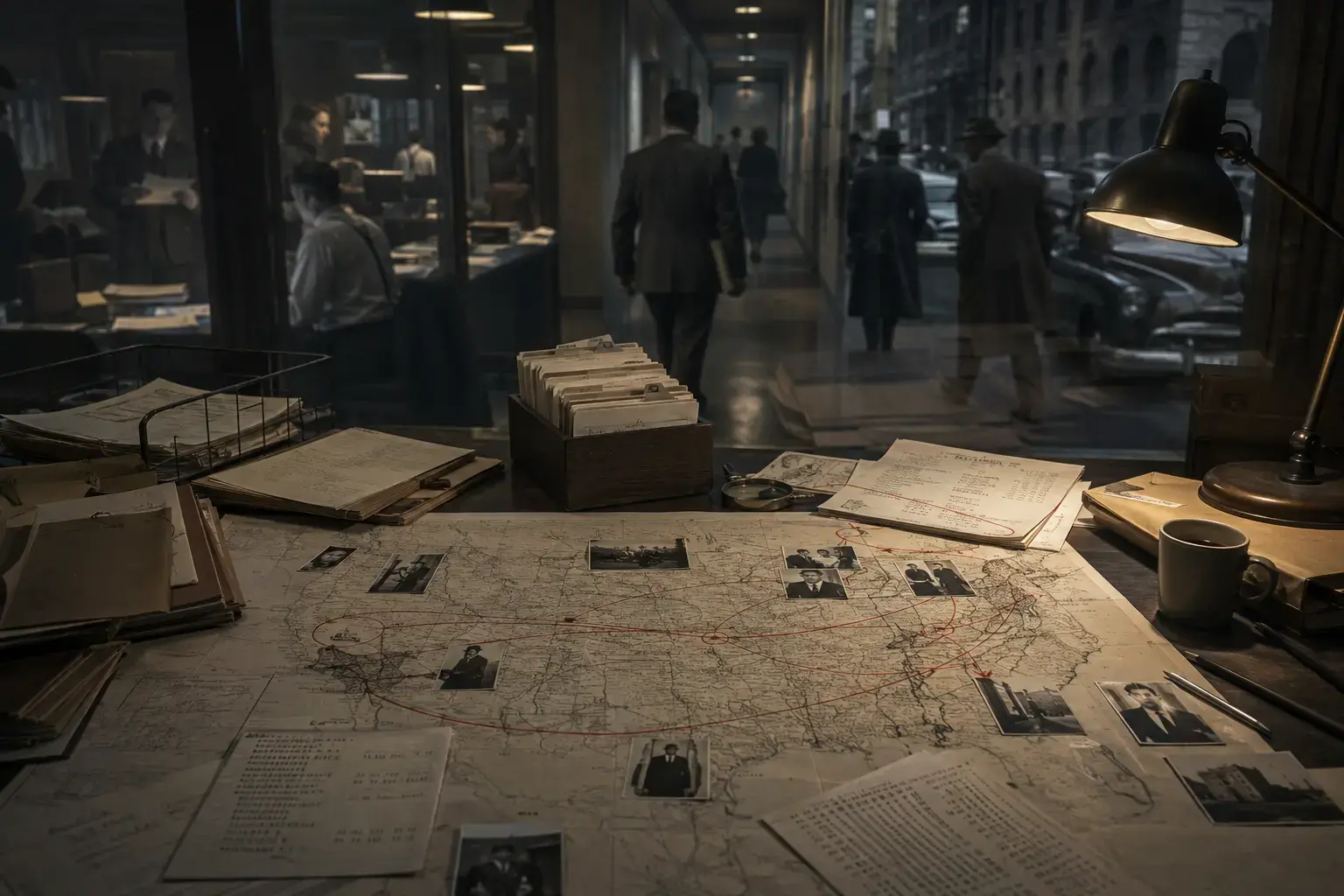
Los Alamos was the target. Santa Fe and Albuquerque provided the surrounding terrain for meetings, movement, and access. New York provided diplomatic cover, couriers, recruiters, and communications infrastructure. Washington held the investigators, policymakers, codebreakers, and institutions trying to understand the breach. Arlington Hall was where fragments of Soviet traffic were turned into leads. Moscow was where the reporting converged with Soviet scientific and political decision-making.
That geography is why the atomic story belongs inside the wider North America espionage landscape. The New York City Espionage History Map shows the urban network around the Manhattan Engineer District, Soviet operations, the Rosenberg case, and the movement of people and information. The Washington, D.C. Espionage History Map follows the cryptologic and counterintelligence response through Arlington Hall, federal institutions, court cases, and the national-security state that emerged from the war.
The ground changes the story.
At Los Alamos, atomic espionage is a problem of trusted access inside a secret scientific community. In Santa Fe, it becomes a problem of contact and movement. In New York, it becomes a human network of recruiters, couriers, diplomatic officers, apartments, and ordinary streets. In Washington and Northern Virginia, it becomes an analytical problem: how to transform broken messages into identities, investigations, and action without revealing the source.
No single city contains the case.
The secret was not one thing
The phrase “the secret of the atomic bomb” is convenient. It is also misleading.
The bomb depended on many secrets: the behavior of fissile material, methods of producing it, implosion, initiators, explosive lenses, detonators, metallurgy, diagnostics, industrial scale, and the organization required to make those elements work together. A successful intelligence collection program did not have to steal all of them from one place or one person.
It could collect pieces and let analysts and scientists assemble the value.
That is what makes the Manhattan Project such a revealing VENONA case. The American program used compartmentation to protect a massive distributed enterprise. Soviet intelligence answered with compartmented collection of its own. Sources did not necessarily know one another. Couriers separated sources from officers. Different Soviet services and operational channels pursued overlapping access. Moscow stood above the compartments and could compare the reporting.
The contest was not between one wall and one spy.
It was between systems.
One system was racing to build a weapon before the war ended. Another was racing to understand that achievement without repeating every wrong turn. VENONA later allowed American and British investigators to see parts of the second system—but only after the information had moved, the war had ended, and the nuclear balance had begun to change.
By then, the question was no longer whether the atomic secret had been penetrated.
It was what could be proved, what could be revealed, and what justice required when the most important evidence had to remain secret.
That is where Chapter 7 begins.
Continue The VENONA Files
Return to The VENONA Files for the full series, chronology, people, places, and declassified record.
- Chapter 4: Meredith Gardner and the Human Work of Cryptanalysis
- Chapter 5: Inside Stalin’s American Networks
- Next chapter: Chapter 7—Code Names, Ambiguity, and Political Consequences
Tradecraft Travel is developing Codebreakers & Atomic Spies, a planned October 2028 journey through New York, Washington, Santa Fe, Los Alamos, and Trinity. The journey follows the secret, the network, the codebreakers, and the counterintelligence response across the actual terrain where the story unfolded. Joining the interest list is nonbinding and does not reserve space.