A code name could open an investigation. Establishing what someone actually did required much more. The Rosenberg case shows why those distinctions carried such terrible weight.
The message gives her first name plainly: ETHEL.
On November 27, 1944, Soviet intelligence in New York sent Moscow a short description of LIBERAL’s wife. She was 29, had been married for five years, and knew about her husband’s work. The surviving translation adds: “In view of delicate health does not work.” In the American analysts’ comments beneath the message, LIBERAL is identified as Julius Rosenberg. His wife was Ethel Rosenberg. Read the declassified message.
Few lines in the VENONA record carry more weight. They place knowledge, activity, family, and responsibility close together, while leaving the reader to examine precisely how they connect.
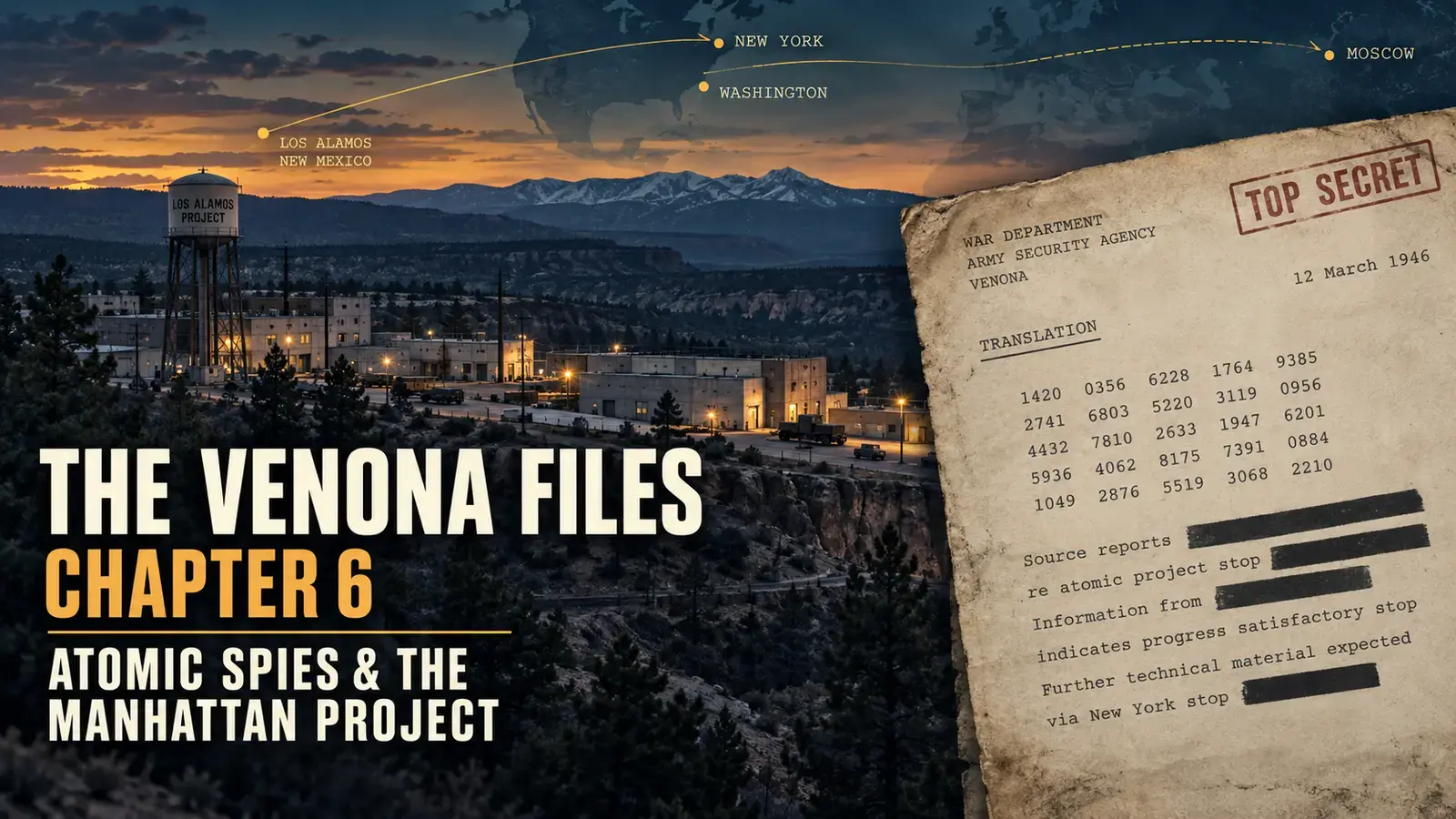
Chapter 6 followed atomic information through sources and couriers. This chapter follows the evidence into an investigation, a courtroom, and a public argument that continued long after two defendants were dead.
A code name needed a context
VENONA’s capital letters can create an impression of certainty. A name appears in a secret Soviet message; surely the meaning is obvious.
Consider KAPITAN. That was a cover name for President Franklin D. Roosevelt. Soviet officers also concealed the names of institutions and places: THE BANK meant the State Department, and BABYLON meant San Francisco. Their vocabulary covered people they discussed as well as people who worked for them. The NSA’s official history explains this distinction.
A reader has to establish the relationship described by the message. Was this person supplying information, arranging a meeting, being considered for recruitment, or simply being discussed?
Even the labels could shift. Julius Rosenberg appeared as ANTENNA and later LIBERAL. Soviet intelligence sometimes reused a cover name for different people, and American identifications developed through investigation. The surrounding details mattered: dates, employment, relatives, travel, and access.
The useful question is what the person was doing in that particular communication. Recognition of a familiar name comes afterward.
How LIBERAL became Julius Rosenberg
A short American memorandum dated June 27, 1950, lets us watch an identification taking shape. It reports that Julius Rosenberg was “probably identical” with ANTENNA and LIBERAL. It also associates David Greenglass with KALIBR and Ruth Greenglass with OSA. The document survives in the joint NSA–CIA collection, Document 31.
That word probably is valuable. It preserves the assessment at a particular moment. Later readers can work backward from an established identity and forget that investigators had to arrive there.
The Soviet messages supplied a different part of the picture. A January 8, 1945, report describes CALIBRE—identified in the American comments as David Greenglass—providing a plan of his workplace and information about its work and personnel. The text contains substantial gaps. Its comments identify WASP as Ruth Greenglass and LIBERAL as Julius Rosenberg.
Read these records together and the work becomes more tangible. One document records clandestine reporting. Another records investigators matching concealed identities to actual people. Neither was written as a finished account for a future reader.
An analyst’s footnote is part of the history, too. It tells us what investigators concluded, and it should be read alongside the message that prompted the conclusion.
Other messages document Julius’s recruiting activity. A July 26, 1944, cable reports ANTENNA’s visit to Max Elitcher, describes Elitcher’s access to valuable naval technical information, and requests Moscow’s approval to bring him into the operation. Here the evidence concerns a specific effort to obtain access. The record supports a firm conclusion that Julius worked for Soviet intelligence and helped recruit its sources.
Ethel’s role deserves its own examination
The phrase “the Rosenbergs” can make two people’s actions sound interchangeable.
The November message places Ethel inside her husband’s confidence while describing her as not working because of her health. It is evidence of knowledge and a contemporary assessment of activity. The extent of her assistance needs to be tested against other records.
An earlier cable complicates the picture. In New York’s September 21, 1944, message, Julius recommends Ruth Greenglass as a possible provider of a safe apartment; the report attributes a favorable assessment of Ruth to both Julius and his wife. That passage belongs in the account, too. It raises a question about Ethel’s assistance that the November description alone cannot resolve.
An additional American assessment became public in 2024. As the Associated Press reported after examining the document, Meredith Gardner’s August 22, 1950, memorandum interpreted the intercepted reporting as indicating that Ethel knew of Julius’s work but did not participate because of ill health. Her sons saw vindication in it; historians continued to disagree over the implications of the wider record.
This records a central American codebreaker’s reading before the trial, adding another interpretation to compare with the Soviet text.
Knowing about espionage, assisting an espionage conspiracy, recruiting a source, and personally delivering secrets describe different conduct. A careful account should identify the evidence for each claim it makes about each person.
That discipline is particularly necessary here. The punishment was irreversible.
The jury heard a different kind of case
Julius and Ethel Rosenberg went on trial in the Southern District of New York in March 1951, alongside Morton Sobell. The charge was conspiracy to commit espionage. The jury convicted all three on March 29; Julius and Ethel received death sentences on April 5. The FBI’s case chronology records those dates and the testimony presented at trial.
VENONA remained secret. Investigators could pursue its leads, but the government protected the codebreaking source and built prosecutions around other evidence. The NSA–CIA historical introduction describes that pattern and the difficulty of bringing intelligence into public proceedings without exposing the program.
In the Rosenberg trial, witnesses therefore carried enormous weight. David and Ruth Greenglass testified that Ethel had typed notes containing atomic information. That allegation described a concrete act of assistance. It gave the jury a picture of her doing something with the information, beyond knowing what her husband did.
To assess the trial, we have to examine that testimony on its own terms. Later discoveries about Julius cannot make an unreliable allegation about Ethel reliable. Likewise, a problem with one witness’s account does not erase independent evidence of espionage.
The testimony that changed
In July 2015, the public gained access to David Greenglass’s previously sealed grand-jury testimony. The National Archives announced the release, following a court order obtained through litigation by historians and archival organizations.
The transcript lets readers compare his earlier account with what the trial jury later heard. Asked in August 1950 whether his sister had urged him to remain in the Army, Greenglass answered: “I never spoke to my sister about this at all.” The passage appears on page 30 of the grand-jury transcript.
That answer concerned a particular conversation; it was not a comprehensive statement about everything Ethel knew or did. Its significance emerges from the comparison. The damaging story about her typing atomic notes did not appear in his grand-jury account. At trial, it became a central allegation against her.
Decades later, Greenglass acknowledged that he had lied about the typing to protect his wife. The National Security Archive’s account of the release brings the testimony, his later admission, and the historical debate together.
The discrepancy forces a difficult question: how much confidence should we place in a specific accusation when the witness’s account changed and the witness later disavowed it?
That question remains necessary even when other evidence establishes that the espionage network itself was real.
When evidence became a political argument
The government’s secrecy left the public without access to material that shaped intelligence assessments. The NSA–CIA history acknowledges the political and social cost: arguments over Soviet espionage grew more polarized in the absence of reliable information that could be examined openly.
VENONA’s first public release came in July 1995, more than four decades after the Rosenbergs’ executions. The NSA’s document collection eventually made approximately 3,000 translations available. Readers could inspect Soviet communications that had been unavailable during the original controversy.
The release strengthened the documentary basis for understanding real Soviet espionage. It also created a responsibility to read closely. A finding about one person cannot establish the guilt of everyone who shared that person’s politics. An identification in a footnote does not, by itself, answer whether every allegation at a trial was true. Evidence of an offense leaves the justice of a punishment open to examination.
For the Rosenberg case, three questions deserve separate answers: What did Julius do? What did Ethel do? Was the process—and the punishment—justified by the evidence against each?
Julius and Ethel were executed at Sing Sing on June 19, 1953. The FBI chronology records their deaths. The archive continued to grow after their lives had ended.
Read a connection, then inspect its evidence
The Soviet Espionage Network Atlas offers a useful companion to this chapter. Begin with Julius Rosenberg, examine the connections around him, then open Ethel’s dossier separately. Select a relationship to inspect its explanation and source.
Keep three questions beside you as you explore:
- What relationship is being shown? Family ties, recruitment, courier work, and institutional access have different meanings.
- What does the source actually say? Read the recovered text, the gaps, and the analyst’s comments separately.
- When was this known? The date a message was sent may be years earlier than the date it was translated or its people identified.
The November 1944 message at the beginning of this chapter carries a May 1975 date on the released translation. That alone should prompt us to ask which version an investigator could have seen in 1950. A finished historical account can conceal years of uncertainty and revision.
Use the atlas to choose a connection worth following. Then let the document determine how much can be said about it.
Follow the story back to the ground
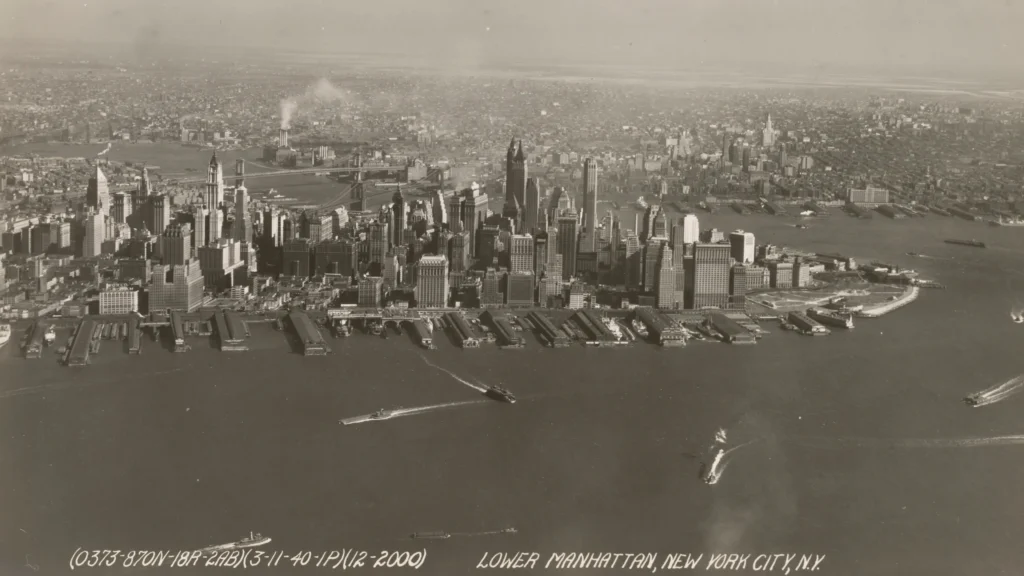
New York brings the different parts of this history unusually close together. It held the Rosenbergs’ home, the Soviet reporting apparatus, and the federal court where the prosecution unfolded. Across those settings, private relationships became intelligence relationships, and intelligence became a public accusation.
The New York City Espionage History Map helps put that geography back into the story. Walking these places gives scale to the record: people went home, visited relatives, traveled to meetings, and entered courtrooms. The documents concern decisions made within those ordinary movements.
The next chapter, Why VENONA Stayed Secret, follows the officials who decided how much of this intelligence could be shared, with whom, and at what cost.
Continue through The VENONA Files, or explore Codebreakers & Atomic Spies, Tradecraft Travel’s planned journey through the places behind the story. The nonbinding interest list lets you follow the journey’s development without reserving a place.