Reading the Ground — London · Chapter 6
A railway station, a residential street, a shopping area, and a bottle mistaken for perfume: how investigators reconstructed the Salisbury attack, and how the city recovered.
The bench was beside shops.
On March 4, 2018, Sergei Skripal and his daughter, Yulia, became critically ill at The Maltings in Salisbury. Earlier, they had visited The Bishops Mill pub and Zizzi for lunch. These were ordinary stops in a city center. By late afternoon, the outing had become a medical emergency.
The setting matters. A shopping area brings together people who have no reason to know anything about one another: families, employees, visitors, someone collecting groceries, someone looking for a place to sit. They share space because that is how a city works.
That Sunday, they also shared space with the consequences of an attempted assassination.
In the previous London chapter, we followed the Cambridge Five into institutions that trusted them with secrets. Salisbury brings the story into a different setting. Here, an intelligence operation reached people whose lives had nothing to do with recruitment, classified information, or betrayal.
A former officer, a father, a neighbor
Skripal had served in Russian military intelligence and secretly worked for Britain. After imprisonment in Russia, he came to the United Kingdom in a 2010 spy exchange and settled in Salisbury.
His arrival in Britain placed a life shaped by intelligence work inside a city with its own routines. An account of the attack needs to follow both: the operation that brought the suspects to Salisbury and the places through which its consequences spread.
At the center of the March attack were a father and a visiting daughter. Looking backward, knowing what happened, we can make every movement seem ominous. The people living that afternoon did not have the benefit of the finished case file.
The useful starting point is the map. The railway station, the approach toward his neighborhood, and The Maltings served different purposes in the sequence. Following them in order helps distinguish the place where poison was deployed from the place where its effects became visible.
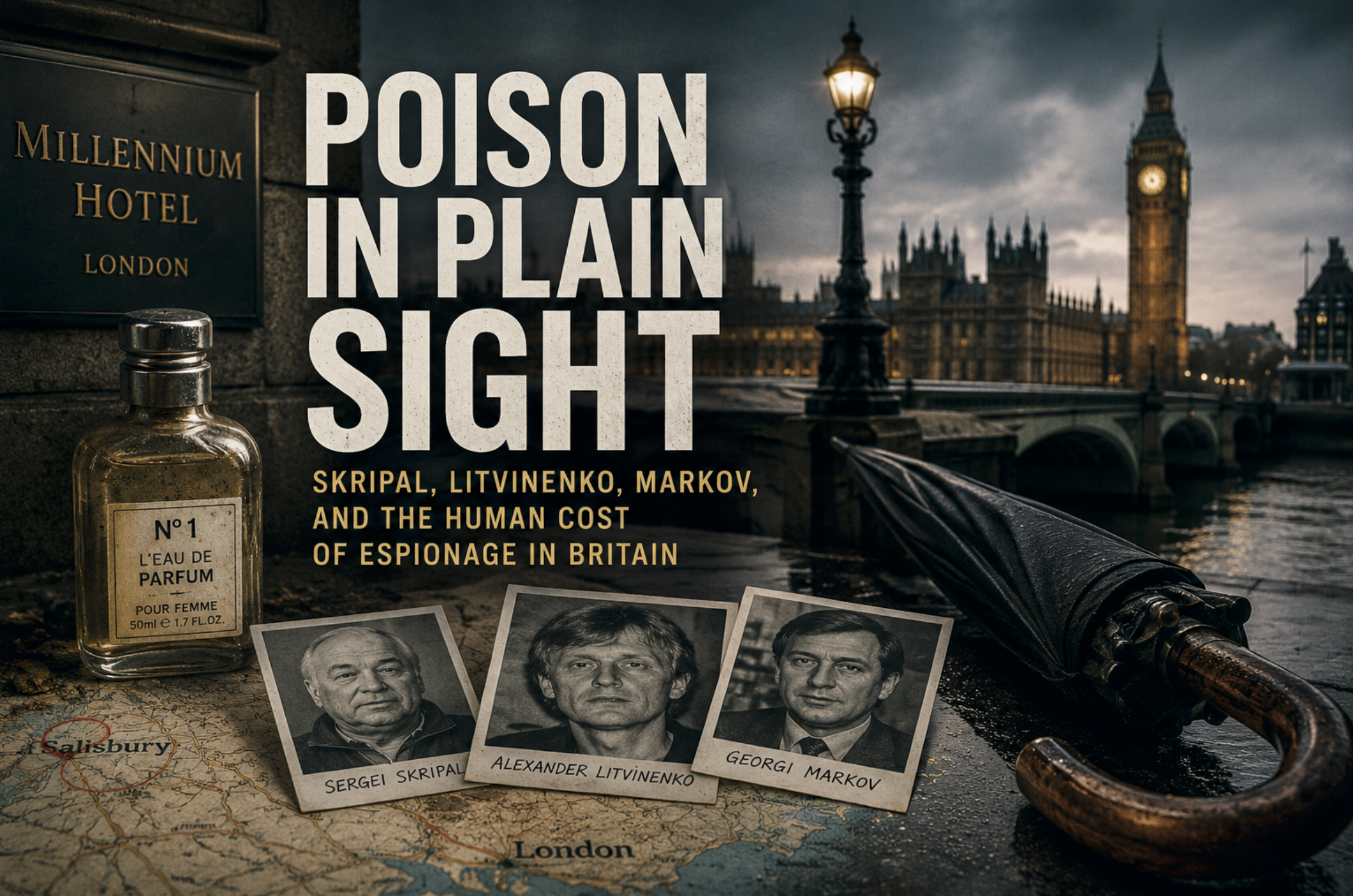
My earlier article, Poison in Plain Sight, placed Skripal alongside Litvinenko and Markov. Here, I want to stay with Salisbury: how investigators followed an operation through a real city, and how its consequences kept reaching outward.
Two men on the railway
The police reconstruction of the suspects’ journeys begins with travel that would have attracted little attention by itself.
Two men using the names Alexander Petrov and Ruslan Boshirov arrived at Gatwick on March 2. They stayed in east London, traveled to Salisbury the following day, and returned on Sunday. Police placed them leaving Salisbury station at 11:48 that morning and walking along Wilton Road ten minutes later.
The released CCTV sequence then follows them through the city and back toward the railway. A street camera preserves a passing moment. Several cameras, combined with other records, can help reconstruct a journey.
The distinction is important. An image shows that a person was in a place. Establishing what that person did—and why—requires more evidence. A convincing account has to connect the observations without making any one of them carry more than it can support.
In 2021, Counter Terrorism Policing identified the men as Alexander Mishkin and Anatoliy Chepiga, members of Russia’s military intelligence service, the GRU. It also identified a third suspect, Denis Sergeev, who had traveled under the name Sergey Fedotov and met the other two in London.
At Salisbury, reading the ground means noticing the relationship between a station, a road, a residential neighborhood, and the center of town. The geography helps explain how people moved. The investigation supplies the evidence of what those movements meant.
A chemical identification is not an attribution
The scientific work answered another part of the problem.
In April 2018, laboratories working for the Organisation for the Prohibition of Chemical Weapons confirmed the United Kingdom’s identification of the toxic chemical used in Salisbury. The organization explained that its technical team worked independently of Britain’s national investigation.
That separation deserves attention. Identifying a substance, establishing how it reached a victim, identifying the people who deployed it, and determining who authorized the operation are different questions. Each needs its own evidentiary support.
After a career spent mostly in intelligence analysis, I find this one of the most useful things to carry into a historical site. Ask which question a piece of evidence answers. Then ask which questions remain.
It makes a story clearer. It also protects us from confusing a strong conclusion with an explanation in which every detail is known.
Dawn Sturgess belongs at the center
On June 30, 2018, in Amesbury, Charlie Rowley gave his partner, Dawn Sturgess, what they believed was perfume. She applied it to her wrists. The bottle contained Novichok. Dawn, a 44-year-old mother of three, died on July 8.
The Dawn Sturgess Inquiry’s final report concluded that the attackers had brought the bottle to Salisbury and discarded it in a public or semi-public place. Exactly when and where Charlie acquired it remains unknown.
Those uncertainties should stay visible. There is no need to invent a scene of someone dropping a bottle into a particular bin, or someone else finding it there, to understand the consequence.
A familiar object concealed a lethal substance. Two people handled it believing it was something else.
Dawn’s death also changes the timeline. An account that ends with the suspects leaving Britain on March 4 stops before the full consequences have unfolded. Investigators had to connect an emergency in Amesbury months later to the earlier attack in Salisbury.
She had no role in the intelligence contest. Her place in this account comes from what happened to her, and from the responsibility of explaining how it happened.
The city had to recover, too
An investigation can identify a route through a city. Recovering the city is a different task.
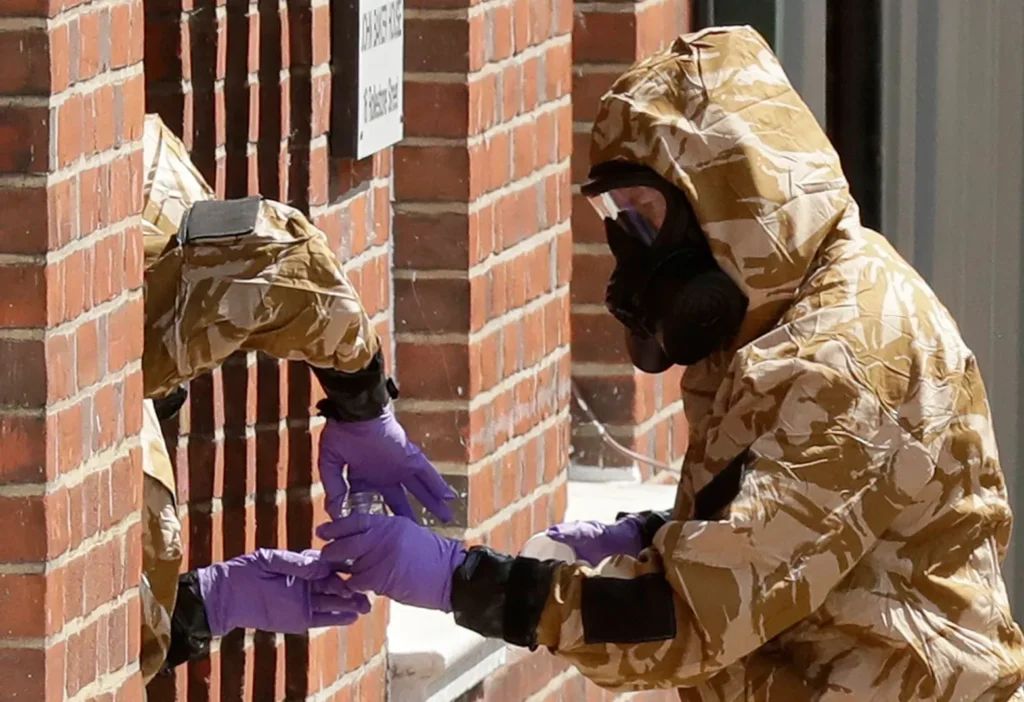
The Maltings decontamination update records specialist teams removing items that might retain contamination before handing the site back to Wiltshire Council in May 2018. Reopening a familiar public space required work most visitors would never ordinarily see.
The wider cleanup continued much longer. On March 1, 2019, the government announced that the final Salisbury site had been declared safe after extensive cleaning and testing. That site was at Christie Miller Road, where the attack had begun.
A cordon is easy to photograph. The work required to remove it is less visible: testing, decisions about what can remain, coordination among agencies, and the responsibility of telling residents that a place is ready to use again.
For a business, a resident, or someone returning to a familiar street, recovery also means regaining confidence in ordinary routines. The destination that outsiders associate with a headline remains the place where other people live.
What the inquiry established
Lord Hughes’s December 2025 report found that GRU officers applied Novichok to Skripal’s front-door handle. He concluded that President Vladimir Putin had authorized the assassination attempt and that those responsible for the operation were morally responsible for Dawn’s death.
These are the inquiry’s findings. They should be presented as such, with the underlying record available to readers. An inquiry finding and a criminal conviction are different forms of accountability.
Nor does identifying responsibility remove the need to examine the individual decisions along the way. The choice of weapon, its placement, and the abandonment of the bottle each belong in an account of how danger reached people beyond the intended victim.
Return to Salisbury as a city
Visitors rightly come to Salisbury for its cathedral. Britain’s tallest cathedral spire and one of four surviving original Magna Carta documents belong to a history far longer than the events of 2018.
A thoughtful visit should make room for both.
The cathedral, the shops, and the streets are not scenery arranged around an intelligence case. They are parts of a living city whose history includes that case. Understanding what happened does not require turning a private home into an attraction or treating a place of suffering as a photographic trophy.
Look instead at the ordinary connections: how a railway brings visitors into town, how residential streets connect to public places, how people move among shops, restaurants, and the river. Then consider how much work was required to investigate and repair the damage done along those connections.
The London series has followed institutions through Bletchley Park’s codebreaking community and Cambridge’s networks of trust. Salisbury asks us to widen our attention to the people outside those institutions.
That is why it belongs in our planned War Rooms & Walk-Ins journey through Britain’s intelligence history. The purpose is to understand the choices, the evidence, and the consequences in the places where they came together.
At The Maltings, the most useful question reaches beyond what happened to a former intelligence officer.
How do you reconstruct what happened—and help a city resume its life—when an operation has left danger behind?