Reading the Ground—London, Chapter 4
On October 30, 1942, three men from HMS Petard boarded a sinking German submarine in the Mediterranean. Lieutenant Anthony Fasson, Able Seaman Colin Grazier and canteen assistant Tommy Brown recovered cryptographic documents from U-559. Brown survived. Fasson and Grazier went down with the submarine.
Those documents helped Bletchley Park read German U-boat messages again after a long interruption. Author Phil Shanahan drew on surviving crew members’ accounts to tell the story of the recovery and its human cost.
Keep those three men in mind when you visit Bletchley Park. They belong in its story as surely as Alan Turing and the famous machines.
So do the radio operators who caught the messages, the women who ran the equipment, and the engineers who built codebreaking machines in Ohio. Once they had done their work, commanders faced another problem: how could they use what they knew without giving away the secret?
In Chapter 3, beneath Whitehall, we followed intelligence into the rooms where leaders made decisions. At Bletchley, we follow it back to the people who made those decisions possible.
Cracking Enigma was a daily job
The story starts in Poland. In 1932, mathematician Marian Rejewski began breaking into Germany’s military Enigma system. He and his colleagues developed methods that Poland shared with Britain and France in 1939. The NSA’s history of Rejewski makes clear how much later Allied success owed to that Polish work.
Bletchley inherited a remarkable start. It also inherited a problem that kept changing.
German services used different Enigma networks and settings. Reading one group of messages did not unlock them all. Operators changed settings and procedures. Yesterday’s breakthrough might do little for today’s traffic.
The Turing-Welchman Bombe helped codebreakers search for the right settings. Turing developed the central approach. Gordon Welchman improved it with his diagonal board. The British Tabulating Machine Company engineered and built the machines.
People still had to give the Bombe a useful problem, check its results and make sense of the messages. Before they could begin, listeners at the Y Service’s intercept stations had to catch the transmissions. Afterward, translators and analysts had to work out what the Germans were saying—and why it mattered.
As you move through Bletchley, ask who handled the message next. That simple question connects the rooms, the machines and the people.
Beyond Enigma: a machine no one had seen
Enigma occupied only part of Bletchley’s effort. German high-level headquarters also sent teleprinter messages protected by the Lorenz cipher system. The British called this traffic Tunny.
Bill Tutte worked out the logic of the Lorenz machine without ever seeing one. He built on messages that John Tiltman had recovered through cryptanalysis. Think about the leap that required: Tutte had to infer how an unseen machine worked from the traces it left in messages.
Two teams pushed the work forward. The Testery brought together codebreakers and linguists. The Newmanry, under Max Newman, developed ways to make machines do more of the searching. The National Museum of Computing traces how those efforts fitted together.
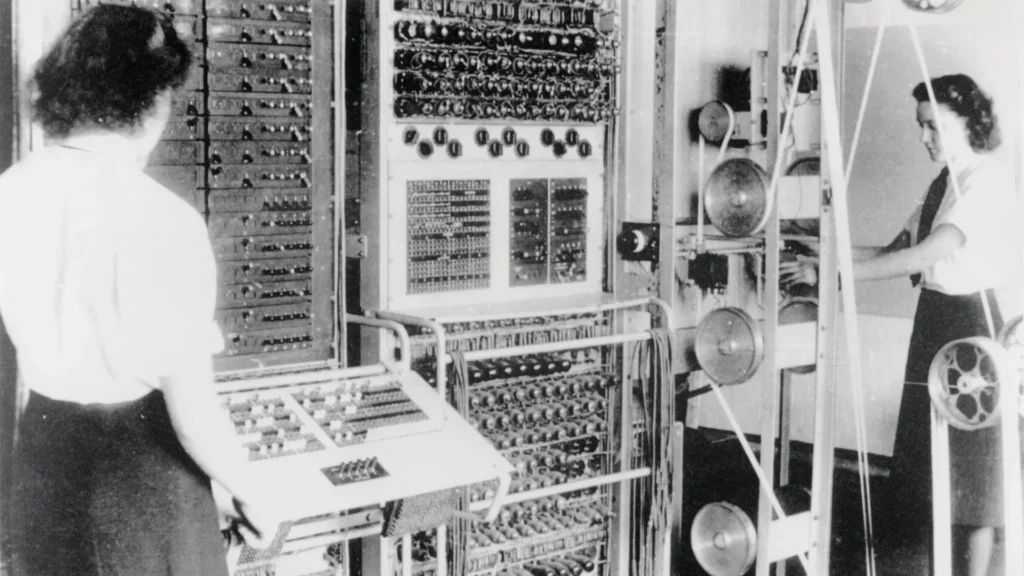
Tommy Flowers and his colleagues at the Post Office Research Station supplied the engineering for Colossus. The first Colossus began work at Bletchley in early 1944. This early programmable electronic digital computer sped up part of the search for Lorenz settings. The Bombe tackled Enigma; Colossus helped tackle Lorenz.
Speed mattered because the Germans were already acting on their orders. Ships were moving. A message that arrived too late might explain a disaster without helping anyone prevent it.
Look at the people beside the machines
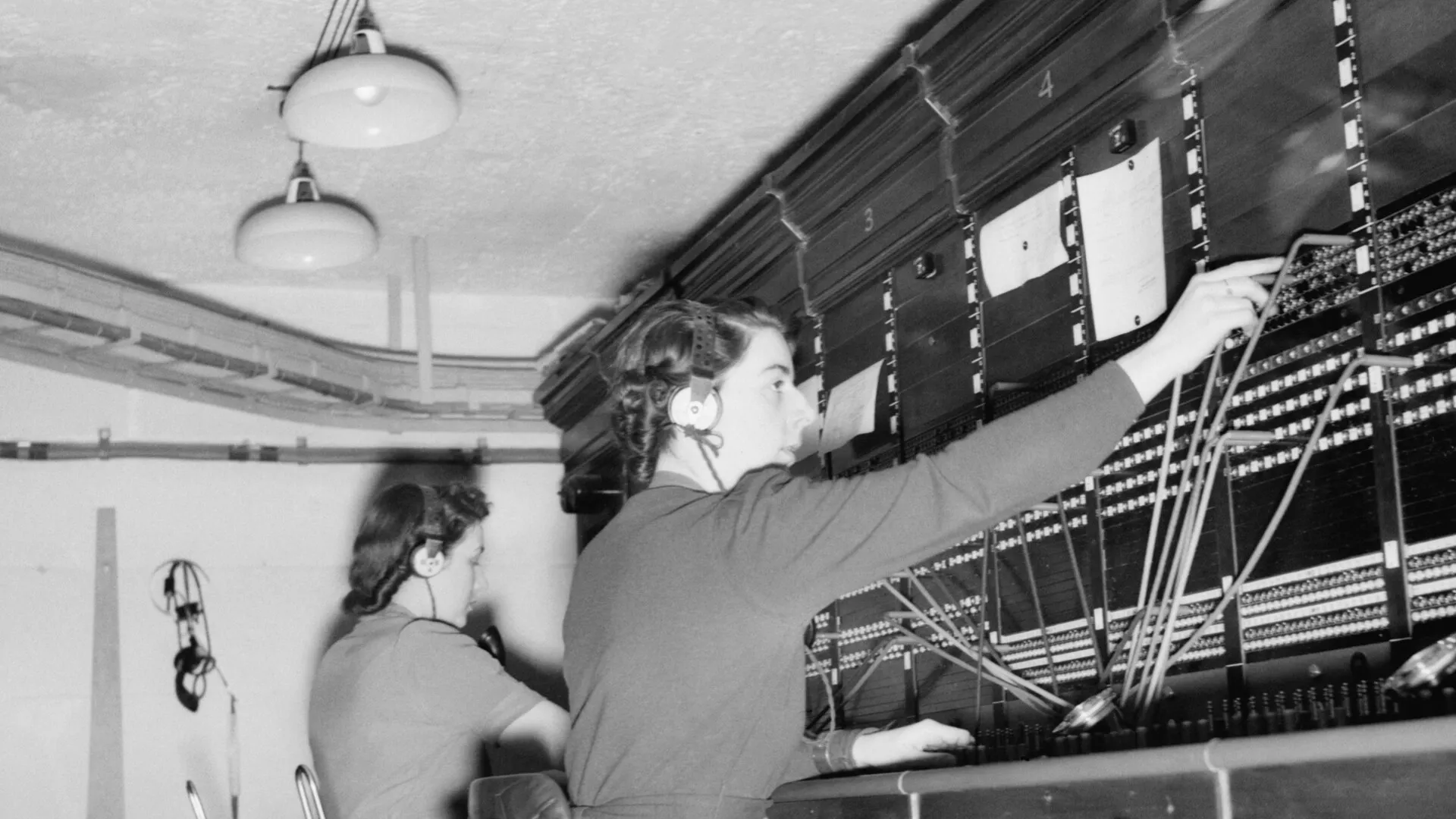
The photograph above shows two women operating Colossus. Give them as much attention as the equipment.
Members of the Women’s Royal Naval Service—the Wrens—also kept the Bombe operation running. By the end of the war, more than 1,600 Wrens worked in that operation. Their trained, careful work turned the designers’ ideas into something the Allies could use every day.
Women made breakthroughs, too. In Hut 8, Joan Clarke used Banburismus, a statistical method that narrowed the search for naval Enigma settings. That saved precious Bombe time and left the machines free to tackle other problems.
Bletchley also worked on messages from beyond Europe. Betty Webb’s service on Japanese messages offers one glimpse of the work that the familiar Enigma story can crowd out.
It is easy to admire these people now that we know what they achieved. Their daily work demanded something harder: accuracy through repetition, patience when answers would not come, and silence about tasks they could not explain at home.
That silence did not feel the same to everyone. People could take pride in their work and enjoy friendships while keeping its purpose secret. But secrecy could also cut them off from a familiar comfort: telling someone they loved why the day had been difficult.
America’s part ran through Dayton
To follow the American contribution, start at the National Cash Register Company in Dayton, Ohio.
There, Joseph Desch led the engineering team that developed the U.S. Navy’s four-rotor Bombes. British codebreakers had regained access to four-rotor naval Enigma in December 1942. The Americans added machines that could attack the problem faster and in greater numbers. The NSA’s account of Desch describes the pressure he faced to make them work reliably.
Desch needed a workforce as well as a design. Civilian employees, sailors and hundreds of WAVES—the U.S. Naval Reserve’s women’s branch—worked at Dayton. Many knew little about the purpose of what they were building. His daughter Deborah Anderson tells their part in her documented history of the project.
Turing visited the American program himself. His 1942 Dayton report, reproduced from U.S. archival records, shows him working through practical questions about machinery and production.
Sharing an enemy did not make cooperation effortless. British and American officials argued over designs, responsibilities and how much information to share. A U.S. Navy memorandum from April 1944 records those disagreements. It also describes production machines leaving Dayton for Washington in September 1943 and their round-the-clock work there.
Read that memorandum with care: its American authors were defending their own decisions. Even so, it shows how much work the alliance took behind the scenes.
The Americans contributed engineering, factories, personnel and codebreaking expertise. The two countries built separate wartime arrangements involving the U.S. Army and Navy, then carried the relationship into the postwar UKUSA agreement. The NSA’s release of those agreements follows that development.
For an American visitor, Dayton and Washington belong alongside Bletchley on the map. The partnership depended on people learning to trust one another enough to share—and then doing the practical work that made sharing useful.
How do you save lives without losing the secret?
Reading an enemy message created an opportunity. Acting on it could create a new danger.
If the Germans noticed that the Allies knew too much, they could change how they protected their communications. The Allies might lose the ability to read messages that could warn of the next attack.
That continuing ability to read the enemy’s messages is what intelligence officers mean here by access. People risked their lives to gain it. Others now had to decide how to use it.
Commanders looked for ways to act without revealing where their knowledge came from. Harry Hinsley, a Bletchley veteran and the official historian of British wartime intelligence, described some of them in his lecture at the U.S. Air Force Academy. In the Mediterranean, the Allies could send an aircraft or vessel to sight Axis shipping before an attack. That gave the enemy a plausible explanation for how the Allies had found the target. In the Atlantic, commanders could steer convoys away from U-boats, though repeated successful evasions could also raise German suspicions.
Those precautions helped. They could not make every choice safe or clear.
The moral difficulty is easy to see. People in danger now need help now. Preserving access might save other people next week, but no one can name all of them or promise how events will unfold. Their uncertainty does not make their lives worth less. Nor does the prospect of saving them automatically justify a loss today.
We should ask hard questions of anyone making that choice. How good was the information? Could they protect the people at risk without exposing the source? What would they really lose if the enemy changed its system?
Those are questions we bring to the history, not dialogue from a particular wartime meeting. They help us think about the responsibility without pretending we know exactly what someone should have done.
And remember who held that responsibility. Bletchley’s staff produced and interpreted intelligence. Military commanders and senior leaders decided how to use it. A scene of a few codebreakers choosing which ship to save makes gripping drama, but it gives them powers they did not have.
What Coventry does—and does not—tell us
You may have heard that Churchill let the Germans bomb Coventry to keep Enigma secret. The evidence does not support that story.
GCHQ’s account of the November 1940 raid describes conflicting clues and officials who expected London might be the target. They identified Coventry that afternoon. British forces tried to defend it, but those efforts failed to prevent the devastation.
That leaves a difficult history of uncertainty and failure. It does not establish a deliberate decision to sacrifice a city.
The distinction matters to the families who lost people, and to any fair judgment of the people in command. Before we ask why someone failed to act, we need to know what they knew, when they knew it and what they could actually do.
Going home with a secret
When the war ended, many of Bletchley’s people returned to ordinary life without being able to explain what they had done.
In 2025, GCHQ released wartime letters about leave and the end of employment. One template told staff that “there is no further work for you to do in this organisation.” Their duty to keep secrets continued. Some never told their stories.
Years of work could end with an administrative letter. A family might know that someone had served, yet never learn how much that service had mattered.
Turing’s experience raises another painful question about what a country owes the people who serve it. In 1952, Britain convicted him for homosexual activity. He underwent hormone treatment and lost his security clearance. The government’s account of his 2013 pardon acknowledges the injustice.
His wartime achievements make that treatment especially bitter. But he did not need to help win a war to deserve fair treatment. He deserved it because he was a person.
A visit to Bletchley should leave room for that history, too: the victories people helped secure, the sacrifices they made and the ways their country later treated them.
Visiting with the whole story in mind
Give yourself time at Bletchley. Look at the machines, then follow the people who fed them information, checked their answers and carried the results onward. Keep the wider map in mind: Poland, the listening stations, the Atlantic, Dayton, Washington and Whitehall.
If you want to see working reconstructions of the Bombe and Colossus, plan for the National Museum of Computing on the Bletchley Park estate. It runs independently, with its own admission and opening schedule. Check its visitor information separately before trying to fit both museums into your day.
This is what makes exploring Britain’s intelligence history through its places so rewarding. An ordinary room can bring you closer to the work—and to the people who did it.
Tradecraft Travel’s War Rooms & Walk-Ins journey, September 4–9, 2027, includes a planned full day at Bletchley Park as part of a wider exploration of London and British intelligence history. See the journey page for the current itinerary and participation details.
Before you leave, look once more at the people beside the machines. They made the breakthroughs useful. They kept the work going. And long after the war ended, many still carried its secrets.