
Reading the Ground — London · Chapter 1
Walk off Caxton Street in Westminster and the city seems to fold inward.
The traffic recedes. A tree-lined courtyard opens between two red-brick wings. At the far end stands St. Ermin’s Hotel, theatrical without being showy: stone-trimmed windows, Dutch gables, an entrance canopy, and a façade that seems designed to hold attention without revealing everything behind it.
I took the photograph above during a stay at St. Ermin’s in 2016. At night, the courtyard became a corridor of warm light framed by dark brick and winter trees. The setting invites the usual language of espionage fiction, but its significance does not depend on atmosphere. The documented history is more revealing than the stagecraft.
To understand St. Ermin’s Hotel spy history, begin not with its legends but with its position in Westminster.
St. Ermin’s did not become important because it looked like a spy setting. It became useful because of where it stood, how it was arranged, and what surrounded it. Parliament, Whitehall, government departments, military offices, and the headquarters of the Secret Intelligence Service were all close at hand. In the late 1930s and during the Second World War, that geography made an operating hotel part of Britain’s secret machinery.
Before the spies, a building made for arrivals
The building began as St. Ermin’s Mansions, not a hotel. Historic England’s official listing dates it to 1887–89, credits the design to E. T. Hall, and describes a six-storey, U-shaped red-brick building arranged around an entrance court. It was converted into a hotel by 1899. The hotel’s own history credits theatre designer J. P. Briggs with reshaping its public rooms through sweeping staircases, balconies, and elaborate plasterwork.
That architecture matters to the later intelligence story.
A hotel offered what an ordinary government office could not: a steady flow of people, private rooms, several ways to arrive and leave, and no obvious reason for two strangers to meet. It provided anonymity through normality. A visitor carrying papers through a lobby did not automatically look out of place. A conversation behind a closed door did not require a sign on the building.
St. Ermin’s was also positioned inside what is now best understood as a wider intelligence neighborhood. The Secret Intelligence Service—SIS, commonly known as MI6—operated from 54 Broadway nearby. Other wartime offices were scattered through Westminster. The buildings were not isolated landmarks; together they formed a working landscape of cabinet government, military planning, secret intelligence, communications, and covert action.
The hotel sat inside that landscape rather than outside it.
Section D and the problem Britain had not solved
By March 1938, SIS Section D was using St. Ermin’s as a headquarters. Section D had been created to think about activities that went beyond the collection of foreign intelligence: sabotage, subversion, propaganda, and irregular action that might weaken an enemy from within.
Those questions became urgent in 1940.
German forces swept through Western Europe. Britain faced the possibility that conventional military power alone would not be enough to carry the fight back into occupied countries. The government needed a way to support resistance, disrupt transport and industry, spread political warfare, and prepare agents for work behind enemy lines.
The answer was not simply to enlarge MI6. Secret intelligence collection and covert action can support one another, but they are not the same task. An intelligence service may spend years protecting access to a source; a sabotage organization may need to destroy the railway that source watches. The same person, place, or communications channel can be an asset to one mission and a target in another.
In July 1940, the government combined three existing organizations: SIS Section D, the War Office’s MI R, and the propaganda specialists of the Foreign Office’s Electra House. The organization that emerged was the Special Operations Executive. Its mandate, as summarized in a British Army history of SOE, was to coordinate subversion and sabotage against the enemy overseas.
The National Archives describes SOE as the wartime organization created to promote sabotage and subversion and to assist resistance groups in enemy-occupied territory. Its surviving records now occupy an entire archival department, HS—a reminder of how large and varied the organization became.
St. Ermin’s belongs to the beginning of that institutional story. Section D worked there. SOE recruiters used rooms there. SIS maintained wartime offices there because Broadway was so close.
The hotel was not the headquarters of every British secret organization, nor did all of SOE remain there throughout the war. SOE soon became associated with Baker Street and expanded across offices, training schools, workshops, airfields, and overseas stations. But St. Ermin’s was one of the places where the personnel, problems, and predecessor organizations of Britain’s irregular war came together.
A hotel room as a threshold
For some recruits, St. Ermin’s was the point where an ordinary appointment became something else entirely.
The British Army account describes candidates being interviewed in sparse hotel rooms: a table, two chairs, an exposed lightbulb. Some believed they had arrived to discuss routine employment or war pensions. The real question was whether they were willing and suited to work behind enemy lines.
The contrast is revealing. Downstairs, St. Ermin’s remained a functioning hotel. Upstairs, a conversation could redirect a life toward clandestine training, occupied Europe, forged identities, wireless schedules, resistance networks, capture, or death.
SOE recruited people whose language, experience, temperament, and social position could help them operate in particular environments. Women served in essential roles, including as agents sent into occupied territory. Foreign nationals and displaced Europeans brought knowledge that no conventional British unit could reproduce. Some recruits fit the traditional establishment; many did not.
The hotel room was therefore more than a convenient interview site. It was a threshold between public life and clandestine service.
That human dimension matters more than the gadgets that often dominate popular spy history. Concealed tools, secret inks, escape maps, and compact radios were ingenious, but equipment did not accept the risk. People did.
Today, the hotel displays SOE-related objects, including wartime field equipment and an escape-and-evasion silk. Those artifacts are worth seeing. Their real value, however, is the question they prompt: who carried such an object, under what cover, and what would have happened if it had been found?
SIS was here too—but precision matters
St. Ermin’s connection to SIS is well supported during the war.
Kim Philby later wrote that he was interviewed at the hotel for SIS work in the summer of 1940. A review in the CIA’s journal Studies in Intelligence notes both the recruiting rooms and other wartime MI6 offices at St. Ermin’s, while emphasizing that those offices were given up after the war.
That last point is important because St. Ermin’s has accumulated a thick layer of legend.
The hotel’s own account of its secret history says Guy Burgess is “heavily rumoured” to have met a Soviet contact in the Caxton Bar. That phrasing should be preserved. It is a story associated with the hotel, not a fact that can be stated with the same confidence as wartime recruiting or SIS office use.
The CIA review of a book about St. Ermin’s is unusually direct about the distinction. It confirms the wartime SIS presence but criticizes attempts to stretch the evidence into a continuous postwar history or to attach famous names to the hotel without adequate support.
That does not make St. Ermin’s less interesting. It makes the real history more valuable.
Intelligence history attracts mythology because secrecy leaves gaps and famous names make those gaps tempting to fill. A serious account has to resist that temptation. The task is to distinguish what is documented, what is plausible, what is remembered, and what remains rumor.
The International Spy Museum’s discussion of St. Ermin’s offers a useful way to continue exploring that evidence without turning the building into a stage set.
Why the geography worked
To understand St. Ermin’s, it helps to stop imagining intelligence history as a collection of separate monuments.
The hotel, Broadway, Whitehall, Parliament, St. James’s Park, the Cabinet War Rooms, and a changing network of government offices were close enough to function as one landscape. People could move between overt and secret work without crossing the city. A hotel offered meeting space inside that network without advertising the purpose of the meeting.
Our public London espionage history map makes that density visible. Some locations are museums. Others are working government buildings, private property, approximate historical sites, or exteriors that should be treated with restraint. Seen together, they show why Westminster became such consequential intelligence ground.
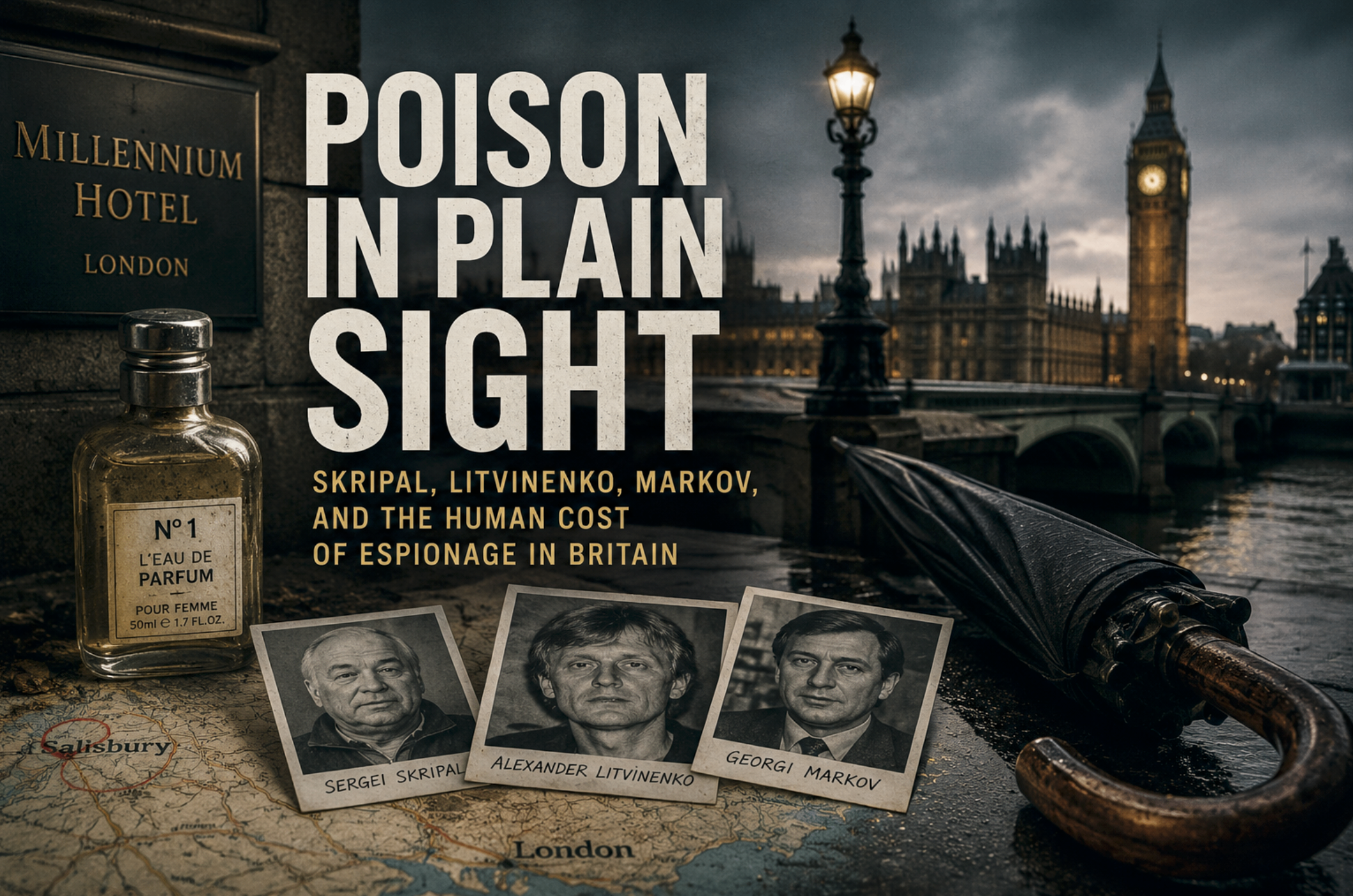
St. Ermin’s also helps explain why British intelligence history extends beyond London. The decisions and organizations concentrated in Westminster depended on work elsewhere: codebreaking at Bletchley Park, recruitment and elite networks associated with Cambridge, training schools across the country, resistance organizations overseas, and later intelligence operations that reached places such as Salisbury.
The hotel is therefore a starting point, not a self-contained story.
What the hotel reveals
St. Ermin’s matters less as a supposed “spy hotel” than as evidence of how intelligence institutions inhabit a city. Secret work does not always announce itself through fortified compounds or conspicuous headquarters. It also uses borrowed offices, commercial buildings, private rooms, railway stations, university corridors, parks, and ordinary streets. Their normal appearance is part of their usefulness.
The hotel’s wartime importance came from a convergence of geography and function. It stood near SIS at Broadway and the departments of Whitehall. Its rooms could accommodate offices, interviews, and meetings without transforming the building into an overtly secret establishment. Its public life provided a kind of cover that a dedicated government building could not.
That makes St. Ermin’s a useful starting point for studying intelligence history through place. The building connects institutional change with human experience: Section D confronting the problem of irregular warfare, recruiters assessing people for clandestine service, SIS officers working within Westminster’s government landscape, and later storytellers trying to separate evidence from legend.
St. Ermin’s is still a functioning hotel. Guests enter for afternoon tea, meetings, dinner, or a night in London. Most pass through the courtyard without needing to know anything about Section D, wartime recruiting, or SOE. The building does not explain itself. History makes the ground legible.
Continue the briefing
This is Chapter 1 of Reading the Ground — London, a historical series tracing the people, institutions, decisions, and places that shaped British intelligence.
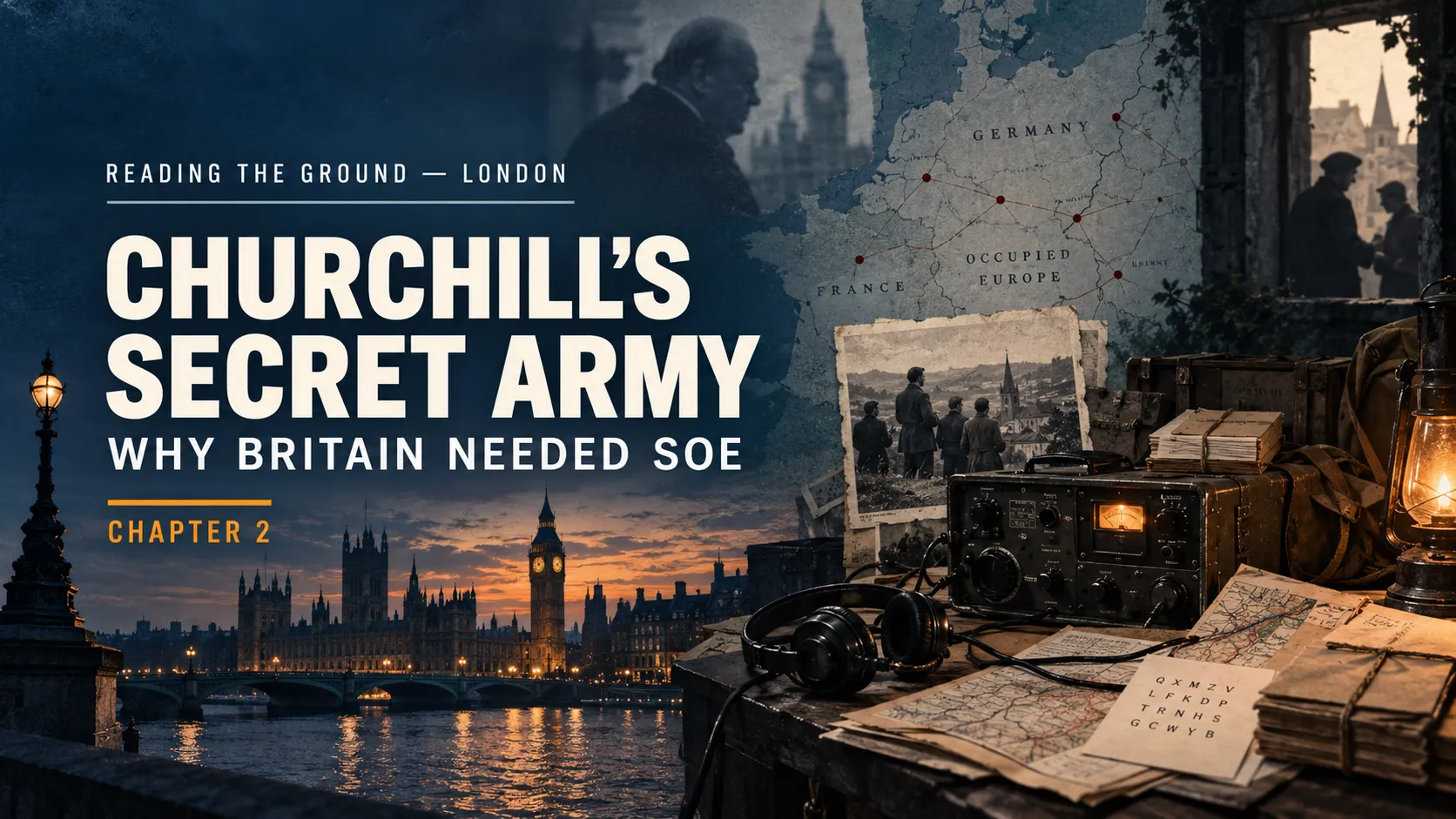
Chapter 2 will examine why Britain created the Special Operations Executive, what distinguished covert action from intelligence collection, and why Churchill believed occupied Europe had to be set ablaze from within.