
Booking a cruise can look deceptively simple.
Choose a destination. Pick a ship. Select a cabin. Enter a credit card number.
But the booking screen does not tell you whether the ship fits the way you like to travel, whether the advertised promotion is actually the best value, whether the cabin sits beneath a nightclub, or whether a more flexible fare would be worth the difference.
It also does not tell you whether a private or unpublished rate might be available through a travel advisor.
That is why good cruise planning begins before the deposit—not after it.
When you book a cruise through Tradecraft Travel, I do more than process the reservation. I help you compare the real options, understand the tradeoffs, choose the right cabin and fare, and manage the decisions that follow from deposit through departure.
Here is what that process actually looks like.
One of the first branches is product type: use the Ocean Cruises hub to compare ship-driven and itinerary-driven ocean products, and the River Cruises hub to compare destination-first river and small-ship approaches.
1. We Start With the Traveler, Not the Promotion
A cruise line’s advertisement usually begins with a price.
My process begins with you.
Before recommending a particular sailing, I want to understand:
- Who is traveling?
- Is this your first cruise?
- Are you traveling as a couple, solo, with friends, or with family?
- Do you want a lively ship or a quieter one?
- How important are dining, entertainment, nightlife, enrichment, pools, or children’s programming?
- Do you care more about the ship or the destinations?
- How much time do you want in port?
- What level of cabin comfort matters?
- What is your realistic total-trip budget?
- How much flexibility do you need if plans change?
These questions help narrow a very large cruise market into a manageable set of choices.
A family traveling during a school break, a couple celebrating an anniversary, a solo traveler looking for community, and a history-focused traveler exploring the Mediterranean may all need completely different ships—even when they are considering the same destination.
Travelers who are still trying to identify the right cruise line can begin with the Tradecraft Travel Cruise Matchmaker. It compares preferences such as dining, atmosphere, formality, ship style, and destination focus.
The broader Tradecraft Travel cruise-planning page also explains how I evaluate ships, cabins, fares, itineraries, and the complete trip rather than relying on the headline price.
2. We Compare the Ship, Itinerary, and Cruise Line
There is no universally “best” cruise line.
There is only the cruise line, ship, and itinerary that best fit a particular traveler and trip.
Two ships sailing from the same port during the same week may offer dramatically different experiences. One may emphasize waterslides, entertainment, and family activities. Another may be quieter and more destination-focused. A third may be adults-only, dining-driven, and intentionally unconventional.
Even ships within the same cruise line can differ by age, size, layout, passenger capacity, dining options, and onboard atmosphere.
The itinerary also deserves more scrutiny than a simple list of ports. I look at:
- How long the ship remains in each destination
- Whether the strongest ports receive enough usable time
- The balance between port days and sea days
- Tender ports versus docked ports
- The embarkation city and whether an early arrival is advisable
- Seasonal weather and sea conditions
- Whether the itinerary repeats similar experiences
- The availability and likely cost of worthwhile excursions
- Whether a pre- or post-cruise stay would improve the trip
The right cruise is therefore not always the one with the most ports or the newest ship. It is the one whose overall rhythm matches what you want from the vacation.
First-time cruisers may also find my guide, Cruising for the First Time: What New Cruisers Should Know Before They Book, useful before comparing individual sailings.
3. I Review the Public Fare—and Look Beyond It
Once we identify a promising sailing, I examine the fare being offered.
That includes more than the advertised percentage discount. Cruise promotions often combine several elements:
- A reduced base fare
- Onboard credit
- Included drinks or dining
- Wi-Fi
- Gratuities or service charges
- Excursion credits
- Reduced deposits
- Discounts for additional guests
- Military, resident, loyalty, or age-based offers
- Group amenities
- Future-cruise certificates
- Nonrefundable or restricted fare conditions
A large discount printed on a website does not automatically mean that the resulting price is unusually good. Cruise lines regularly change the language around promotions while adjusting the underlying fare.
The question is not, “How large is the advertised discount?”
The question is, “What am I actually receiving, what restrictions apply, and what will the complete trip cost?”
The “covert rate” check
Travel advisors sometimes have access to private, unpublished, advisor-only, consortium, host-agency, or group fares that do not appear on the cruise line’s public booking page.
These are known as covert rates.
They are not secret in any improper sense. They are legitimate cruise inventory made available through travel-industry distribution channels rather than displayed to the general public.
On the right sailing, a covert rate can be substantially lower than the public fare. In other cases, the fare may be similar but include additional onboard credit or another useful benefit.
These rates are not available on every cruise. They may apply only to certain cabin categories, dates, or amounts of remaining inventory. They may also have different deposit, cancellation, or amenity terms.
That is precisely why it is worth checking before you book.
The most useful thing you can do is send me the sailing details before placing a deposit. Include the cruise line, ship, date, cabin category, current price, and promotion you are seeing. I can then compare the public offer with any advisor-access options that may be available.
4. We Select the Fare Type, Not Just the Fare Amount
Many cruise lines now offer multiple fare levels for the same cabin.
The least expensive option may have stricter cancellation rules, reduced flexibility, fewer inclusions, or limitations on cabin selection. A higher fare may include drinks, dining, Wi-Fi, gratuities, or more favorable change provisions.
The lowest fare may be entirely appropriate when your plans are firm and you understand the restrictions. But saving a small amount can be a poor trade if it leaves you with a nonrefundable deposit or removes benefits you were likely to purchase separately.
I review:
- Deposit requirements
- Refundability
- Cancellation penalties
- Change fees
- Repricing rights
- Included amenities
- Loyalty benefits
- Promotion-combination rules
- Final-payment timing
The goal is not automatically to select the cheapest or most inclusive fare. It is to choose the fare whose cost and rules fit your circumstances.
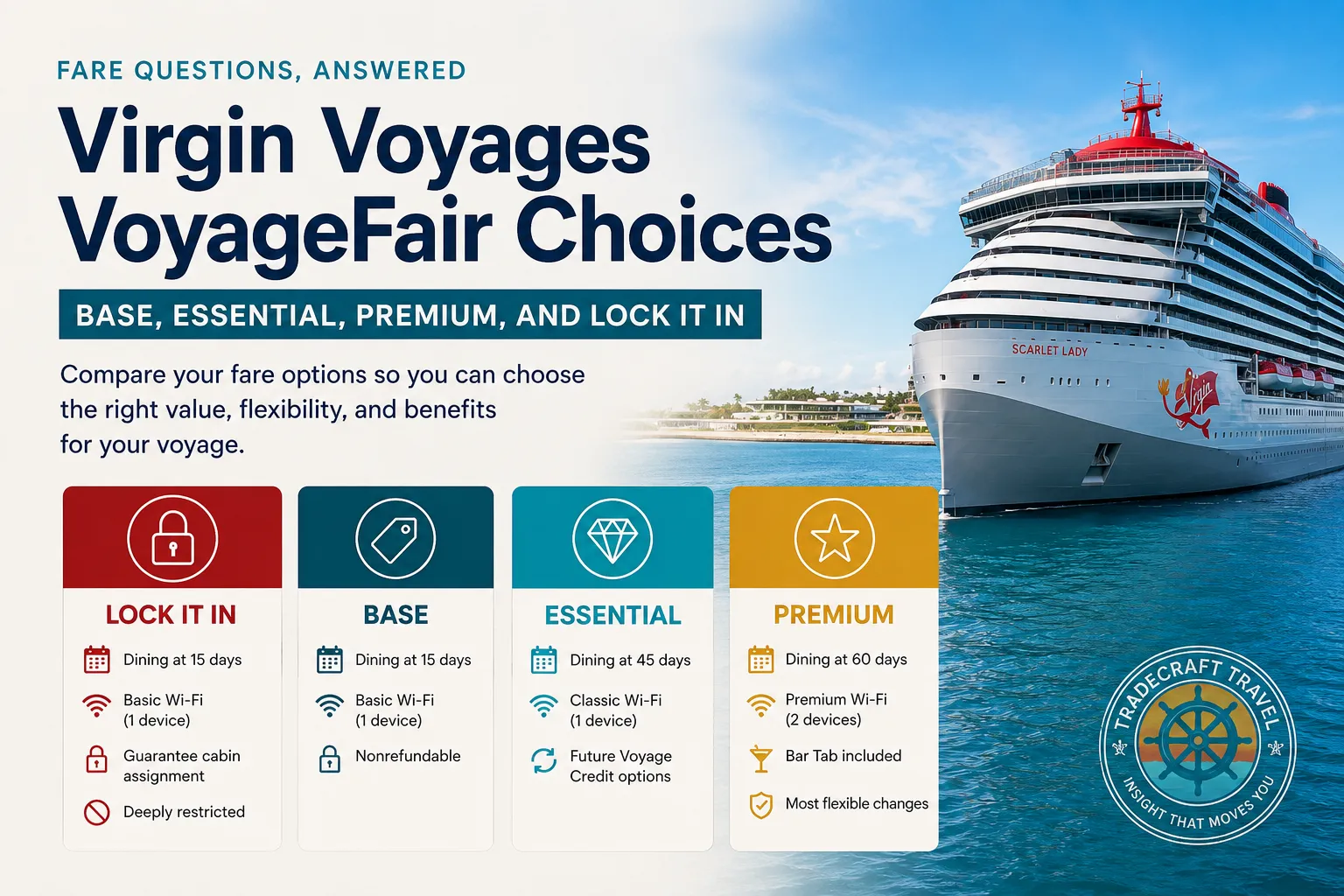
This is particularly important with distinctive cruise lines such as Virgin Voyages, where fare choices and onboard inclusions differ from more traditional cruise products. My independent Virgin Voyages briefing explains the line’s traveler fit, fare options, cabins, strengths, and tradeoffs.
5. We Choose the Specific Cabin
A cabin category is not the same thing as a cabin.
Two balcony cabins with the same general description may be located on different decks, near different public spaces, or in sections of the ship with very different noise and motion patterns.
When reviewing a cabin, I consider:
- Forward, midship, or aft location
- Deck height
- Proximity to elevators
- Nearby restaurants, theaters, pools, clubs, or crew areas
- Connecting doors
- Obstructed views
- Balcony size and configuration
- Bed arrangement
- Bathroom and storage layout
- Accessible features
- Likely motion
- Walking distance to frequently used areas
- The price difference between nearby categories
Cabin choice is especially important for travelers sensitive to motion or noise, travelers with mobility needs, families requiring adjacent rooms, and anyone considering a major category upgrade.
Sometimes the least expensive cabin is a sound decision. Sometimes a modest increase produces a substantially better location or experience. Sometimes an expensive upgrade adds little practical value.
My role is to help distinguish among those situations.
6. You Authorize the Deposit
Once we have agreed on the sailing, fare, and cabin, I prepare or confirm the reservation and provide the applicable booking terms.
The cruise line—not Tradecraft Travel—generally charges your card directly for the deposit and subsequent cruise payments. Your funds go to the supplier rather than being held by my business.
Before authorizing the deposit, you should understand:
- The total cruise price
- What is and is not included
- The deposit amount
- Whether the deposit is refundable
- The cancellation schedule
- The final-payment date
- The fare restrictions
- The selected cabin
- The names and dates of birth attached to the booking
- Any promotion or amenities being applied
After the deposit is processed, you receive a booking confirmation and reservation number.
That confirmation should be reviewed promptly. Names must match travel documents, and errors become more difficult to correct as departure approaches.
For many standard cruise bookings, the cruise line pays the advisor’s commission and using an advisor does not increase the cruise fare. More complex custom planning, extensive air work, or itinerary development may involve a separate professional fee, which will be disclosed before the work begins.
7. We Discuss Travel Insurance Early
Travel insurance should be considered soon after the first trip payment—not as an afterthought shortly before departure.
Some insurance benefits are available only when coverage is purchased within a specified period after the initial deposit. Depending on the policy, timing can affect eligibility for preexisting-condition provisions, supplier-default protection, or certain optional benefits.
Insurance decisions should account for:
- The nonrefundable cost of the trip
- Traveler ages and health considerations
- Medical coverage outside the United States
- Emergency evacuation
- Trip cancellation and interruption
- Travel delays
- Missed connections
- Baggage coverage
- Whether your existing health insurance applies abroad
- Your ability to absorb a financial loss
Insurance does not cover every event or every reason for cancellation. Policies have definitions, exclusions, documentation requirements, and maximum benefits. The correct question is not simply whether insurance is “good.” It is whether a particular policy adequately addresses the risks of this particular trip.
My article Travel Insurance, Chosen Intentionally explains the major coverage levels and how to think about them.
8. I Continue Reviewing the Fare and Reservation
The work does not stop when the deposit is paid.
Cruise pricing and promotions can change between booking and final payment. When permitted by the cruise line and the booking terms, I can review meaningful price changes or new offers to determine whether repricing is possible and whether it would actually improve the reservation.
A lower advertised number does not always produce a better outcome. Repricing can sometimes remove onboard credit, included amenities, a favorable cabin, group benefits, or more flexible terms.
The full reservation must be compared before any change is made.
I also monitor or help manage:
- Payment deadlines
- Missing traveler information
- Cabin or itinerary changes
- Promotion questions
- Loyalty numbers
- Dining or package choices
- Cruise-line communications
- Pre- and post-cruise arrangements
The point is not to create unnecessary activity. It is to make sure important decisions do not disappear into a confirmation email and remain unnoticed until they become urgent.
9. We Build the Trip Around the Cruise
The sailing is often only one part of the journey.
A complete cruise trip may also include:
- Flights
- A pre-cruise hotel
- Airport and port transfers
- Post-cruise lodging
- Rail arrangements
- Private touring
- Travel insurance
- Restaurant reservations
- Accessibility arrangements
- Special celebrations
- International entry requirements
For most cruises involving a flight, I strongly recommend arriving at least one day before embarkation. For international departures, complicated connections, winter travel, or an embarkation city worth exploring, two or more nights may be appropriate.
A same-day flight can appear efficient until weather, maintenance, crew scheduling, or a missed connection puts the entire cruise at risk.
The pre-cruise hotel should also be chosen with embarkation logistics in mind. The cheapest airport hotel may be poorly positioned for the port, while the most famous downtown property may create unnecessary transfer complications.
Good cruise planning connects all these pieces rather than treating the ship reservation as an isolated purchase.
10. We Plan Excursions Deliberately
Shore excursions usually become available months before departure, although the exact timing varies by cruise line.
The cruise line’s excursion menu is a useful starting point, but it is not the only option. Depending on the destination, travelers may prefer:
- A cruise-line excursion
- A vetted independent group tour
- A private guide
- A transfer to a beach or attraction
- A self-guided walking day
- A deliberately unstructured port day
- Staying aboard the ship
Cruise-line excursions provide convenience and certain operational protections, but they can also be larger, more standardized, and more expensive.
Independent excursions may provide smaller groups, specialized experiences, or better value, but transportation, cancellation terms, meeting points, and return-to-ship timing deserve careful review.
Not every port needs an elaborate excursion. Sometimes the strongest plan is a focused walking route, a carefully chosen restaurant, or a slow day near the harbor. The point is to decide intentionally rather than defaulting to either “book everything” or “we will figure it out when we arrive.”
The January 29, 2027 Valiant Lady sailing from San Juan provides a good example. Aruba’s late departure, Bonaire’s marine environment, walkable Willemstad, and the balance between five port calls and two sea days each call for a different planning approach.
11. We Confirm Travel Documents and Entry Requirements
Cruise-document requirements can be more complicated than they first appear.
Some closed-loop cruises departing from and returning to the same U.S. port may permit certain U.S. citizens to travel with documents other than a passport. That does not necessarily make doing so the safest choice.
The U.S. Department of State recommends that cruise passengers carry a passport book, even when it is not strictly required for the itinerary. If you become ill, miss the ship, or need to fly home from a foreign country, a birth certificate or passport card may not be sufficient for air travel.
Before departure, we should confirm:
- Passport validity
- The exact name on the reservation
- Visa or electronic travel-authorization requirements
- Requirements for every port, including ports where you may remain aboard
- Rules for minors traveling without both parents
- Health or vaccination documentation, when applicable
- Cruise-line online check-in
- Emergency contact information
- Boarding passes and luggage tags
Entry rules can change, and responsibility ultimately remains with the traveler. I help identify what needs to be verified and direct clients to authoritative sources rather than relying on social-media reports or old message-board posts.
12. Final Payment Is a Decision Point
The final-payment date is important because cancellation penalties often increase sharply after it.
Before final payment, I review the reservation and confirm:
- The current balance
- The cabin and fare
- Applied payments
- Promotions and amenities
- Traveler names
- Insurance status
- Cancellation terms
- Flights and arrival timing
- Any remaining questions
Final payment may be processed automatically when authorized, or it may require a new payment instruction depending on the supplier and booking arrangement.
After final payment, the emphasis shifts from evaluating the reservation to completing the departure plan.
13. We Prepare for Departure
As the cruise approaches, clients may need to complete online check-in, provide passport information, select arrival times, upload photographs, register a payment card, reserve dining, and download the cruise line’s app.
This stage may also include:
- Final excursion reservations
- Dining selections
- Beverage or Wi-Fi packages
- Specialty dining
- Spa appointments
- Entertainment reservations
- Airport transfers
- Hotel confirmations
- Luggage-tag preparation
- Emergency contact planning
- Reviewing prohibited items
- Understanding embarkation procedures
I provide practical guidance about what deserves advance attention and what can reasonably wait until boarding.
A cruise should not require a military operation to enjoy. But a small amount of preparation prevents avoidable friction.
14. You Have Support When Something Changes
Travel does not always go according to plan.
Flights are delayed. Weather affects ports. Cruise lines modify itineraries. Cabins develop problems. Transfers fail to appear. Travelers become ill. Documentation questions arise.
A travel advisor cannot control the weather, force a supplier to make a particular decision, or guarantee that every disruption will be resolved exactly as a client wishes.
What I can do is help assess the situation, identify the appropriate contact, explain the available options, preserve documentation, and advocate with the supplier when intervention is warranted.
That is substantially easier when I already understand the reservation, the traveler, and the decisions that produced the plan.
During the trip, true emergencies should still be directed first to the cruise line, insurer, emergency-service provider, or local authorities as appropriate. Advisor support complements those channels; it does not replace them.
15. Support Continues After the Cruise
After travel, I remain available to help with issues such as:
- Missing loyalty credit
- Unresolved onboard charges
- Supplier follow-up
- Insurance documentation
- Future-cruise certificates
- Feedback about the ship or itinerary
- Planning the next cruise
Your experience also improves my advice to future clients. A ship can look excellent in supplier materials while functioning differently in practice. Client observations about service, cabin condition, crowd flow, excursions, accessibility, and onboard atmosphere provide useful context.
The relationship should not end when you step off the ship.
What Should You Send Before You Deposit?
You do not need to prepare a formal request.
Send whatever you currently have:
- Cruise line
- Ship
- Sailing date
- Number and ages of travelers
- Cabin category or cabin number
- Public fare or screenshot
- Promotion being advertised
- Loyalty status or future-cruise certificates
- Whether you have already placed a hold or deposit
- What matters most about the trip
I will help determine whether the sailing fits, whether the cabin and fare make sense, and whether a public, group, private, or unpublished advisor-access option could provide better value.
Before You Click “Book”
A cruise reservation is easy to make.
A good cruise decision requires more judgment.
The value of working with a travel advisor is not simply having someone else enter the booking. It is having someone examine the complete decision before your money and expectations are committed—and remain engaged as the trip takes shape.
That can mean finding the right ship instead of the most heavily advertised one.
It can mean avoiding the wrong cabin.
It can mean choosing a fare with better flexibility.
It can mean understanding the real cost before you deposit.
And, at times, it can mean finding a covert rate that is substantially better than the fare available to the public.
Considering a cruise? Send me the sailing details before you deposit. A brief review now can prevent expensive mistakes and produce a much better trip later.
Considering Virgin Voyages? Browse sailings and book directly with Virgin Voyages through Jack’s advisor link. Opens in a new tab.