A practical look at Princess, Royal Caribbean, Virgin Voyages, and Norwegian—and why your itinerary matters as much as your favorite drink.
Supplier information checked September 16, 2026.
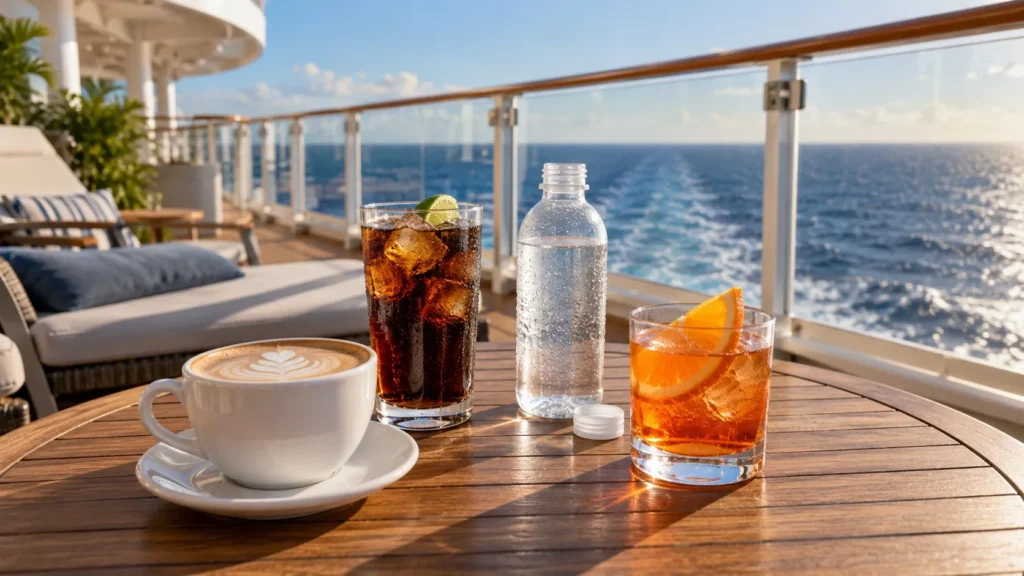
A cappuccino before breakfast. A cold beer by the pool. Sparkling water with lunch. A glass of wine at dinner.
Those purchases can add up on a cruise. So can a beverage package you barely use because you spend most of your vacation exploring ashore.
When I compare the options, I start with a simple question: What would you realistically spend if you bought drinks individually? The answer depends on both people in the cabin, what they like to drink, what is already included, and how they expect to spend their days.
A package can save money. It can also make the budget more predictable. But those are different benefits, and neither requires turning your vacation into a daily effort to get your money’s worth.
As with choosing the right cruise line, the strongest decision starts with how you actually travel.
Start with soda, coffee, and water
“We don’t drink much” does not settle the question. Specialty coffee, soft drinks, mocktails, and bottled water can represent a meaningful part of your spending. Conversely, if you are happy with the beverages already included in your fare, do not assign imaginary savings to upgrades you would never buy.
Keep three distinctions in mind:
- Soda: A fountain drink and a can are not always treated the same way. A package may cover one, discount the other, or apply specific substitution rules.
- Coffee: Ordinary brewed coffee and a barista-made latte are different purchases. Even a package covering specialty coffee may exclude a licensed Starbucks venue.
- Water: Included drinking water, small bottles, large bottles, and premium still or sparkling brands are different categories. You do not need a broad beverage package simply to stay hydrated.
Here is how those distinctions play out across the four lines:
| Cruise line | Sodas | Specialty coffees | Bottled water |
|---|---|---|---|
| Princess | Fountain sodas are covered by Plus, Premier, and the nonalcoholic options. Check canned-soda provisions. | Included in Plus, Premier, and Zero-Alcohol; do not assume the Classic Soda package includes them. | Plus and Premier cover eligible bottles of 500 mL or less, with a 12-bottle daily limit. Larger bottles have separate rules. Zero-Alcohol also includes eligible waters. |
| Royal Caribbean | Classic Soda, Refreshment, and Deluxe cover fountain soda. Freestyle-machine access has an additional detail explained below. | Refreshment and Deluxe include premium coffees and teas, but licensed Starbucks purchases are excluded. | Refreshment and Deluxe include still and sparkling bottled water. Separate water packages are another option. |
| Norwegian | Standard Free at Sea includes fountain soda. A separate soda option is available. | Do not assume the standard open-bar benefit covers your Starbucks order. Separate Starbucks packages and the Free at Sea Plus upgrade address that expense. | Standard Free at Sea excludes bottled water. Water packages and qualifying Free at Sea Plus inclusions are separate choices. |
| Virgin Voyages | Included in the fare. | Drip coffee is included; specialty coffees cost extra and can be paid for with Bar Tab. | Filtered still and sparkling water are included. Premium bottled water is a separate purchase. |
These are different ways of buying beverages. The fine print matters most where the names sound similar.
Princess: compare the whole bundle
On Princess Cruises, distinguish Princess Plus and Princess Premier, the broader bundles, from the beverage packages with similar names.
The Plus and Premier bundles combine drinks with other benefits, including Wi-Fi and Crew Appreciation. If you would already purchase connectivity and pay those gratuities separately, charging the entire bundle price against cocktails gives you a misleading comparison. Value the other benefits at what they are worth to you, then assess the remaining cost.
There is also an important detail in the newer Plus Beverage Package terms. For packages purchased on or after July 22, 2025, for departures on or after January 14, 2026, the 15-beverage allowance runs from 6 a.m. to 6 a.m. and includes alcoholic and qualifying nonalcoholic drinks. Specialty coffees and teas do not count toward it. Eligible small bottled waters also sit outside that allowance, with their own 12-bottle daily limit.
That is different from the older shorthand of “15 alcoholic drinks.” Purchase date and sailing date matter.
Current Premier removes the daily alcoholic-drink cap and raises the covered menu-price ceiling from Plus’s $15 to $20 on USD-priced sailings. It still has terms and exclusions; “unlimited” does not mean every bottle or purchase is included.
For travelers who want coffees, mocktails, and water without alcohol, Princess also offers a Zero-Alcohol package. Compare it with individual purchases and the broader bundles before deciding.
Royal Caribbean: calculate the cabin’s bill
Royal Caribbean offers three main approaches: Classic Soda, Refreshment for a broader range of nonalcoholic drinks, and Deluxe for qualifying alcoholic and nonalcoholic beverages. Its beverage comparison explains the inclusions and venue exclusions.
The critical calculation may involve your companion. Royal’s published policy requires all guests of legal drinking age in the same stateroom to purchase Deluxe when one does. A package that looks attractive for one traveler can become expensive when the second person drinks very little.
Check the actual offer for your sailing and the final checkout total, including applicable gratuities and taxes. A percentage-off banner is not the number you need for the comparison.
Coffee drinkers should also note that licensed Starbucks, room service, and minibar purchases are excluded. And since March 15, 2026, Deluxe and Refreshment no longer automatically include the souvenir cup needed for Coca-Cola Freestyle machines; Royal lists it as a separate $4.99 onboard purchase. Fountain soda remains covered.
For someone mainly interested in coffee and bottled water, start by comparing Refreshment or narrower purchases with paying individually.
Norwegian: an open bar does not cover every beverage
With Norwegian Cruise Line, read the offer attached to your reservation. Package versions and purchase terms have changed, and an older booking may carry different benefits.
The current Free at Sea terms cover a selection of spirits, cocktails, beer, wine by the glass, fountain soda, and juice. They also specify additional package costs. The word “free” should not replace a look at the amount added to your booking.
Standard Free at Sea excludes bottled water and Starbucks, along with other listed premium purchases. Norwegian sells separate Starbucks and water packages, while Free at Sea Plus adds Starbucks, specified bottled waters, and broader benefits.
That makes the upgrade a separate decision. If your main extra purchase is one latte each morning, compare that spending with the upgrade cost. If you also want its connectivity, service-charge, and dining benefits, evaluate those together.
Check premium brands and wines by name, too. A discount on a drink outside the included selection is not the same as having that drink included. Pride of America has a separate Hawaii beverage offering, so do not apply the general comparison to it automatically.
Virgin Voyages: buy the amount you expect to use
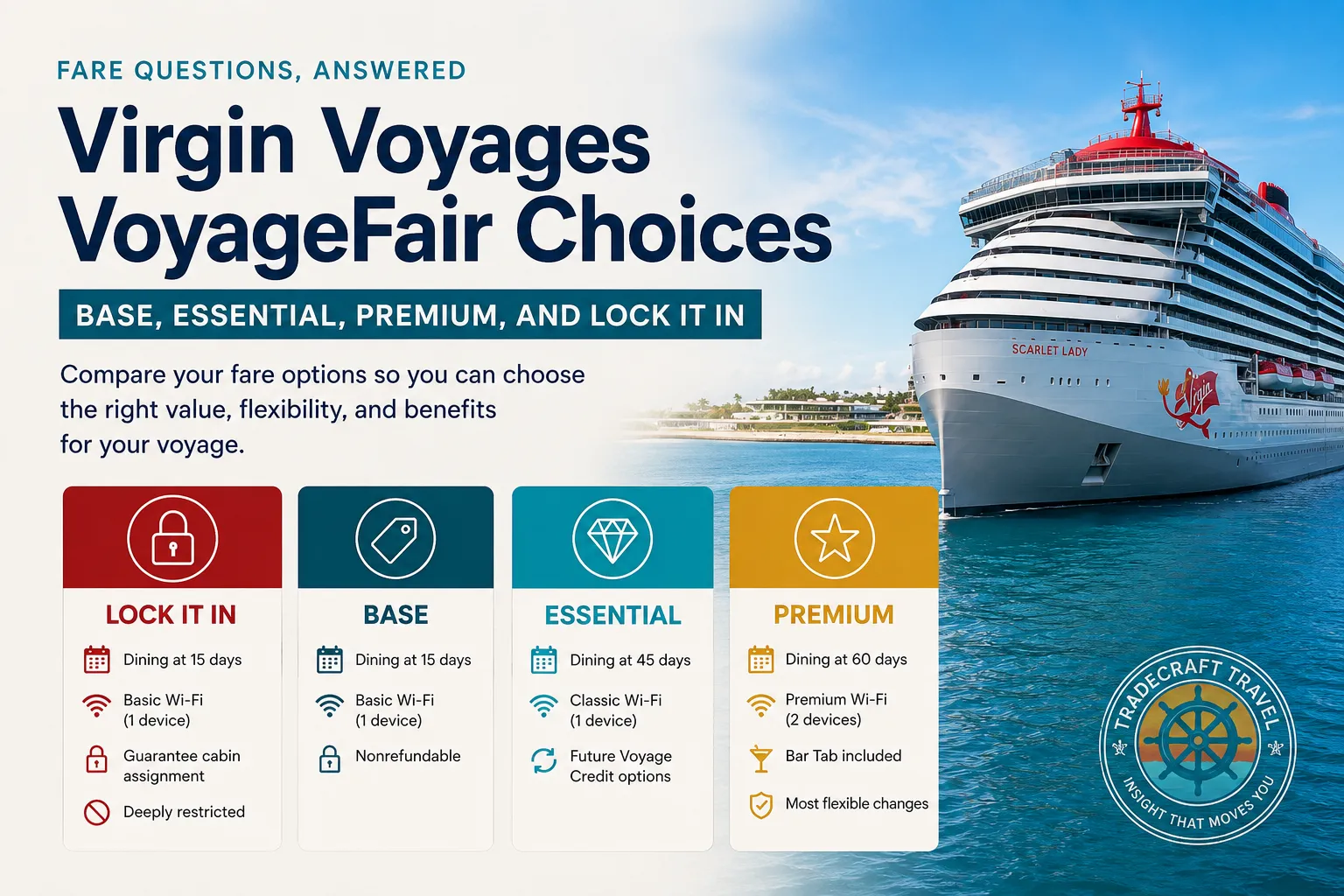
Virgin Voyages uses a different model. Its included essential drinks cover soda, drip coffee, tea, non-pressed juices, and filtered still and sparkling water. Alcohol, specialty coffees, and other premium drinks cost extra.
Virgin’s Bar Tab is prepaid beverage credit, rather than a traditional unlimited package. You can use it to buy drinks for yourself or other people, and both occupants of the cabin do not have to buy one.
The current Bar Tab offer adds $50 to a $300 purchase, for example. If you would otherwise spend $350 on eligible drinks, that produces a $50 saving. If you spend only $220, you have paid $300 for drinks you could have bought for $220. The unused purchased credit and bonus are not refunded at the end of the voyage.
Start with any beverage credit already on your booking, then estimate the additional amount you need. A larger bonus is useful only when your expected spending justifies the larger purchase. Paying individually remains an option.
Sea days and port days deserve different estimates
A sea day might include a morning latte, drinks by the pool, water throughout the afternoon, and wine with dinner. A full day ashore might leave time for coffee before departure and one drink when you return.
If you plan to be among the first passengers off the ship at every stop—and among the last back—you have fewer hours to use an onboard package. Lunch, coffee, and local beer bought ashore are additional expenses, usually outside that package.
Do not multiply your busiest sea-day spending by the length of the cruise. Build separate estimates for days mostly aboard, full days ashore, and shorter port visits. Embarkation day may also look different from a full sea day.
Princess and Royal sell their standard daily beverage packages across the voyage rather than letting you select only your busiest drinking days. Norwegian’s promotional benefit similarly runs across the sailing. Your comparison therefore needs to cover the whole trip.
You may still get good value from coffee before an excursion and drinks after dinner. Just count what you expect to order, not the theoretical maximum available. A daily allowance is a ceiling, not an assignment.
Does the package work on a private island?
A cruise-line beach day can be an exception to the usual port-day calculation. Several programs extend ashore, but the destination and package must match.
| Line and destination | What applies |
|---|---|
| Princess — Princess Cays | Princess Plus and Premier beverage benefits extend to Princess Cays. Included choices remain subject to the package and what is available ashore. |
| Royal Caribbean — Perfect Day at CocoCay and Labadee | Royal’s onboard beverage packages are honored at these destinations, during normal service hours and within the package’s coverage. This describes the beverage policy, not a guarantee that a destination appears on your itinerary. |
| Royal Caribbean — Royal Beach Club Paradise Island | This is different from CocoCay. A separate day pass is required, and its selected drink option determines what is included. An onboard package alone is not admission or a substitute for that pass. |
| Norwegian — Great Stirrup Cay | Norwegian’s current official guidance says Free at Sea’s open-bar benefit applies across the island. Use the current terms rather than older reports about proposed changes. |
| Norwegian — Harvest Caye | The standard Free at Sea beverage benefit does not apply at Harvest Caye’s bars, restaurants, or venues. Budget for purchases there separately. |
| Virgin Voyages — The Beach Club at Bimini | Bar Tab can be spent at Virgin’s Beach Club. That does not make it valid at unrelated bars and restaurants elsewhere on Bimini. |
Count covered purchases during these beach visits in your estimate. Do not assume that every private destination, beach club, or shore excursion follows the same rule—or offers the ship’s complete beverage menu.
Three ways the numbers can lead to different answers
Use the total price for every traveler required to participate, including applicable service charges and taxes. Compare it with the cost of the eligible drinks those travelers would otherwise buy. Account for existing beverage credits, loyalty benefits, and any other included drinks before paying for overlapping coverage.
These examples are illustrative calculations, not cruise-line quotes.
1. Light drinkers on a busy itinerary. Suppose a couple faces a beverage-only package costing $60 per person per charged day, including service charges. Seven charged days cost $840 for two. If each person expects to spend $30 on each of three days mostly aboard and $15 on each of four port days, the couple’s projected spending is $300. Paying individually is the clear financial choice under those assumptions.
2. Different habits in the same cabin. Suppose one traveler expects $500 in eligible beverage purchases over the week and the other expects $120. Their combined total is $620. If both must buy the same $840 package, the first traveler’s apparent individual saving does not make the cabin-level purchase worthwhile. A rule requiring both adults to participate can change the answer.
3. A bundle containing things you already want. Suppose a broader package adds $70 per person per day. You would otherwise spend $40 daily on its non-beverage benefits. The remaining $30 is the amount your expected beverage spending needs to justify financially. Coffee, water, soda, and a modest amount of alcohol could make that work—but only if those drinks are covered and the other benefits are things you would actually buy.
That last calculation is especially useful when comparing bundled fares. Do not count Wi-Fi at full value if you planned to disconnect, or assign a dining benefit its advertised value if you prefer the included restaurants.
What about more inclusive luxury lines?
At the more inclusive end of cruising, the drinks decision may already be largely built into the fare. For example, Regent Seven Seas includes a broad beverage selection, fine wines, cocktails, and specialty coffees, alongside other included services.
Here, compare the full voyage cost and the experience you want. Do not add a hypothetical beverage package to a fare that already provides the drinks you expect to order. Equally, do not assume that a “premium” or “luxury” label means every beverage and every extra is included; check the particular fare and its exceptions.
My recommendation: buy for your vacation
A beverage package makes the strongest financial sense when its eligible drinks match your normal preferences, your expected purchases exceed its complete cost, and your itinerary gives you time to use it. A broader bundle can also work well when you would use and value the other inclusions.
Paying individually deserves serious consideration when you drink lightly, spend long days ashore, already have useful beverage benefits, or face a cabin-wide purchase requirement that does not match your companion’s habits. A nonalcoholic package or a modest Bar Tab may be the better middle ground.
Predictability has value, too. If a package costs slightly more than your realistic estimate but makes the trip easier to budget, that can be a reasonable decision. Know what you are paying for that convenience.
Buy for the vacation you expect to enjoy. Do not reshape the vacation to justify the package.
If you are weighing a cruise and its beverage options, send me the sailing and how you expect to spend your days. I can help compare the package, fare, and itinerary as one decision.
Package rules and prices can vary by ship, sailing, market, and purchase date. This article reflects supplier information checked September 16, 2026; confirm the terms attached to your reservation before purchasing.
Considering Norwegian Cruise Line? Explore sailings on Norwegian’s website through Jack’s NCL link. Opens in a new tab.
Considering Virgin Voyages? Browse sailings and book directly with Virgin Voyages through Jack’s advisor link. Opens in a new tab.