At about seven on the evening of December 1, 1924, the young woman who helped care for Pastor Ado Köögardal’s children came in from the kitchen with alarming news from Tallinn. The pastor had spent part of the day in the garden with his children and part of it translating a medieval chronicle. He called a friend in the capital. Communists had seized the railway stations. A government minister was dead. By the time the news reached the family in Keila, the government was back in control.
I like starting with Köögardal’s diary entry for that night. It tells us something an official chronology cannot: you could live close enough to catch a train to Tallinn and still spend most of the day unaware that someone had tried to overthrow your government.
How Estonia got a republic
Tallinn is the capital of Estonia, a country on the Baltic Sea across the Gulf of Finland from Helsinki. In 1924 its republic was only six years old. For generations Estonia had been part of the Russian Empire, and the First World War gave its leaders a chance to decide their own future. Two revolutions shook Russia in 1917. The first brought down the tsar. The second brought Lenin’s Bolsheviks to power. They set out to build a communist state, but they did not inherit settled borders or unquestioned authority across the old empire.
Estonian leaders seized a brief opening as German forces advanced and Russian power receded. On February 24, 1918, they declared independence. Their manifesto promised equal protection under the law regardless of ethnic origin, religion or political views. A declaration, though, could not keep armies out. Germany occupied Estonia, and only after Germany’s defeat in November could the provisional government resume its work. By the end of that month, the Red Army had attacked. The Estonian War Museum’s account of the War of Independence follows the fighting and the help Estonia received from the British navy and Finnish volunteers.
Estonians did not wait for peace to build a government. They elected a Constituent Assembly in April 1919, while the war was still on. It took up land reform, drafted a constitution and held most of its sessions in the White Hall of Toompea Castle, now home to Estonia’s parliament. In February 1920, the Treaty of Tartu ended the war. Soviet Russia recognized Estonia’s sovereignty and renounced its old claims. The words it chose were “voluntarily and forever.”
The people who tried to take power
Less than five years later, Estonian communists, among them Jaan Anvelt, tried to overthrow that government. They had support from across the border. The Communist International, usually shortened to Comintern, was a Moscow-based organization that sought to spread communist revolution abroad. Historian Zenonas Butkus’s research in Baltic and Russian archives traces the roles of the Comintern and Soviet leaders. The plotters hoped to claim power long enough to ask Moscow for help. If that worked, the Soviet Union could present its intervention as an answer to a request from inside Estonia.
That doesn’t mean Moscow and the local party acted as one. In the Estonian National Archives’ journal, historian Reigo Rosenthal documents Soviet military intelligence’s involvement. He also found that Soviet leaders decided on November 29 to halt preparations, influenced by a report from Tallinn that judged the chances of success poor. The Estonian communists went ahead anyway.
The danger was real before dawn on December 1. As Estonia’s Ministry of the Interior recounts, insurgents briefly held the head of state’s residence and the main post office. But taking buildings didn’t give them control of the government. They didn’t draw the wider public into the uprising. Estonian authorities declared martial law, recalled General Johan Laidoner to command the armed forces and put down the revolt that day.
A railway station and four names
At Balti jaam, Tallinn’s Baltic Station, the dead included Karl Kark, Estonia’s minister of roads. An engineer, Kark had helped bring electric rail service to the line between Tallinn and Pääsküla. A period account preserved by Estonia’s National Library places his death on the station steps. If you arrive in Tallinn by train, his is a name worth knowing: a man who had helped modernize the railway died at one of its stations.
At the military school in Tondi, cadets repelled the attack, but four died. Their classmates kept those names on the rolls and began a commemorative roll call. The Estonian Defence Forces’ account explains the custom. To a visitor, the monument is the obvious thing to see. To a cadet standing there before daylight, hearing the four names read alongside those of the living, the school itself is the memorial.
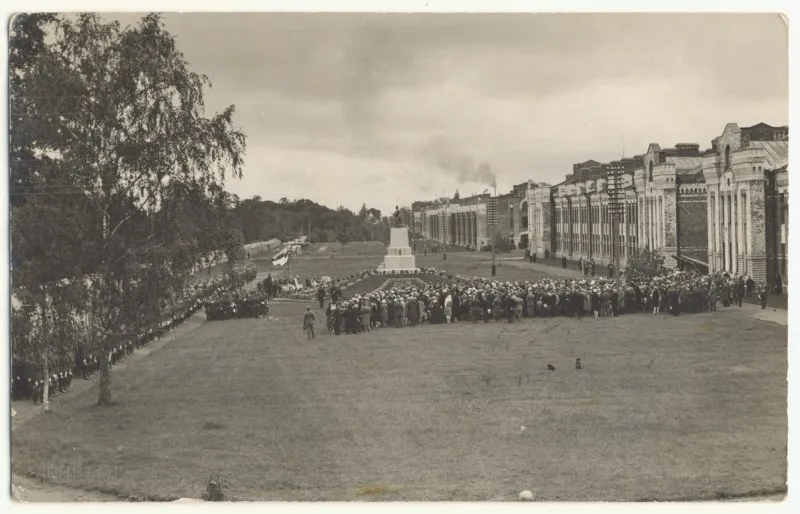
The monument in the photograph at the top of this article is not the one you see in Tondi today. Amandus Adamson sculpted the original, which the school unveiled in 1928. It did not survive 1941. The present monument, unveiled in 2009, owes its existence to old photographs. In this case, the archive did more than record a lost object. It helped give it back.
What survived the morning
Estonia remembers December 1 as Internal Security Day. The Estonian War Museum’s centenary exhibition counted 26 Estonian soldiers and civilians killed. In the aftermath, the government reorganized the political police and revived the Defence League, a volunteer defense organization. The republic survived.
The Soviet occupation came sixteen years later, in a different war. In 1939, Nazi Germany and the Soviet Union signed the Molotov–Ribbentrop Pact. A secret protocol put Estonia in the Soviet sphere. Under pressure, Estonia accepted Soviet military bases, and Soviet forces occupied the country in June 1940. The United States refused to recognize the forced incorporation of Estonia, Latvia and Lithuania, a policy announced in the July 1940 Welles Declaration. Nazi Germany occupied Estonia from 1941 to 1944, and Soviet forces then returned. Estonia restored its independence in August 1991. These events belong to the same national story, but nobody in Tallinn in 1924 knew how the next decades would unfold.
The family diary survived, too, though it might not have. Köögardal later destroyed some earlier volumes because he feared what they might mean for him under Soviet occupation. His family allowed the Harjumaa Museum to publish the surviving diaries. That is why we can still set a pastor’s evening telephone call beside the government’s account of that morning.
Our Tallinn espionage history map puts the station, Tondi and the city’s other sites in context. If you would like to explore the Baltic region with former intelligence practitioners, join the interest list for In Moscow’s Shadow, our journey in development.