At five in the morning on November 4, 1956, heavy guns opened fire in the suburbs of Budapest. Twenty-five minutes later, Edward Wailes reported the sound to Washington from the U.S. legation. He thought the guns were firing out from the city. He had word that a Hungarian leader had told people to take shelter in their cellars. He couldn’t say which leader. He asked Washington to keep the line open.
Seventy years later, you can read the legation’s teletype transcript and follow the morning as the staff lived it. They flagged a convoy report as unconfirmed, passed along a call from a Hungarian official’s office and tried to find out whether American families had made it across the Austrian border. As they learned more, they had fewer choices.
The tanks had started to leave
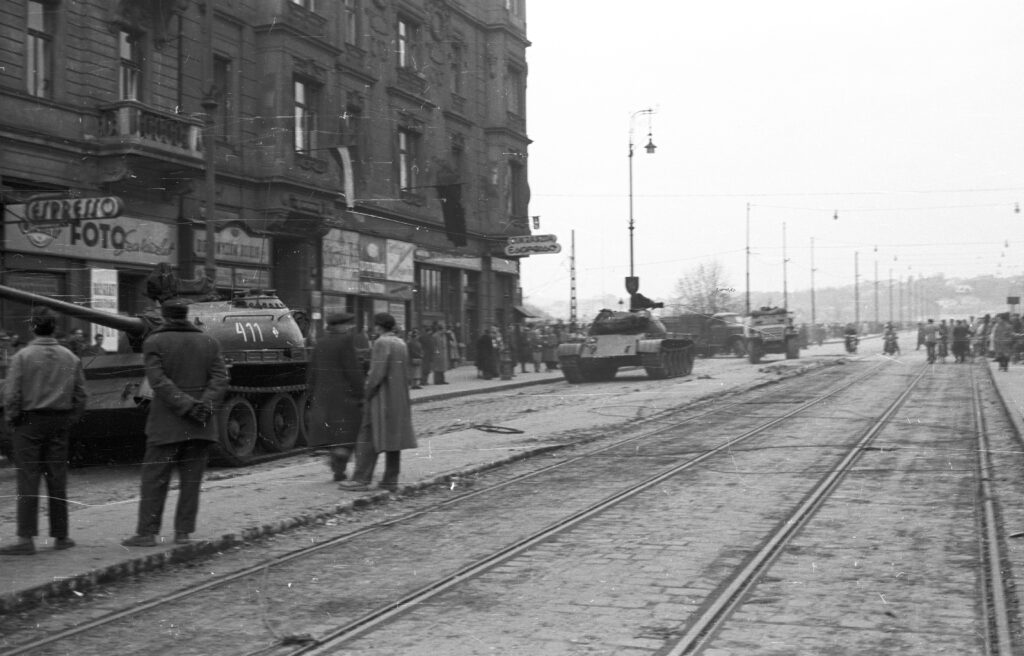
On October 23, students and other Budapest residents took to the streets. Protesters went to the Hungarian Radio complex on Bródy Sándor Street and tried to get their demands on the air. Fighting broke out, and Soviet forces entered Budapest. By the end of the month, Imre Nagy’s government had announced a ceasefire, and Soviet units had started pulling back from parts of the capital. The October 31 photograph above shows Soviet armor on Szent István Boulevard, looking toward Margaret Bridge.
That same day in Moscow, Soviet leaders changed their minds. The notes of the October 31 Presidium meeting show Nikita Khrushchev arguing that pulling out would make the Soviet Union look weak to the West. Israel had invaded Egypt two days earlier, and Britain and France were joining the attack. Khrushchev brought up Egypt as he argued for intervening in Hungary and weighed who might lead a new government.
A witness on the boulevard could tell you the tanks were leaving. The notes from Moscow explain why they came back.
Nagy had his own sources. On November 1, according to the Hungarian cabinet minutes, the chief of the general staff confronted Soviet ambassador Yuri Andropov with reports that fresh Soviet troops had crossed Hungary’s eastern border and were heading toward Budapest. The cabinet declared Hungary neutral, withdrew from the Warsaw Pact and appealed to the United Nations. Nagy was trying to buy his government some room to act before the troops reached the city.
The talks move to Tököl
On November 3, Hungarian and Soviet negotiators met at the Hungarian Parliament to discuss the withdrawal. They agreed to meet again at ten that night. Nagy’s defense minister, Pál Maléter, led his delegation to Soviet military headquarters at Tököl, south of Budapest, to work out the details.
The two sides were still talking about the departure and what to do about Soviet memorials, according to the later United Nations inquiry. Nagy had been getting regular reports from the meeting. Around midnight, the calls stopped. KGB chief Ivan Serov had walked in with Soviet officers and announced that he was arresting the Hungarian delegation. A Hungarian general sent scouts toward Tököl, but they failed to return.
What crossed the wire
The State Department’s editors put Nagy’s first broadcast at 5:20 a.m. on November 4. He told listeners that Soviet troops had attacked the capital. The Americans later passed along a report about a Nagy broadcast while they were still sorting out who had said what. The times in the transcript tell you when news reached the wire. Sometimes the event itself had happened minutes earlier.
By 5:44 a.m., the staff had started destroying sensitive material. Washington asked about the convoy and suggested that Wailes present his credentials if he could. He had arrived just two days earlier.
At 5:56 a.m., Nagy went on the radio again. This time he called on Maléter, his chief of the general staff and the other men from Tököl to return to their posts. The Soviets already had them in custody.
At 6:42 a.m., Wailes reported a lull and Hungarian troops in Parliament Square. He still doubted he could get to the official he needed to see. Then someone rang the legation’s doorbell. Wailes stepped away from the teletype to see what the visitor wanted.
The visitor was István Bibó, a minister Nagy had appointed the day before. He had brought a message for President Eisenhower. As the staff translated it, Wailes passed along word that Soviet tanks had reached two bridges about half a mile from the legation.
Bibó told Eisenhower that Hungary’s most urgent need was political help. He asked the president to help broker a truce in Egypt and urge Moscow to withdraw from Hungary. That meant pressing two American allies, Britain and France, while confronting Moscow. The next message from Washington said the U.S. ambassador to the United Nations would likely speak at the General Assembly shortly.
The legation had another visitor that morning. Cardinal József Mindszenty came to the door seeking shelter. Wailes took him in and asked Washington if he could admit the cardinal’s secretary, too. Washington said yes.
The Americans in Budapest could now tell Washington they’d seen tanks with markings. Later, when Washington asked what things looked like outside the legation, the operator at the teletype had to guess. The blinds were down. The staff had pushed safes against the window more than a week earlier to shield the machine and the people who worked beside it from gunfire. From his seat, the operator couldn’t see the street.
Late that morning, the military attaché heard two explosions and wondered whether they had come from Margaret Bridge and the Chain Bridge. Wailes passed along the guess. The line went down again. An operator in Vienna tried to reconnect. The transcript ends there.
What listeners expected
For Hungarians listening to Western radio, the question was whether anyone would come to help. In a November 20 memo to President Eisenhower, CIA director Allen Dulles acknowledged that some Radio Free Europe scripts went beyond the news and offered tactical advice. In a later dispatch from Budapest, American diplomats asked what listeners had taken from the broadcasts. They concluded that many Hungarians heard the West’s encouragement and expected more direct help.
Eisenhower asked Soviet Premier Nikolai Bulganin to withdraw his troops. At the United Nations, Moscow vetoed the U.S. draft resolution in the Security Council. The General Assembly took up the question later that day. It called for a Soviet withdrawal and asked for UN observers. The administration had ruled out a UN force for Hungary. No troops came to Hungary’s aid.
Hungarians kept fighting in parts of Budapest for days. János Kádár took power with Moscow’s backing. Nagy took refuge in the Yugoslav Embassy on the morning of the attack. He left on November 22 after receiving assurances of safe passage. Soviet officers seized him and took him to Romania.
The new Hungarian authorities executed Nagy and Maléter in 1958.
The crackdown drove about 200,000 people to flee Hungary. The legation’s transcript covers one morning. The people who fought, hid or left lived with the consequences for years.
Reading the city today
I’d start at Kossuth Square, at Parliament’s memorial to the October 25 shootings. Then I’d head to Corvin köz, an enclosed passage off a main road where people took up arms. I’d finish in Liberty Square, outside the U.S. Embassy on Szabadság tér. That’s the building where Wailes and his staff tried to work out what was happening, one report at a time.
Our Continental Europe intelligence-history guides tell other Cold War stories through the places where people made difficult decisions. In Budapest, I’d bring the transcript with me and linger over the moments when someone says they’re still checking. Seventy years later, those lines bring me closest to that morning.