A Soviet passenger ship, an American naval officer, and a public telephone that rang exactly when he had asked.
At Tradecraft Travel, espionage history is a specialty, alongside cruises and other journeys built around our clients’ interests. Occasionally, those worlds meet in a single story. In 1977, a Bermuda cruise aboard a Soviet passenger ship became the opening move in an American counterintelligence operation.
The ship was the Kazakhstan. The passenger was Lieutenant Commander Arthur “Art” Lindberg of the U.S. Navy. He went aboard carrying an offer that Soviet intelligence might find difficult to ignore: military information, for money.
The offer was a trap. But before the Americans could discover who would take it, Lindberg had to persuade someone on that ship to pass it along.
Why a Soviet cruise ship?
The Kazakhstan was a Soviet passenger vessel carrying vacationers, including Americans. Built in Finland and delivered in 1976, she belonged to the Soviet Black Sea Shipping Company. Her national affiliation mattered to this operation: an American buying a cruise ticket could come into contact with Soviet personnel through the ordinary routines of travel.
Investigators suspected a connection between Soviet merchant shipping and the KGB, the Soviet security and intelligence service. They wanted to test whether a cruise ship could provide an entry into an espionage network. A passenger who volunteered useful information might draw a response that surveillance from shore alone could not produce.
That was the purpose of the dangle. In intelligence work, a dangle is someone deliberately presented to an opposing service as a potential recruit. The apparent opportunity encourages the other side to act—and, in acting, reveal something about itself.
The FBI and Naval Investigative Service recruited Lindberg for the task. Naval investigators brought knowledge of the service whose information was at stake; the Bureau pursued Soviet espionage in the United States. Their joint effort became Operation Lemon-Aid.
A believable recruit
Lindberg’s naval career gave the proposition substance. He had access to information, a modest income, and retirement approaching. Those circumstances could support a plausible story about wanting extra money.
His actual reasons were different. When naval investigator Terry Tate approached him, Lindberg was directing procurement at Lakehurst, New Jersey. He initially assumed the meetings concerned his regular work. Instead, he was being asked to undertake an assignment he could not discuss with his family.
He considered it during a vacation. A sermon about service helped him decide to accept, according to his later account. The decision placed a secret alongside his ordinary responsibilities: he would continue as an officer and a family man while allowing Soviet intelligence to believe he was prepared to betray his country.
He took the cruise. Later, he remembered its loneliness. The important moment came at the end, when he handed a Soviet officer a note before disembarking.
An archived Defense Security Service summary places that handoff on the return to New York. His offer linked approaching retirement with information he could sell. The note also supplied a telephone number and a particular day and time to call.
He signed it “Ed.”
The Americans had supplied the opening. Now they needed an answer.
The telephone call
On August 30, Lindberg went to the Castle Diner in Neptune, New Jersey. He arrived early and waited near the public telephone outside.
At 11:45 a.m.—the requested time—the phone rang.
In Lindberg’s recollection, published by the University of New Mexico and reprinted by AFIO, the voice introduced itself:
“Hello, Ed. My name is Jim. We got your message and would very much like to meet with you.”
Jim arranged another call a week later, at the same time and number.
The note had reached someone willing to act on it. The cruise had ended, but the relationship it was designed to create had begun.
An appointed public phone gave the two sides a place to communicate without exchanging home numbers or meeting face to face. It was a small, practical piece of tradecraft. Its significance lay in what came next: instructions, questions, and an effort to establish what this American could deliver.
Subsequent written questions probed Lindberg’s access and ability to remove material. A willing seller was useful only if he could obtain information worth buying. The Soviets were assessing a prospective source. The Americans were watching that assessment unfold.
One relationship, two operations
For Soviet intelligence, the attraction was access to American military knowledge. The operation sought antisubmarine warfare information, a field concerned with locating and countering submarines. Such information could help an adversary understand capabilities that the Navy wanted to protect.
Intelligence turns information into knowledge useful for decisions. Recruiting a person with privileged access is one way to acquire information that cannot simply be read in public. The apparent advantage of “Ed” was that he already worked inside the institution the Soviets wanted to understand.
The American operation worked in the opposite direction. Counterintelligence seeks to detect, understand, and counter an adversary’s intelligence activity. Here, it also meant drawing that activity into a relationship the Americans could observe and control from their end.
Arresting someone at the first possible moment would end that opportunity. Letting the relationship develop could reveal the subjects the Soviets cared about, their methods of communication, and the people who collected the material.
Feeding the dangle
Getting Jim to call was only the beginning. Now Ed had to produce. A naval officer offering secrets would not remain interesting indefinitely if he never delivered anything worth reading.
The Navy helped supply his credibility. Historian John Prados describes Lindberg passing antisubmarine warfare data supplied by Navy experts. The FBI’s account adds a crucial distinction: the earlier deliveries contained declassified information. Actual classified material was used in the final arrest operation.
Declassified does not mean fabricated. Authentic naval information could make Ed’s access believable even when the United States no longer required that information to remain secret. The deception concerned whom Ed really served; it did not require every technical fact he delivered to be false.
What, exactly, would the Navy share—and where would it draw the line? The published accounts establish the subject and the use of declassified material, but provide no document-by-document release list. The broader judgment in an operation like this is a balance between keeping the source credible and protecting military capabilities. Current submarine patrol positions, usable communications keys, or undisclosed sensor weaknesses illustrate what could make a disclosure dangerously costly. Those are examples of the stakes, not a documented list of requests or withheld items in Lemon-Aid. A handler’s appetite for information would not, by itself, justify satisfying it.
Nor would simply inventing impressive-sounding nonsense solve the problem. Soviet intelligence could compare a report with other sources, ask specialists whether its claims made sense, and consider whether an officer in Ed’s position could obtain it.
There is a telling example in the separate John Walker case. Prados recounts how Soviet officers checked the markings and format of a stolen NSA document against papers already supplied by another spy. They had something against which to test a newcomer’s offering.
Obvious fabrications could therefore do more than disappoint a customer. They could suggest that Ed was working for the other side. Contact might stop; collectors might change their routines; the Americans might lose the network they were trying to understand. These are the tradecraft risks, not events the published Lemon-Aid accounts say occurred.
For Lindberg, each delivery sustained the same difficult proposition: he had to look useful enough to keep the relationship alive. Behind him, naval experts and investigators had to decide what that usefulness could safely consist of.
The things beside the road
Instructions and payments traveled in cigarette packets, cans, juice cartons, and magnetic key holders. Ordinary packaging concealed an extraordinary purpose.
The exchanges used dead drops: one person left a package and another collected it later. Source and handler did not have to stand together. That reduced the chance that an observer would see a meeting and connect the two.
It did not eliminate the need for someone to approach the hiding place. The Americans knew about exchanges through Lindberg and kept drop sites under surveillance. Each delivery could therefore tell them more about the people operating behind “Jim.”
The months of contact eventually led investigators to Valdik Enger and Rudolf Chernyayev, Soviet employees of the UN Secretariat, and Vladimir Zinyakin, a diplomat at the Soviet mission to the United Nations. The case linked New Jersey’s roadside exchanges to New York’s international community.
On May 20, 1978, Lindberg drove to the final drop in Woodbridge. Two FBI agents were concealed in his car’s trunk. Other agents waited nearby.
He collected an Ann Page pear can, left five canisters containing classified material, and drove away. The FBI arrested Enger and Chernyayev. Zinyakin’s diplomatic immunity protected him from prosecution; he was later expelled.
The distinction between their official positions now became decisive. Enger and Chernyayev’s UN employment did not confer the same protection. The court rejected their immunity arguments. Both were convicted and sentenced to 50 years.
The Americans had exposed an operation and secured convictions. They had also gained something less visible: knowledge of Soviet methods that, the FBI later reported, helped its work for years afterward.
Epilogue: the exchange at JFK
The convictions did not end the story. They changed the setting—from surveillance and courtrooms to negotiations between governments.
Moscow wanted its officers returned. A declassified November 1978 State Department cable records the dispute over their treatment and the private discussions continuing behind it. The Americans had an opportunity to secure the freedom of people imprisoned in the Soviet Union.
President Jimmy Carter approved an exchange. On April 27, 1979, he commuted Enger’s and Chernyayev’s sentences. The White House announcement named five Soviet prisoners released in return: Alexander Ginzburg, Eduard Kuznetsov, Mark Dymshits, Valentyn Moroz, and Georgi Vins. Their immediate families, it said, would follow.
The exchange took place at JFK, in Hangar 17.
The five men arriving had endured imprisonment for different reasons. Ginzburg was a human-rights activist; Moroz, a Ukrainian nationalist; Vins, a Baptist pastor. Kuznetsov and Dymshits had been imprisoned following the 1970 attempt to seize an aircraft and escape the Soviet Union. Their death sentences had been reduced after international protests.
Freedom also meant exile. Behind the announcement that families would follow were lives that now had to be reassembled outside their country.
The University of Virginia Law Library preserves two revealing reactions. Vins arrived gaunt, with his head closely shaven from imprisonment. “I thank my Lord that I am free,” he said. Enger, preparing to depart, told the prosecutor: “I would have enjoyed meeting you under different circumstances.”
The officers returned to the Soviet Union. Within days, Kuznetsov and Dymshits were addressing a New York rally for Soviet Jewry. Men who had once faced execution could speak to a crowd in freedom.
The counterintelligence operation had created an opportunity for diplomacy. Carter’s decision turned that opportunity into five releases. A note carried off a cruise ship had consequences none of its wording disclosed.
Epilogue: what became of the Kazakhstan?
The Soviet passenger ship kept sailing. She outlived the operation and, eventually, the Soviet Union.
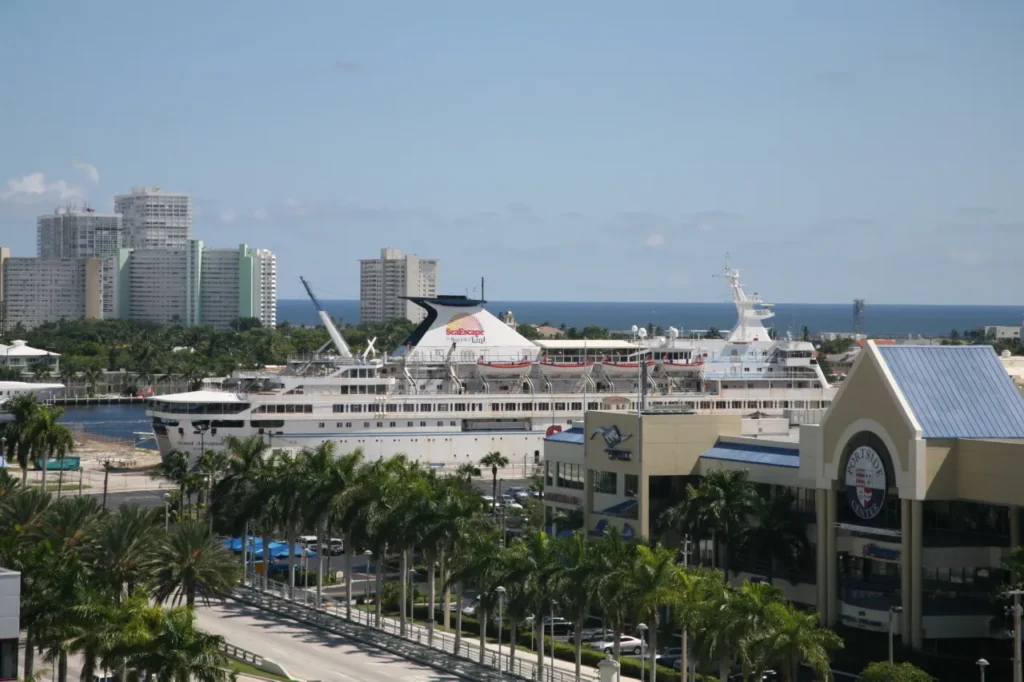
After conversions and changes of ownership, she became Ukraina and later Island Adventure. Her next American chapter involved SeaEscape casino cruises off Florida. The same hull that had carried Lindberg into a counterintelligence operation now took passengers out for gambling and entertainment.
Her published vessel chronology records the end of service in 2008, sale for demolition in 2011, and dismantling at Alang, India, in 2012. Maritime historian Peter Knego’s gallery documents her breaking-up, under the final shortened name Adventure.
There is no ship left to visit, but the places around the operation remain part of the region’s history. The UN headquarters and Soviet mission provide institutional context; New Jersey holds the exchange sites; JFK marks the diplomatic conclusion. Our New York City espionage map offers a starting point for exploring that wider landscape.
For a traveler departing on a cruise, it is a reminder that the story of a journey can begin well before the ship leaves port. To combine a sailing with time exploring the city’s intelligence history, talk with Tradecraft Travel about your itinerary.