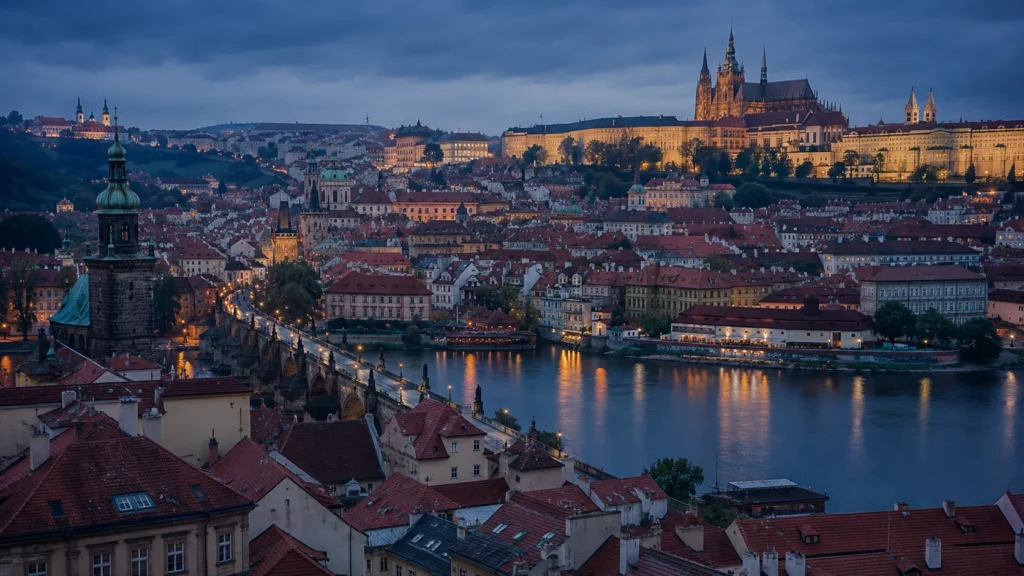
Prague does not initially present itself as an intelligence city.
The first impressions are usually towers, tiled roofs, church domes,
the Vltava, and the procession of visitors crossing Charles Bridge. The
city can feel composed for a postcard. But its beauty can conceal the
more consequential ways Prague has been used: as an occupied capital, a
center of resistance, the headquarters of a communist security service,
a meeting ground between East and West, and—eventually—a stage on which
citizens dismantled an authoritarian state.
To understand Prague’s espionage history, it helps to look beyond
isolated “spy sites.” Intelligence history is not just a collection of
plaques, headquarters, safe houses, and prison cells. It is a
relationship among people, institutions, streets, and power. Prague
rewards travelers who learn to read those relationships.
That is the purpose of the new Prague
Espionage History Map: not to turn the city into a spy-movie set,
but to show how occupation, resistance, surveillance, dissent, and
counterintelligence became embedded in its terrain.
One city, several security
regimes
Prague’s twentieth century did not produce one tidy intelligence
story. It produced several overlapping ones.
Nazi Germany occupied the Czech lands in March 1939 and made Prague
the capital of the Protectorate of Bohemia and Moravia. Resistance
networks operated under extraordinary pressure while German police and
security organs used arrests, informants, interrogation, and collective
punishment to break them.
After the war, Czechoslovakia’s communist takeover in February 1948
established a different system of political control. The State Security
service—widely known by its Czech abbreviation, StB—monitored suspected
opponents, recruited informants, penetrated social networks, and helped
enforce the boundaries of permitted political life.
The reform movement of 1968 briefly challenged that order. The
Soviet-led invasion in August ended the Prague Spring and began the
period of “normalization,” when outward political conformity was
restored and dissent was again subjected to sustained state pressure. By
November 1989, however, demonstrations centered on Národní třída and
Wenceslas Square had grown into the Velvet Revolution.
Each regime left different traces. Some are preserved in museums and
memorials. Others survive as ordinary-looking buildings whose historical
function is easy to miss. Together, they make Prague a city where the
visible architecture and the invisible machinery of power often occupied
the same ground.
The crypt
where resistance became national memory
The most emotionally powerful intelligence-history site in Prague is
beneath the Orthodox Cathedral of Saints Cyril and Methodius.
In 1942, Czechoslovak parachutists trained in Britain carried out
Operation Anthropoid, the attack on Reinhard Heydrich, acting Reich
Protector and one of the most powerful figures in the Nazi system. After
the attack, seven parachutists took refuge in the church. German forces
surrounded it on June 18, 1942. The final battle unfolded in the nave
and crypt.
Today, the National
Memorial to the Heroes of the Heydrich Terror occupies that
authentic battle site. The crypt is not simply a place where an
operation ended. It forces the visitor to consider the network behind
the operatives: clergy, families, couriers, safe-house providers, and
others who accepted risks that were often fatal.
That broader network is essential to understanding clandestine
activity. Intelligence operations are frequently remembered through a
few celebrated names. Their survival, however, usually depends on less
visible people who supply shelter, transportation, documents,
communications, or trust. The Nazi reprisals that followed Heydrich’s
death—including the destruction of Lidice—demonstrated the terrible
price imposed not only on the attackers but on Czech society.
When visiting the crypt, look beyond the bullet scars. Consider the
surrounding streets, the entrances, the nearby river, and the problem of
moving people through an occupied city. The site becomes more
comprehensible when viewed as part of a contested urban system rather
than as an isolated chamber.
Surveillance
was a network, not a single building
Communist-era Prague presents a different interpretive challenge.
There is no single location that explains the StB.
Bartolomějská Street is one important anchor because it was closely
associated with the communist security apparatus. Yet the work of
surveillance did not remain inside an office. It extended into
residences, hotels, embassies, restaurants, workplaces, transit routes,
and the private relationships of people considered politically
significant.
The Czech Institute
for the Study of Totalitarian Regimes has published surveillance
photographs and films made by the StB Surveillance Directorate between
1969 and 1989. They are revealing precisely because many look mundane. A
person walks down a street. Someone enters a building. A car waits near
a corner. Nothing in an individual frame necessarily appears
dramatic.
That banality was part of the system’s power. Persistent observation
could identify contacts, routines, meeting locations, and deviations
from routine. A photograph of an apparently uneventful doorway could
become one component in a much larger pattern.
This is why Prague’s cafés, passages, tram stops, and hotel lobbies
matter to its intelligence history. They provided the connective tissue
between official institutions and private lives. The correct question is
often not “What famous operation happened here?” but “What could be
observed, controlled, or concealed from this position?”
Hotels,
embassies, and the problem of controlled space
Travelers often treat a hotel as neutral territory: a convenient base
from which to explore a city. Intelligence and security services do not
necessarily see it that way.
During the Cold War, prominent hotels in communist capitals brought
foreign visitors, diplomats, businesspeople, journalists, and officials
into spaces the state could more readily monitor. Reception desks
recorded arrivals. Staff observed behavior. Telephones, rooms,
restaurants, and meeting areas created opportunities for surveillance
and contact.
Prague’s Hotel Jalta, built on Wenceslas Square in the 1950s,
embodied the official confidence of the communist state above ground
while a protected shelter lay below. The contrast is instructive:
hospitality, prestige, state preparedness, and security could coexist
within one structure.
Embassy districts present a related geography. Diplomatic missions
are legitimate centers of state activity, but they also concentrate
officials, communications, security procedures, liaison relationships,
and opportunities for observation. In an intelligence city, the
meaningful terrain may include the route between an embassy and a
residence, the café near an office, or the public place where repeated
presence would not immediately appear suspicious.
This does not mean every grand hotel was filled with spies or every
diplomatic doorway concealed an operation. Serious intelligence history
requires resisting that temptation. The value lies in understanding why
certain environments offered access, cover, control, or
vulnerability—not in inventing intrigue where the record does not
support it.
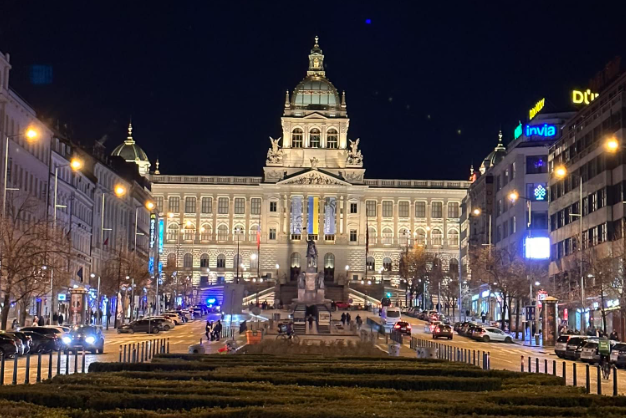
Wenceslas
Square as a measure of political power
Few places reveal Prague’s shifting balance between state power and
public resistance as clearly as Wenceslas Square.
The square has repeatedly served as a national stage. Communist power
was publicly consolidated there in February 1948. In January 1969,
student Jan Palach set himself on fire nearby in protest against the
Soviet-led occupation. In November 1989, enormous gatherings helped
propel the Velvet Revolution that ended communist rule. The city’s
official tourism history of Wenceslas
Square traces these successive moments in the same physical
space.
For an intelligence-minded traveler, the square raises useful
questions. Who controls a public gathering? Where can movement be
channeled? How do authorities identify organizers, monitor
communications, or separate spontaneous participation from coordinated
action? At what point does a crowd become too large—or too legitimate—to
suppress without changing the political equation?
A short walk away, Národní třída marks another decisive moment.
Police violence against a student demonstration on November 17, 1989,
helped trigger escalating protests. The commemorative plaque there is
modest compared with the scale of the political change that followed.
That contrast is characteristic of Prague: a small marker can identify
the point where an established system began to lose control of
events.
The
post-Cold War city did not leave information conflict behind
The Velvet Revolution ended communist rule, but it did not remove
Prague from the wider contest over information.
Radio Free Europe/Radio Liberty moved its headquarters from Munich to
Prague in 1995, initially occupying the former Czechoslovak Federal
Assembly building beside the National Museum. The organization’s own history of Radio Free Europe
and Radio Liberty explains that the services began broadcasting
during the early Cold War to audiences denied independent information by
communist governments. Their relocation to Prague carried obvious
symbolism: a former communist capital became the operational center of a
broadcaster once targeted by communist regimes.
RFE/RL later moved to a purpose-built facility east of the center,
but its continuing presence is an important reminder. Intelligence
history does not stop neatly in 1989. Disinformation, political
influence, hostile intelligence activity, cyber operations, threats to
journalists, and the security of democratic institutions remain current
concerns.
Prague therefore offers something more useful than Cold War
nostalgia. It allows a traveler to see continuity and change: the tools
evolve, the political system changes, but information, access, trust,
and vulnerability remain central.
How to read Prague’s
intelligence terrain
The best way to explore this history is to slow down and examine
relationships among places. Five habits help.
1. Notice transitions
Bridges, stations, arcades, hotel entrances, and tram interchanges
move people between environments. They can also create observation
points, predictable routines, and moments of exposure.
2. Look for institutional
clusters
Government offices, police facilities, courts, embassies,
universities, media organizations, and major hotels often matter not
only individually but because of their proximity to one another.
3.
Distinguish documented history from plausible atmosphere
Prague can make almost any doorway feel mysterious after dark. That
is not evidence. Use archival records, institutional histories,
memorials, and responsible scholarship to separate documented events
from colorful storytelling.
4. Ask who is missing from
the plaque
Memorials often emphasize the central figure or final event. Look for
the couriers, family members, clergy, assistants, informants,
interrogators, and ordinary citizens whose choices made the larger story
possible.
5.
Consider what the city remembers—and what it does not
Some sites are carefully preserved. Others have been repurposed,
demolished, or absorbed into daily life. The difference can reveal how
societies process occupation, collaboration, resistance,
authoritarianism, and democratic recovery.
A city worth reading
carefully
Prague’s espionage history is not hidden because every secret has
remained buried. It is hidden because the modern city functions so
successfully around it. People commute past former security offices.
Visitors meet beneath monuments shaped by revolution. Hotels welcome
guests into buildings once designed around very different assumptions
about access and control.
The city becomes more meaningful when those layers are placed back
into relationship.
Use the Prague
Espionage History Map to explore the individual locations, their
access status, and the documented people and events connected to them.
Prague also fits within the broader intelligence landscape of Continental
Europe, alongside divided cities, resistance networks, surveillance
states, and Cold War frontiers.
For travelers who want to examine these histories in sequence, Prague
is one of four cities in Dead
Drops & Double Agents, an expert-led journey through Berlin,
Leipzig, Prague, and Vienna. You can also explore Tradecraft Travel’s
wider collection of espionage history
maps and journeys.
The objective is not simply to locate where something happened. It is
to understand why it happened there—and what the terrain allowed people
to see, conceal, control, or resist.