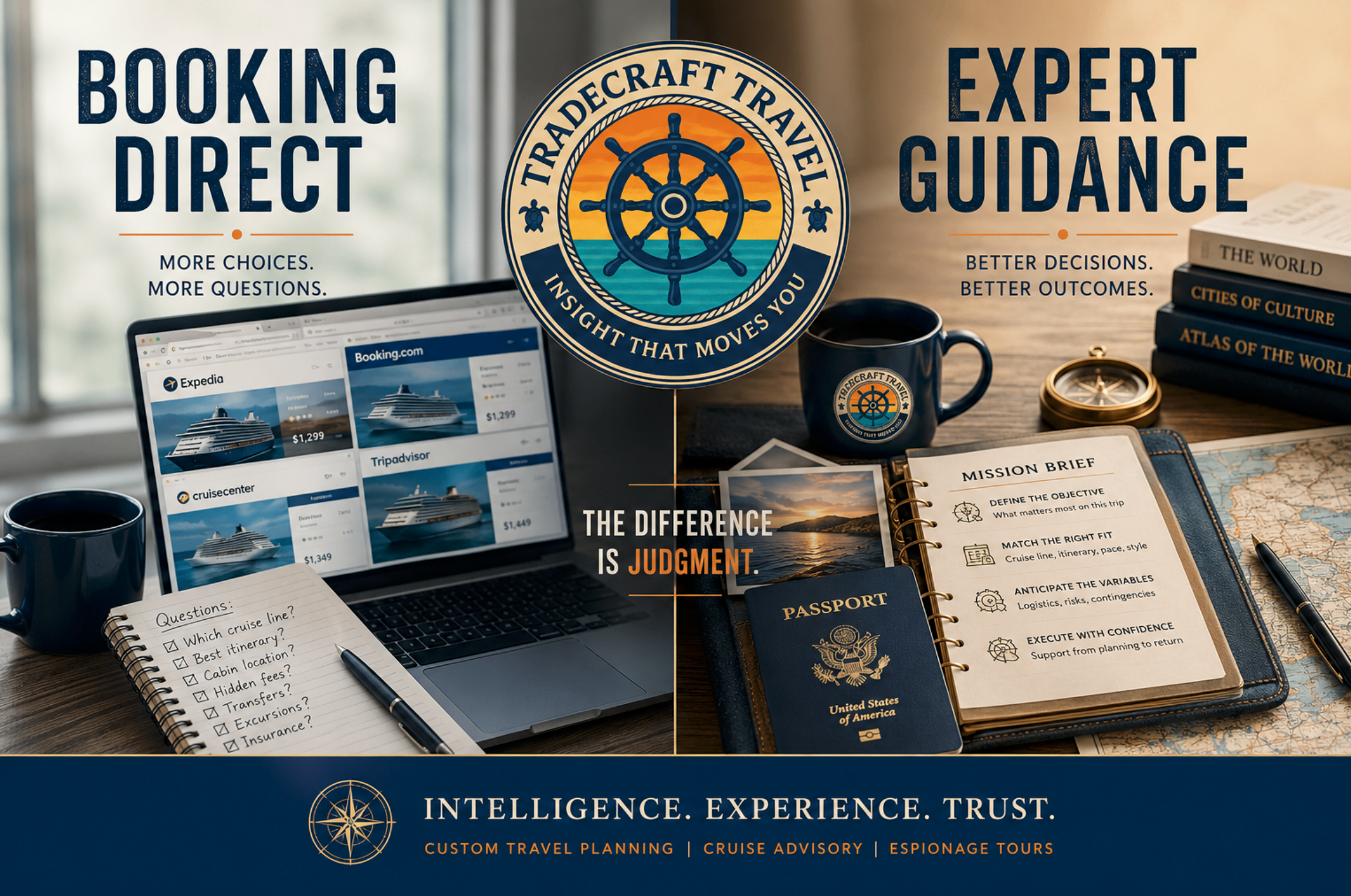

Some trips are easy to book on your own.
A quick hotel night on the way to a wedding. A nonstop flight on a familiar route. A simple weekend away where the stakes are low and the choices are obvious.
But other trips are different.
They involve multiple travelers, tight timing, unfamiliar destinations, cruise fare rules, private guides, insurance decisions, accessibility needs, milestone expectations, or enough moving parts that one wrong assumption can create real friction.
Those are the trips where planning properly matters.
That is where a good travel advisor can be useful.
Not every trip needs one. But if the trip matters enough that the details matter, it is worth stepping back before you book and asking whether you want someone in your corner who understands the moving pieces.
At Tradecraft Travel, I think about travel the same way I spent decades thinking about complex problems in government service: gather the facts, understand the client, identify the risks, evaluate the options, and build a plan that fits the mission.
Here are the kinds of trips where an advisor can add real value.
1. When a Cruise Has More Variables Than You Realized
Cruises look simple from the outside.
Pick a ship. Pick a date. Pick a cabin. Go.
In practice, there are often more decisions than most travelers expect.
Which fare type actually makes sense? Is the lower price really lower once gratuities, drinks, Wi-Fi, specialty dining, excursions, and cancellation terms are considered? Is the cabin category worth the upgrade? Is the itinerary port-heavy or ship-focused? Is the ship a good match for adults, families, solo travelers, or multigenerational groups?
And then there is the cabin itself.
Two balcony cabins on the same ship may not be equal. Location, obstruction, noise, motion, deck plans, connecting doors, proximity to elevators, and what is above or below the cabin can all matter. A cabin that looks fine in a booking engine may not be the best fit for the traveler.
Cruising is also full of timing issues: deposits, final payment dates, repricing opportunities, insurance deadlines, passport requirements, excursion windows, and transfer logistics. These are not impossible to manage on your own, but they are easy to overlook.
A travel advisor can help you understand what you are actually buying, not just what the booking page says.
That matters whether you are considering Alaska, the Caribbean, Europe, a river cruise, an adults-only sailing, or a premium small-ship experience. The cheapest available cabin is not always the best value, and the most expensive option is not always the smartest one.
The better question is: what kind of trip are you trying to have?
That is the point of working with a cruise travel advisor. The work is not just finding a sailing. It is comparing ship, itinerary, cabin, inclusions, timing, port experience, and total value.
If you are still early in the process, the Tradecraft Travel Cruise Matchmaker can also help you think through which style of cruise may fit the way you actually travel.
2. When the Trip Is Custom, International, or Built Around You
A custom trip is not just a bundle of hotels and tours. Done properly, it is a sequence of decisions.
How many nights should you spend in each place? Which city should come first? Should you rent a car, hire a driver, use trains, or fly internally? Where does a private guide add value, and where would you rather explore independently? Is the hotel location right for the way you actually travel? Are you trying to move quickly, or do you need more breathing room?
These questions matter because travel is not experienced as a spreadsheet. It is experienced hour by hour, on the ground.
A beautifully designed itinerary should account for pace, energy, geography, interests, transfer time, restaurant timing, jet lag, and the fact that real people do not want every day to feel like a forced march.
This is especially important for trips built around personal interests: food and wine, history, gardens, aviation, family heritage, art, architecture, military history, intelligence history, or a once-in-a-lifetime destination.
Search engines can show you what is popular. A good advisor helps you decide what fits.
That distinction matters.
Tradecraft Travel’s custom travel planning is built around that idea: private itineraries shaped by your interests, budget, timing, comfort level, must-haves, and tradeoffs.
Before planning international travel, it is also wise to check practical requirements early. The U.S. State Department’s International Travel Checklist is a useful starting point for passports, entry requirements, and destination research. The State Department also maintains current travel advisories, and the CDC’s Travelers’ Health destination pages can help travelers identify health considerations before departure.
Those resources do not replace planning judgment. But they are part of the terrain.
3. When You Are Planning for a Group
Group travel can be rewarding. It can also become a part-time job for whoever volunteered to organize it.
Families, alumni groups, friend groups, academic groups, professional associations, clubs, and affinity groups all come with the same basic challenge: different people want different things, but everyone expects the trip to work.
Someone has to think about deposits, rooming lists, payment deadlines, cancellation terms, arrival times, dietary needs, accessibility issues, pre- and post-trip extensions, communication, and what happens when one traveler changes plans.
That is before you even get to the emotional side of group travel.
Some people want structure. Some want free time. Some want the least expensive option. Others want comfort. Some read every email. Some read none.
A good group trip needs more than a destination. It needs architecture.
What is included? What is optional? What is the trip’s center of gravity? How much togetherness is too much? Where does the group need expert guidance, and where should people be left alone to enjoy the place?
An advisor can help turn a rough idea into a workable plan. That may mean a cruise group, a custom land itinerary, an alumni journey, a special-interest tour, or a celebration trip for family and friends.
The goal is not to control every minute. The goal is to remove avoidable friction so the group can focus on the experience.
Tradecraft Travel helps with group travel planning for families, friends, clubs, organizations, alumni groups, professional communities, and affinity groups that need structure and clear coordination.
4. When the Trip Is Built Around a Story, Theme, or Interest
Some travelers do not just want to “go somewhere.”
They want a trip with meaning.
They want to understand the Cold War in Berlin. Follow literary history through England. Visit the battlefields, museums, and archives tied to a family story. Explore wine regions with someone who can explain what they are tasting. Build a trip around food, faith, architecture, aviation, intelligence history, music, or ancestry.
That kind of travel benefits from interpretation.
It is one thing to stand in front of a building. It is another to understand why that place mattered, what happened there, and how it connects to a larger story.
This is where interest-led travel becomes powerful. The destination is still important, but the trip is organized around curiosity. It gives the traveler a reason to care about the places on the itinerary.
For Tradecraft Travel, this is especially visible in espionage travel. But the same principle applies far beyond intelligence history. A well-planned trip can be built around almost any serious interest if the design is thoughtful enough.
The best journeys are not random collections of attractions. They have a thread.
5. When Mistakes Would Be Expensive
The more important the trip, the less you want to discover a problem after you have already paid.
This is true for honeymoons, retirement trips, anniversary trips, major family vacations, first cruises, bucket-list journeys, and expensive international travel. It is also true when travelers have limited vacation time, health considerations, mobility needs, or a narrow travel window.
Mistakes can take many forms.
A hotel in the wrong location. A cabin that does not fit the traveler. A connection that is too tight. A tour that sounds good but does not match the traveler’s actual interests. A missed insurance deadline. An unrealistic itinerary. A supplier that is not the right fit. A group trip with unclear expectations. A fare that looked cheaper but came with tradeoffs no one explained.
No advisor can eliminate every risk from travel. Weather happens. Flights change. People get sick. Ships adjust ports. Restaurants close. Museums change hours. Life intervenes.
But planning can reduce avoidable risk.
For air travel, the U.S. Department of Transportation maintains an Airline Customer Service Dashboard that helps travelers compare airline commitments during controllable delays and cancellations. For trip protection, insurance details matter as well. Some benefits, including certain pre-existing medical condition waivers, may depend on when the policy is purchased and whether the traveler meets the plan’s requirements. Allianz explains those timing rules in its overview of travel insurance and existing medical conditions.
The broader point is simple: a good advisor helps you ask better questions before the money is spent.
A Travel Advisor Should Not Just Sell You Something
The best advisor relationship is not transactional.
It should feel like having someone who understands what you are trying to accomplish and helps you make better decisions. Sometimes that means recommending a trip. Sometimes it means steering you away from one. Sometimes it means saying the cheaper option is perfectly fine. Other times it means explaining why the more expensive choice may actually be the better value.
This is where trust matters.
You should expect your advisor to be clear about costs, realistic about tradeoffs, and honest about what they know. You should not feel pushed toward a trip simply because it is available.
At Tradecraft Travel, my role is to help clients think through the trip before they commit. I want to understand the purpose of the journey, the people involved, the budget, the comfort level, the desired pace, and the details that would make the trip feel successful.
That approach comes naturally to me. I spent more than three decades as an intelligence analyst and senior officer. The work required judgment, research, careful questioning, and an ability to separate what mattered from what was just noise.
Travel planning is obviously different work. But the habits translate well.
The point is not to overwhelm you with information. The point is to help you make a better decision.
That is also why I wrote about the connection between analysis and travel planning in From Intelligence to Itinerary. The same habits that support sound analysis — asking better questions, weighing tradeoffs, and identifying what could go wrong — also support better travel planning.
When You Probably Do Not Need a Travel Advisor
There are plenty of times when you may not need help.
If you are booking a simple overnight stay, a familiar hotel, a short domestic flight, or a low-stakes weekend trip, you may be fine handling it yourself.
That is not a problem.
A travel advisor is most useful when the trip has complexity, consequence, or enough personal importance that you want the planning to be more deliberate.
The dividing line is not luxury. It is value.
A modest trip can still benefit from advice if it involves a group, a first-time cruise, a complicated route, or a traveler who wants reassurance. An expensive trip can still be poorly planned if no one has thought carefully about fit, flow, and purpose.
The right question is not, “Can I book this myself?”
Of course you can.
The better question is, “Would this trip be better if I had help thinking it through?”
Before You Book, Pause
Many travelers contact an advisor after they have already booked something direct. Sometimes a reservation can still be transferred or improved. Sometimes it cannot. The better move is to start the conversation earlier.
Before you put down a deposit, ask:
Is this the right trip for me?
Do I understand what is included and what is not?
Are there better options for my budget?
Am I missing a deadline or restriction?
Is the itinerary realistic?
Does this supplier fit the kind of experience I want?
If something goes wrong, who is helping me?
Those are simple questions, but they can change the quality of a trip.
The Bottom Line
Some travel is easy to book alone. Some travel deserves more care.
If you are planning a cruise, a custom international trip, a family or affinity group, a milestone journey, or an interest-led itinerary, a travel advisor can help you move from scattered options to a coherent plan.
That does not mean making travel complicated. It means making the planning clearer.
If the trip matters enough that the details matter, start a conversation before you book.
At Tradecraft Travel, that is the work: thoughtful planning, clear advice, and travel designed around the people taking the journey.