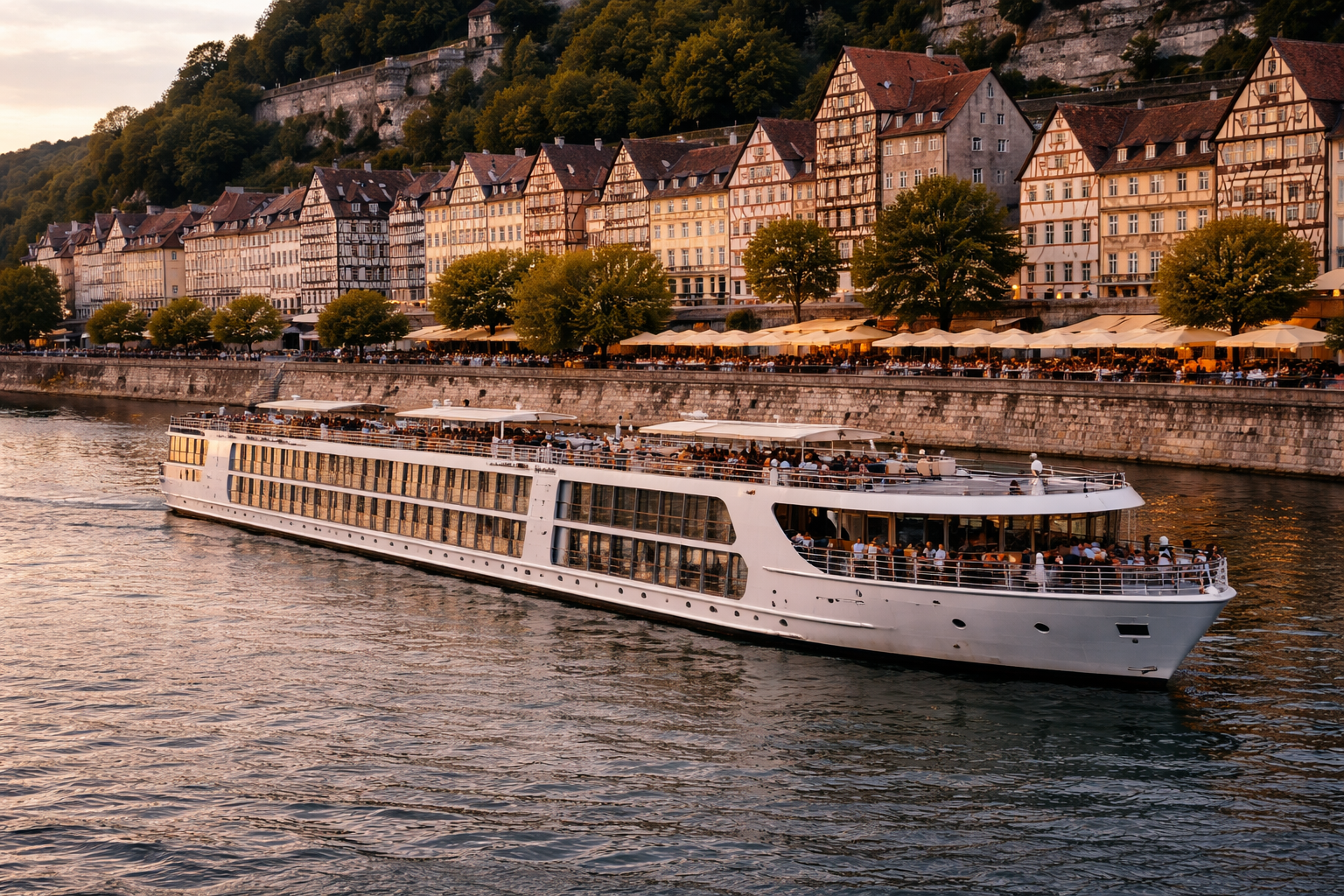

Europe’s rivers are having a difficult summer.
On August 12, 2026, Reuters reported that the Rhine had fallen to unprecedented lows at a critical navigation point, halting some vessel movements. Weeks earlier, near-record low water on the Danube had stranded cruise vessels north of Budapest and suspended some sightseeing services. This is not just a freight story. It is a useful reminder that a European river cruise is shaped by four connected choices: the river section, the month, the carrier, and your tolerance for disruption.
No cruise line can control the rain. No operator can promise that a bridge will remain passable during a flood or that a shallow reach will carry enough water after a prolonged drought. But water-related disruption is not a uniform, random risk. Some rivers are more vulnerable than others. Some months carry a higher historical exposure. And some operators have more ships, more interchangeable sister vessels, or more developed contingency systems when a planned route becomes impassable.
That does not mean everyone should avoid a Rhine or Danube cruise in August. Most departures still operate, and water conditions can change quickly. It does mean that travelers who would feel deeply disappointed by a ship swap, a motorcoach transfer, a missed port, or a hotel night should treat hydrology as part of the purchase decision—not as fine print discovered after final payment. My approach to comparing European river cruises therefore looks beyond the ship and headline itinerary to the river section, season, operator resources, and the traveler’s own risk posture.
Quick answer
Low-water disruption is historically most concerning from July through September on exposed sections of the Rhine, Danube, and especially the Elbe. High water can create a separate spring and early-summer risk. Travelers with low disruption tolerance should consider lower-risk months, more regulated or tidal rivers, and operators with deep sister-ship coverage—but no river, month, or cruise line is disruption-proof.
The right question is not simply, “Which river?”
Shopping by river name alone is too blunt. The Rhine is not equally vulnerable from Basel to Amsterdam. The Danube is a 1,770-mile system whose upper, middle, and lower reaches can behave differently at the same moment. Long Amsterdam-to-Budapest journeys add the Main and Main-Danube Canal and therefore inherit exposure from more than one waterway.
The better planning question is:
What river section am I sailing, in what month, with which operator, and how would I feel if the trip became partly a land tour?
That last element is personal. One traveler may consider a well-executed sister-ship transfer a minor inconvenience. Another may feel that packing mid-cruise and riding a motorcoach defeats the entire purpose of an unpack-once vacation. Neither reaction is wrong. Risk tolerance is part of fit, just like cabin layout, excursion pace, dining, accessibility, and price. The Tradecraft Travel Cruise Matchmaker is designed around that broader idea of fit rather than simply ranking cruise lines by popularity.
What actually happens when the water is too low—or too high?
River ships have shallow drafts, but they still need enough water beneath the hull to navigate safely. As a river falls, an operator may first reduce speed, alter timing, change a docking point, or take on fewer supplies. If a critical stretch becomes impassable, the response can include:
- changing the embarkation or disembarkation port;
- using a nearby docking location;
- moving guests around an obstruction by motorcoach;
- modifying or replacing excursions;
- placing guests in a hotel overnight;
- transferring guests between sister ships on opposite sides of the obstruction; or
- cancelling a departure when the operator cannot deliver a reasonable version of the itinerary.
High water creates a different problem. A ship may have plenty of depth beneath it but insufficient clearance beneath a bridge. Strong currents, closed locks, flooded docks, and local safety restrictions can also stop navigation. This is why “drought risk” and “water-level disruption risk” are not identical.
A modified itinerary may preserve most destinations while materially changing the vacation. Travelers with mobility limitations should pay particular attention: an unexpected ship transfer, substitute dock, or longer motorcoach movement can magnify the physical challenges already described in my guide to river-cruise accessibility.
The Rhine: the Kaub choke point matters
For Rhine cruising, one name is worth knowing: Kaub.
This small town in Germany’s Middle Rhine sits beside a particularly shallow and operationally important reach. The Kaub gauge is consequently watched closely by commercial shipping companies and river-cruise operators. When usable depth falls substantially, vessels may need to reduce their draft or become unable to pass through the Rhine Gorge.
The severe European drought of 2018 caused major Rhine navigation problems. Low water returned prominently in 2022. In 2026, the river again approached and then reached exceptional lows; days before the latest stoppages, German shippers warned that low water at Kaub could effectively split the Rhine in two.
For travelers, the principal low-water watch period is generally late summer into early autumn, especially after a hot, dry summer. That does not make every August or September Rhine cruise a poor choice. It means the probability of modification is generally higher than in many spring or early-winter windows. Spring and early summer carry the countervailing risk of high water and inadequate bridge clearance.
The Danube: assess the section, not just the river name
The Danube is more complicated because it crosses a large part of Europe. Conditions in Germany can differ from those in Austria, Hungary, Serbia, Bulgaria, or Romania.
Regensburg–Passau and the upper Danube. The German reach can become a navigation constraint during low water, particularly on itineraries connecting through the Main-Danube system.
Passau–Vienna–Budapest. This heavily traveled middle section includes the Wachau and several of Europe’s signature river-cruise cities. It can be affected by both drought and high-water events.
Budapest to the lower Danube and Black Sea. Hungary, Croatia, Serbia, Bulgaria, and Romania can experience serious late-summer low-water conditions. The scale of the 2026 drought became visible well beyond tourism: Associated Press reporting described emergency interventions tied to record-low Danube water and power infrastructure, while historic wreckage re-emerged from the shrinking river.
Significant Danube low-water problems occurred in 2015, 2018, 2022, and again in 2026. For planning purposes, July through September deserves the most attention, with August and September carrying the greatest concern after prolonged dry weather.
The Main and Main-Danube Canal: the connecting link
Long itineraries between Amsterdam and Budapest depend on more than the Rhine and Danube. They traverse the Main River and Main-Danube Canal. The canal is engineered and controlled by locks, so it does not behave like a free-flowing river. But the itinerary can inherit trouble at either end.
This is the tradeoff behind the great “Grand European” journeys. Their scope is a major strength: travelers cross a continent without changing hotels. That same geographic reach creates more hydrological and operational choke points. The longer and more interconnected the route, the more heavily I weigh fleet redundancy and the operator’s ability to place compatible ships on both sides of a closure.
The Elbe: Europe’s most water-sensitive major cruise river
If the Rhine and Danube receive the most attention, the Elbe deserves the most caution. It is naturally shallow and less intensively regulated than several other European cruise rivers. Low water has repeatedly interfered with navigation, including during the droughts of 2015 and 2018–2019.
The Elbe also demonstrates why ship design matters. Viking’s Astrild and Beyla were custom-built for the Elbe, giving the operator purpose-designed vessels for this unusually shallow environment. That can extend the range of navigable conditions; it cannot eliminate the river’s physical limits.
If water-level reliability were the overriding concern, I would treat a summer Elbe cruise as materially more exposed than a Seine, Rhône, Bordeaux, or Douro itinerary. A traveler who chooses it should do so because the destination and route justify accepting that additional uncertainty.
The Moselle: usually less exposed, but not isolated
The Moselle winds through France, Luxembourg, and Germany and is frequently combined with the Rhine. It can experience low water, high water, and lock interruptions, but it has not produced the same recurring cruise-disruption profile as the Elbe or the critical Rhine and Danube reaches.
A Moselle-focused itinerary may therefore appeal to travelers who want Central European river scenery with somewhat less low-water exposure. The caveat is route dependency: if the cruise uses the Middle Rhine and passes Kaub, it inherits Rhine risk regardless of what appears most prominently in the itinerary title.
France is not one river-cruise market
The Seine
The Seine connects Paris with Normandy and the English Channel. Summer low water is generally less troublesome here than on the Rhine, Danube, or Elbe. High water and bridge clearance can be the more relevant concerns, particularly in winter and spring.
For a traveler especially concerned about late-summer drought disruption, a Seine cruise can be an attractive alternative. It is not risk-free, but the risk profile is different and generally lower during the peak Central European low-water season.
The Rhône and Saône
The Rhône runs from Lyon toward Provence and the Mediterranean and is heavily engineered through dams and locks. That regulation makes it comparatively resilient to classic late-summer low water. The Saône, which joins the Rhône at Lyon, is more responsive to changing flows, so a combined Burgundy–Saône–Rhône itinerary has somewhat more exposure than the regulated Rhône alone.
Even so, the Rhône system is usually one of the stronger choices for a traveler who wants a conventional European river cruise while reducing drought-related navigation risk.
Bordeaux: Garonne, Dordogne, and Gironde
Bordeaux itineraries use the Garonne and Dordogne rivers and the Gironde estuary. Tides shape docking and navigation, which makes the operating environment different from a free-flowing inland river.
Tidal timing can alter schedules, and wind or current can still interfere. But Bordeaux generally has a lower exposure to the kind of drought-driven choke-point closure associated with Kaub on the Rhine.
Portugal’s Douro: dry country, engineered river
At first glance, Portugal’s Douro seems like an obvious drought risk. The valley is hot and dry in summer, and Portugal and Spain experience recurring drought. The navigable Douro, however, is controlled by a succession of dams and locks.
That produces a different risk profile from the shallow Elbe. Reservoir management, lock operations, high flows, extreme heat, and wildfire can still affect the trip, but low rainfall does not translate automatically into the same kind of navigation failure seen on less regulated waterways. The Douro is therefore often a sensible alternative for travelers wary of the busiest Central European corridors.
The carrier matters—but not because it controls the river
No river-cruise company can guarantee normal operations. The meaningful question is what the company can do after a stretch becomes impassable.
Four structural factors matter most:
- Fleet size on the affected river system;
- the number of similar or identical ships with compatible cabin layouts;
- ships operating in opposite directions on both sides of likely choke points; and
- the ability to reorganize transportation, hotels, excursions, and luggage quickly.
AmaWaterways: particularly strong adaptation on core European rivers
AmaWaterways’ current travel updates acknowledge adjustments on selected 2026 Rhine and Danube sailings. The line has also described how it uses ship swaps, rerouting, and newly built itineraries to keep journeys moving during historically low water.
On suitable routes, guests can tour or transfer around an impassable section while luggage moves to a sister ship. Ideally they arrive at a corresponding cabin and continue from the other side. That is not an uninterrupted cruise, but it can preserve much of the planned experience. AmaWaterways’ fleet depth and river specialization put it among the strongest contingency positions on the Rhine, Main, and Danube.
Viking: scale and identical sister ships create options
Viking’s structural advantage is scale. Its large European fleet includes many standardized Longships on the core Rhine–Main–Danube network. Viking explicitly describes using identical sister ships sailing in opposite directions, allowing guests and luggage to transfer to the same stateroom layout on the far side of an affected river section.
Fleet scale does not make Viking immune to severe conditions, and a ship swap still interrupts the trip. But having many closely related vessels on the same corridors gives the company more pieces to move. Its purpose-built Elbe vessels are an additional advantage on that river.
Scenic and Emerald: a broad contingency toolkit
Scenic’s 2026 low-water alert describes the Danube, Rhine, and Main conditions and the operational changes they can require. Depending on fleet position and itinerary, Scenic can use sister-ship transfers, revised embarkation points, hotel stays, and altered touring. Scenic and sister brand Emerald have meaningful European infrastructure, although the precise solution always depends on where ships happen to be when conditions change.
Avalon Waterways: sister-ship capacity and a willingness to cancel
Avalon has a broad Suite Ship fleet and the touring infrastructure of the Globus family behind it. Avalon’s current FAQ says its fleet will often make a sister-ship transfer possible when a water-level disruption persists.
Summer 2026 also illustrated another reality: cancellation can be a legitimate contingency decision. Reuters reported that Avalon cancelled a small number of departures during the July low-water episode. That is not automatically a sign of weaker preparation. There is a point at which too many motorcoaches, hotel nights, and missed sailing hours produce a fundamentally different trip. Sometimes cancellation is more honest than operating a badly compromised itinerary. The important follow-on questions are what remedies, rebooking options, and protections the traveler receives.
Uniworld: experienced, with a boutique-fleet tradeoff
Uniworld has deep European experience and especially attractive programs in France. Its one-of-a-kind boutique vessels are part of its appeal. They can also make a transfer less seamless than a move between standardized sister ships with matching cabin plans.
That does not mean Uniworld is unprepared. It means its differentiation creates a specific operational tradeoff. Uniworld’s 2026 terms recognize that water levels can require changes to itineraries, vessels, and hotels, and the company has decades of experience managing European river operations.
How risk tolerance should change the booking decision
I would not choose a river cruise line solely because of its low-water contingency resources. That would allow an unusual event to dominate a decision involving cabins, dining, excursions, inclusions, service, price, and itinerary design.
But I would not ignore resilience either.
If a motorcoach substitution would be an irritation but not a vacation-ruining event, choose the river and season you most want, understand the possibilities, and favor an operator with a credible response plan. If you would be genuinely upset by losing sailing time or changing ships, reduce the exposure at the planning stage:
- choose a historically lower-risk month for the specific river section;
- consider the Seine, Rhône, Bordeaux, or Douro rather than the Elbe or an August Rhine–Danube itinerary;
- favor routes that do not cross multiple hydrological choke points;
- compare operators’ fleet coverage and published contingency language;
- arrive early and avoid tightly coupled, nonrefundable independent arrangements; and
- read the booking terms and travel-insurance coverage before depositing.
Travel insurance should be evaluated carefully rather than treated as a blanket solution. A changed port or modified itinerary is not automatically a covered loss, and “cancel for any reason” benefits have their own purchase deadlines, reimbursement percentages, and conditions. This is one reason it helps to understand what a travel advisor checks before and after a cruise booking.
Frequently asked questions about European river levels
When is low water most likely to disrupt a European river cruise?
On the most exposed sections of the Rhine, Danube, and Elbe, the principal low-water watch period is generally July through September, especially after a hot, dry spring and summer. This is a relative risk pattern, not a prediction that a particular departure will be disrupted.
Which European cruise river has the greatest water-level risk?
The Elbe has the highest recurring low-water exposure among Europe’s major cruise rivers because it is naturally shallow and less regulated. The Rhine near Kaub and several upper, middle, and lower Danube reaches also deserve particular attention in late summer.
Which river cruise lines are best prepared for low water?
AmaWaterways, Viking, Scenic/Emerald, and Avalon have structural advantages on the Rhine–Main–Danube network because they operate multiple ships and can sometimes arrange sister-ship transfers. Viking also uses purpose-built ships on the Elbe. No operator can guarantee a swap or an unchanged itinerary because the available response depends on fleet position and the severity of the conditions.
What is the best European river cruise for a traveler with low disruption tolerance?
Consider a late-summer Seine, Rhône, Bordeaux, Douro, or Dutch-and-Belgian-waterways itinerary, all of which generally carry less classic drought-related navigation risk than the Elbe or a long Rhine–Main–Danube route. The best choice still depends on the month, exact river section, operator, itinerary, and the traveler’s other priorities.
European river-cruise water-level disruption risk by month
The matrix below is a planning assessment, not a forecast or actuarial probability table. It synthesizes recurring patterns over roughly the last decade, the physical characteristics of each river section, seasonal low- and high-water tendencies, and operator fleet structure. A “high” rating does not mean most cruises fail. It means that the relative exposure to a material water-related itinerary change is higher than in the other cells.
Legend: Low = comparatively limited recurring exposure; Moderate = meaningful but not dominant seasonal exposure; Med–High = elevated watch period; High = the strongest recurring exposure among major European cruise rivers. Winter ratings describe hydrological exposure, but some routes have few or no scheduled departures.
| River / section | Jan | Feb | Mar | Apr | May | Jun | Jul | Aug | Sep | Oct | Nov | Dec | Supplier positioning if disruption occurs |
|---|---|---|---|---|---|---|---|---|---|---|---|---|---|
| Rhine: Basel–Amsterdam Highest attention near Kaub / Middle Rhine |
L | L | M | M | M | M | M–H | High | High | M–H | L | L | AmaWaterways, Viking, Scenic/Emerald, and Avalon are structurally well positioned where sister ships are operating on both sides of a closure. Viking’s standardized fleet and Ama’s river specialization are notable. Actual relief depends on vessel location. |
| Main & Main-Danube Canal Often part of Amsterdam–Budapest routes |
L | L | M | M | M | M | M | M–H | M–H | M | L | L | The canal is controlled, but long itineraries inherit Rhine and Danube problems. Viking, AmaWaterways, Scenic/Emerald, and Avalon generally have the strongest network redundancy across the full system. |
| Upper Danube: Regensburg–Passau | L | L | M | M | M | M | M–H | High | High | M–H | L | L | AmaWaterways, Viking, Scenic/Emerald, and Avalon benefit from multiple ships and established motorcoach or sister-ship plans. Routes ending in Vilshofen or Passau may offer different options than through-routes. |
| Middle Danube: Passau–Vienna–Budapest | L | L | M | M | M | M | M–H | High | High | M–H | L | L | AmaWaterways, Viking, Scenic/Emerald, and Avalon have the most visible fleet-scale advantages. Uniworld and Tauck have deep regional operating experience, but exact sister-ship interchangeability varies by departure. |
| Lower Danube: Budapest–Black Sea | L | L | M | M | M | M–H | High | High | High | M–H | L | L | Fewer simultaneously positioned sister ships can reduce swap flexibility versus the core upper Danube. Viking and AmaWaterways have meaningful corridor presence; Scenic and Avalon may also have strong logistical tools, depending on the season and route. |
| Elbe: Prague region–Saxon Germany–Berlin routing | M | M | M–H | M–H | M–H | High | High | High | High | M–H | M | M | Viking is especially notable because Astrild and Beyla were designed for the shallow Elbe. Even purpose-built ships cannot remove the river’s unusually high hydrological exposure; land substitution may be more likely than a broad sister-ship network. |
| Moselle: France–Luxembourg–Germany | L | L | M | M | M | M | M | M–H | M–H | M | L | L | A Moselle-only assessment can be comparatively favorable, but many itineraries also use the Rhine. On combined routes, Viking, AmaWaterways, Scenic/Emerald, and Avalon generally have better network depth. |
| Seine: Paris–Normandy | M | M | M–H | M–H | M–H | M | L | L | L | L | M | M | High water and bridge clearance matter more than late-summer drought. Viking, AmaWaterways, Scenic, Uniworld, and Avalon all have established French operations; fleet redundancy is smaller than on the Rhine–Danube system but routes are geographically compact. |
| Saône & Rhône: Burgundy/Lyon–Provence | L | L | M | M | M | M | L | L | L | L | M | M | The regulated Rhône lowers classic drought exposure; the Saône adds variability. Viking, AmaWaterways, Scenic, Uniworld, and Avalon have local experience. Itinerary modification is more likely to be managed within the French network than by a Rhine-style mass ship swap. |
| Bordeaux: Garonne–Dordogne–Gironde | L | L | L | L | L | L | L | L | L | L | L | L | Tides can change timing without constituting the same low-water failure seen on the Elbe or Rhine. Uniworld, Scenic, AmaWaterways, Viking, and Avalon operate purpose-assigned Bordeaux programs; because vessels are route-specific, schedule flexibility matters more than identical-ship swaps. |
| Douro: Porto–Spanish border | M | M | M | L | L | L | L | L | L | M | M | M | Dams and locks reduce classic summer low-water exposure, while high flow, lock operations, heat, and wildfire remain considerations. AmaWaterways, Viking, Scenic, Uniworld, and Avalon use river-specific ships, but limited local fleet size can constrain swaps. |
| Dutch & Belgian waterways Rhine delta, canals, and estuaries |
L | L | L | L | L | L | L | L | L | L | L | L | Dense, engineered waterways generally offer lower water-level exposure, though wind, locks, and downstream Rhine routing can still change plans. Most major European operators are well established here; check whether the itinerary continues through Kaub before treating it as low risk overall. |
Important: These ratings compare relative historical exposure; they do not predict a particular sailing. Water can rise after sustained rain, fall after a dry spring, or change rapidly upstream. “Best positioned” describes structural contingency capacity, not a guarantee, quality ranking, or promise that the published itinerary will operate unchanged.