
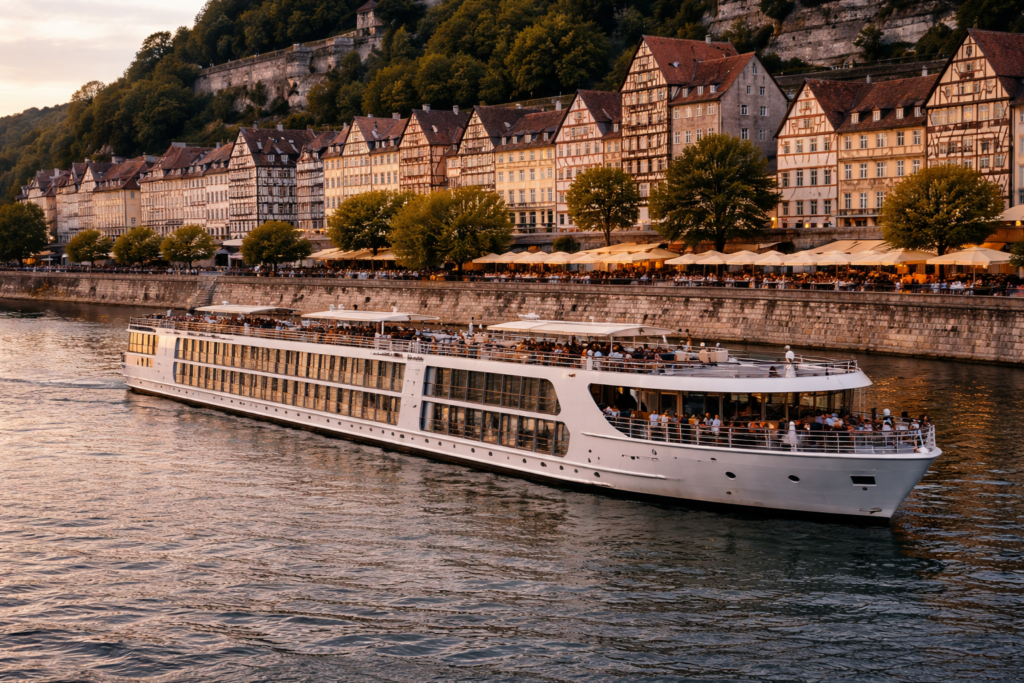
River cruises are often positioned as the simplest way to see Europe. Unpack once. Move effortlessly from city to city. Let the itinerary come to you.
For many travelers, that promise holds up.
For travelers in wheelchairs, including one couple I recently helped, it requires a much closer look.
Accessible travel is not about what’s advertised—it’s about what works in practice. And river cruising, particularly in Europe, is one of the most misunderstood segments in that regard.
Tradecraft Travel is proud to support accessible travel. That said, part of truthful advising is calibrating expectations early.
There is no single answer to whether river cruises are accessible. The experience varies significantly depending on where you sail, the ship you choose, and your mobility level.
The most important distinction is geographic:
That divide is structural, not cosmetic.
In the United States—on rivers like the Mississippi or Columbia—river cruising operates within ADA requirements. That changes everything.
Ships built to operate inside the United States generally have:
For a traveler who uses a wheelchair full-time, this is where river cruising becomes viable.
It’s not perfect, but it is functional—and that matters more than marketing language.
European river cruising is built around historic waterways and cities that predate modern accessibility standards by centuries.
The limitations aren’t isolated—they stack.
In many ports, ships dock side-by-side. It is common to walk through one or more other vessels just to reach the shore. These vessels may be different sized, forcing guests to step up or down onto the adjacent deck.
Gangways shift with water levels. They can be steep, narrow, and uneven.
For a traveler in a wheelchair, that’s not an inconvenience—it’s a barrier.
Most European river ships:
Even newer ships improve comfort more than accessibility.
Even if you manage the ship, the destinations introduce a second layer of challenge:
This is particularly true in smaller towns—the very places that make river cruising appealing.
There’s no benefit in softening this.
If a traveler:
Then most European river cruises are not a good fit.
That’s not a judgment—it’s a planning constraint.
There are a few, but they are exceptions.
Certain newer ships from lines like AmaWaterways, Avalon Waterways, and Scenic have made incremental improvements. These can work for travelers with limited mobility who can still walk short distances.
There is also a niche accessible vessel–a former hospital ship, in fact–operating in the Netherlands, Belgium and Germany. It was purchased and modified to make European river cruising accessible to wheelchair users. This ship is certainly the exception rather than the rule.
For travelers who are not fully wheelchair-dependent but still require support, some itineraries are more workable than others.
The key is infrastructure.
Large cities. Better docks. More predictable boarding conditions.
Capital cities with improved accessibility and more structured excursions.
Flatter terrain and the specialized accessible ship.
These are not perfect solutions—but they reduce friction.
Some itineraries are consistently problematic for accessibility.
The Douro River in Portugal, for example, combines steep terrain with limited docking infrastructure. Excursions often rely heavily on motorcoach transfers, adding another layer of complexity.
Smaller, less-developed ports along the Danube and Rhine present similar issues, particularly where historic preservation limits accessibility upgrades.
Long-haul river cruises in regions like Southeast Asia or Egypt introduce even greater challenges, both on and off the ship.
This is where advisory matters.
Before recommending a river cruise, I focus on three practical questions:
If the answer to those questions is no, then river cruising—at least in Europe—is not the right recommendation.
In many cases, travelers in wheelchairs are better served by options designed with accessibility from the ground up. River cruising in the United States will always be an easier trip.
Ocean cruises, particularly on lines like Celebrity or Royal Caribbean, are another option. They offer:
For travelers who want a land-based experience, escorted tours designed for accessibility provide a level of control and predictability that river cruising often cannot.
River cruising can be an exceptional experience. For the right traveler, it delivers exactly what it promises.
But it is not inherently accessible travel—especially in Europe.
The difference between a successful trip and a failed one comes down to understanding the operational reality behind the marketing.
That’s where thoughtful planning matters. And it’s where honest guidance makes all the difference.