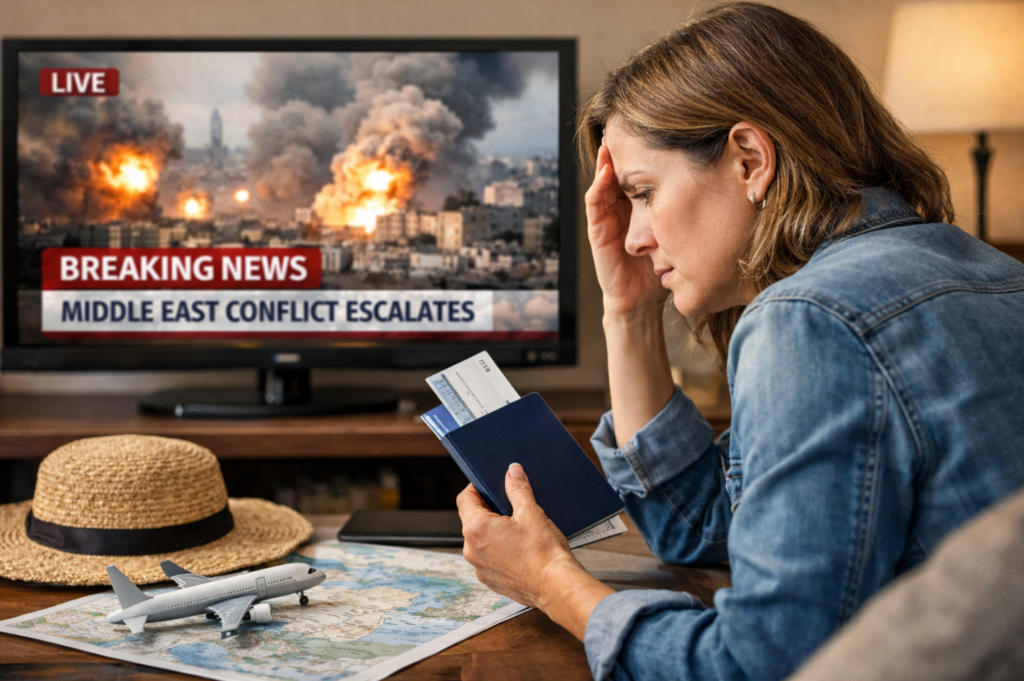
When war breaks out in the Middle East, the question comes quickly:
Is it still safe to travel?
For many Americans, that question isn’t really about a specific destination. It’s broader. If the United States is involved in a conflict overseas, does that make all international travel riskier—even places like Bermuda, Italy, or a river cruise in Europe?
It’s a fair question. But it needs a clear, grounded answer.
First, separate perception from reality.
Most leisure travel destinations—Europe, the Caribbean, much of Asia—operate entirely outside the geographic and security footprint of a Middle East conflict. Daily life continues. Tourism continues. Travelers move freely.
What changes is not always the risk itself, but how it feels.
And that matters.
Because leisure travel is optional. If a client is going to spend a trip feeling uneasy, constantly checking the news, or second-guessing their decision, that’s not a good trip—no matter how safe it may be.
My Approach as a Travel Advisor
Unlike during my career in the CIA, I now deal exclusively in leisure travel. That means one thing comes first:
This is always the client’s decision.
If someone tells me they’re uncomfortable traveling abroad right now—even to a destination that I consider to be objectively low risk—I take that seriously. There’s no value in pushing someone into a trip they won’t enjoy.
At the same time, clients often ask for my view.
In those cases, I give it—grounded in my 34 years assessing risk professionally.
- Global conflicts are rarely uniform in their effects
- Risk is highly localized
- Most popular travel destinations remain stable even during periods of geopolitical tension
- In cases where terrorism is a concern, staying away from areas frequented by Americans or dressing like an American are best practices
But I don’t ask clients to rely on my judgment alone.
Use the Right Resources: State Department Guidance
The single best public resource for American travelers is the U.S. State Department.
Each country is assigned a Travel Advisory Level, ranging from:
- Level 1: Exercise Normal Precautions
- Level 2: Exercise Increased Caution
- Level 3: Reconsider Travel
- Level 4: Do Not Travel
These are not abstract labels—they reflect real assessments of security conditions on the ground.
I also strongly encourage clients to enroll in the Smart Traveler Enrollment Program (STEP).
STEP is a free service that allows U.S. citizens to:
- Register their trip with the nearest U.S. embassy or consulate
- Receive real-time security updates and alerts
- Make it easier for the embassy to contact them in an emergency
It’s simple to use, and it adds a meaningful layer of awareness.
Travel Insurance and War: What You Need to Know
Most travelers assume insurance will cover them if global events deteriorate. In reality, war itself is typically not a covered reason under standard travel insurance policies. If you cancel a trip simply because the U.S. is involved in a conflict—or because the situation feels unstable—you should not expect reimbursement on that basis alone.
That said, insurance still provides meaningful protection. Many policies cover secondary impacts like terrorism (in certain circumstances), trip delays, medical emergencies, evacuation, and interruptions due to defined events. In other words, the policy protects against specific disruptions—not broad geopolitical anxiety.
In all cases, make sure you understand your specific plan’s terms and conditions. This is where a good travel advisor can help.
Building Flexibility Into the Decision
Even when a destination is stable, uncertainty can linger. That’s where planning matters.
One of the most practical tools available right now is cancel-for-any-reason coverage.
For example, Collette offers a policy that allows travelers to cancel up to 24 hours before departure and receive a full refund—aside from the insurance premium itself, which is typically around $599.
That changes the equation.
Instead of making a single, high-stakes decision months in advance, clients retain the ability to reassess as conditions evolve.
It’s not about expecting things to go wrong. It’s about keeping control.
Additional Layers of Security
For clients who want more than awareness and flexibility, there are services like Global Guardian.
These firms provide:
- Real-time security monitoring
- Emergency response and evacuation support
- On-the-ground assistance if conditions deteriorate
Most travelers won’t need that level of support. But for those who want it, it exists—and it can provide real peace of mind.
The Bottom Line
Travel is supposed to expand your world, not shrink it.
If a trip feels stressful before it even begins, something is off—regardless of what the headlines say.
My role at Tradecraft Travel is straightforward:
- Provide clear, informed guidance
- Share a professional assessment of risk when asked
- Point clients to authoritative sources
- Build flexibility into every trip
- And never encourage someone to take a security chance
Some clients will decide to travel. Others will wait. Both are reasonable decisions.
The goal isn’t to convince—it’s to ensure that whatever choice is made, it’s made with clarity, confidence, and the right support behind it.
Because the best trips don’t start with uncertainty.
They start with trust.